
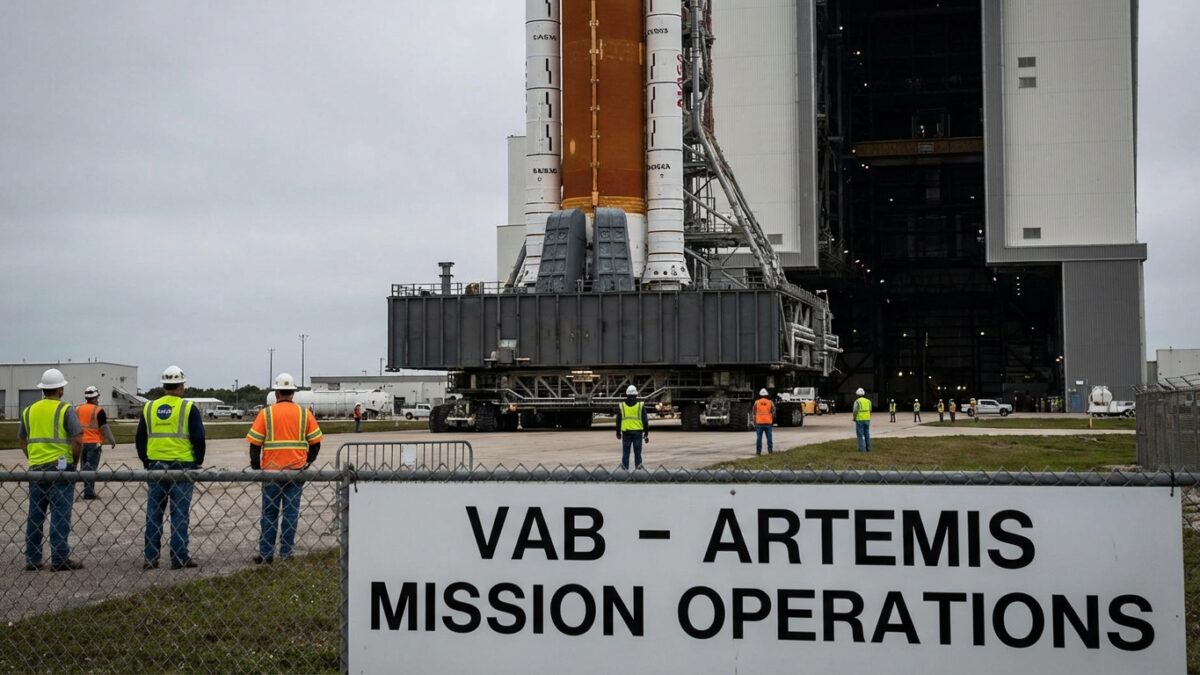
NASA’s Artemis II mission, which will carry astronauts around the Moon for the first time since Apollo 17 in 1972, has been pushed to no earlier than April 2026 after a helium flow anomaly discovered during launch preparations at Kennedy Space Center forced the Space Launch System rocket to be rolled back to the Vehicle Assembly Building in late February.
The setback represents the latest in a series of technical challenges that have complicated NASA’s ambitious lunar return program, though agency officials have emphasized that the issues are being addressed methodically and that crew safety remains the absolute priority. (Sources: NASA, SpaceNews)
The Helium Flow Issue
The problem was identified during pre-launch checkout procedures at Launch Pad 39B, where engineers detected an anomaly in the helium pressurization system used in the rocket’s upper stage. Helium plays a critical role in maintaining proper pressure in the stage’s propellant tanks, and any irregularity in its flow characteristics requires thorough investigation before a crewed flight.
The decision to roll the vehicle back to the VAB on February 25 was made to allow engineers more controlled access to the affected systems than is possible at the launch pad. Similar helium-related issues have affected other launch vehicles, but the zero-fault-tolerance standard applied to crewed missions demands a comprehensive resolution. (Source: NASA)
Wet Dress Rehearsal Complications
The helium issue followed earlier complications during wet dress rehearsal testing, the critical pre-flight exercise in which the rocket is fully loaded with cryogenic propellants and taken through a simulated countdown. Engineers encountered hydrogen leak indications and cold-weather-related challenges during the rehearsal process, though these were ultimately characterized as manageable.
The wet dress rehearsal is one of the most important milestones in launch preparation, as it validates the complex choreography of fueling, thermal conditioning, and countdown sequencing that must work flawlessly on launch day. The Artemis I uncrewed mission in November 2022 was also delayed by multiple wet dress rehearsal issues before its ultimately successful flight around the Moon. (Source: NASA)
The Crew and the Mission
Artemis II will carry a crew of four astronauts, including NASA’s Reid Wiseman as commander, Victor Glover as pilot, Christina Koch as mission specialist, and Jeremy Hansen of the Canadian Space Agency as mission specialist. The roughly 10-day mission will follow a trajectory similar to Artemis I, swinging around the Moon at a distance of approximately 6,400 miles from the lunar surface before returning to Earth.
While Artemis II will not include a lunar landing, the mission is critical for validating the Orion spacecraft’s life support systems, navigation, and communication capabilities with crew aboard. The data gathered will directly inform Artemis III, which is intended to land astronauts on the lunar surface for the first time since 1972. (Source: NASA)
Program Context
The delays come at a sensitive moment for the Artemis program. Congressional supporters have maintained strong bipartisan backing for lunar exploration, but budget pressures and competition for funding with other priorities have created an environment where schedule slips draw heightened scrutiny. NASA Administrator Bill Nelson has repeatedly defended the program’s approach, arguing that the agency will fly when it is ready and not before.
The broader Artemis architecture includes the SLS rocket, the Orion crew capsule built by Lockheed Martin, and SpaceX’s Starship vehicle, which has been selected as the human landing system for Artemis III. Starship’s own development timeline, including its ongoing test flight program, represents an additional variable in the lunar landing schedule. (Source: NASA)
International partners remain committed to the program. The Canadian Space Agency’s participation through Hansen’s crew assignment reflects broader agreements for Canadian contributions to the Lunar Gateway, a small space station that will orbit the Moon and serve as a staging point for future surface missions.
Despite the delays, NASA officials have expressed confidence that the technical issues are well understood and solvable. The agency’s track record with Artemis I, which successfully demonstrated the SLS and Orion systems during an uncrewed lunar flyby, provides a foundation of confidence that the program will ultimately deliver on its promise to return humans to the Moon.
Looking Toward Artemis III and Beyond
Despite the delays, the Artemis program continues to generate significant scientific and engineering momentum. The development of new spacesuits for lunar surface operations, being led by Axiom Space, has progressed through multiple design reviews. The Lunar Gateway, which will be assembled in orbit around the Moon over the course of several Artemis missions, represents an international collaboration involving NASA, ESA, JAXA, and CSA that will enable sustained lunar exploration beyond the initial landing missions.
The program has also catalyzed a broader ecosystem of commercial lunar activity, with companies including Intuitive Machines, Astrobotic, and SpaceX developing landers, rovers, and infrastructure systems that will support both government and commercial operations on the lunar surface. NASA’s Commercial Lunar Payload Services program has already delivered payloads to the Moon, and additional missions are scheduled throughout 2026 and 2027, building toward the infrastructure that will support human operations. (Source: NASA)