
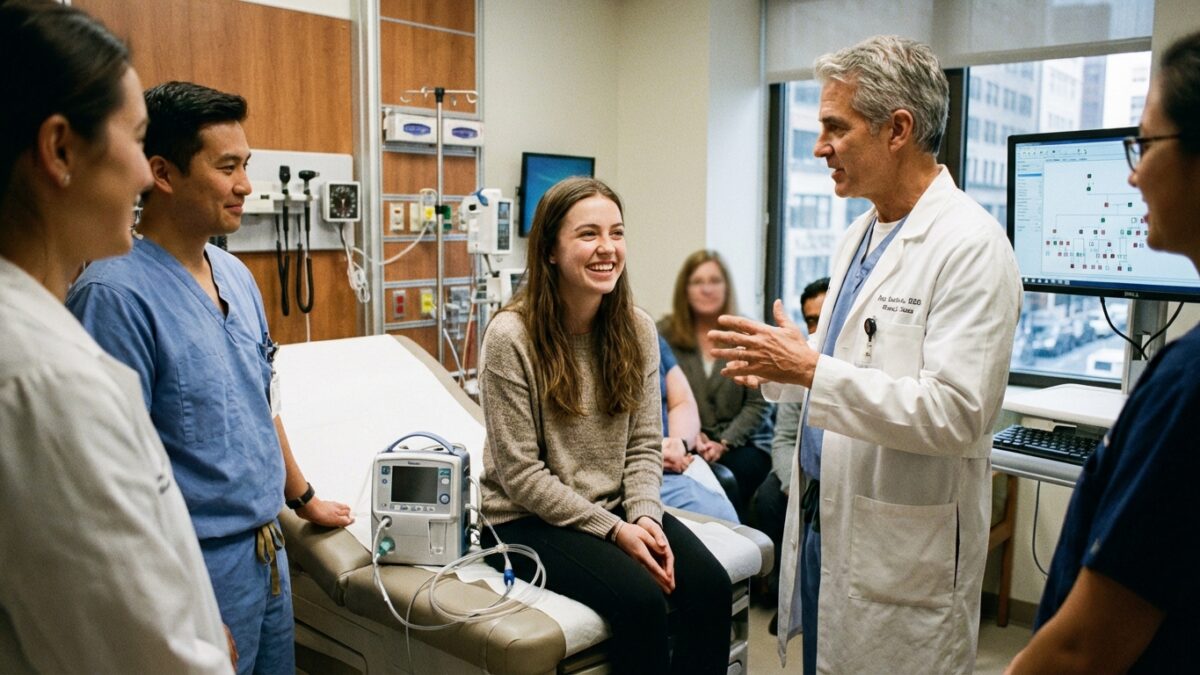
The successful treatment of KJ Muldoon, a young patient who in May 2025 became the first person to receive a fully personalized CRISPR gene therapy, has ignited a transformation in how the medical community thinks about treating rare genetic diseases and potentially a far wider range of conditions.
The groundbreaking case, led by researchers at the University of Pennsylvania and Children’s Hospital of Philadelphia, demonstrated that CRISPR-Cas9 gene editing tools could be designed, manufactured, and administered on an individual basis to correct mutations unique to a single patient. The achievement was published in The New England Journal of Medicine and hailed as a proof of concept for an entirely new category of medical intervention. (Sources: The New England Journal of Medicine, University of Pennsylvania)
How It Works
Unlike traditional gene therapies, which are developed as one-size-fits-all treatments for specific diseases, personalized CRISPR therapy begins with a detailed genomic analysis of the individual patient. Researchers identify the specific mutation responsible for the patient’s condition, then design a custom guide RNA that directs the CRISPR-Cas9 molecular scissors to precisely that location in the genome. The therapeutic construct is manufactured in a specialized facility and delivered to the patient, typically via a viral vector or lipid nanoparticle system.
The turnaround time from genetic diagnosis to treatment delivery has been one of the most remarkable aspects of the approach. In the Muldoon case, the team was able to move from identification of the causative mutation to an administered therapy in a matter of months, a timeline that would have been unimaginable even five years ago. (Source: Nature Medicine)
Expanding the Approach
Since the initial success, multiple research institutions have announced programs to develop similar individualized therapies. The National Institutes of Health has signaled support for expanding personalized gene editing research, and several academic medical centers have begun establishing the laboratory infrastructure needed to design and manufacture patient-specific CRISPR constructs.
Fyodor Urnov, a professor at the University of California, Berkeley, and a pioneer in gene editing technology, has described the Muldoon case as representing the beginning of an era in which the genetic code of each patient could potentially be treated as a unique therapeutic target. The implications extend well beyond rare diseases, with researchers exploring whether similar approaches could be adapted for more common conditions driven by specific genetic variants. (Source: UC Berkeley)
Challenges Ahead
Despite the excitement, significant obstacles remain before personalized CRISPR therapies can become widely available. Manufacturing costs for individualized treatments remain extremely high, as each therapy is essentially a unique pharmaceutical product that must undergo its own quality control and safety testing. The regulatory pathway for such treatments is also uncharted territory, requiring new frameworks from the FDA and equivalent agencies worldwide.
There are also important scientific questions about long-term safety. While CRISPR-Cas9 has demonstrated remarkable precision, off-target editing effects, in which the molecular scissors cut at unintended locations in the genome, remain a theoretical concern that requires years of follow-up monitoring. Researchers are developing increasingly sophisticated methods to detect and minimize off-target activity, including newer editing tools like base editors and prime editors that may offer improved precision. (Source: Nature Reviews Genetics)
The Cost Equation
Perhaps the most formidable barrier is economic. Current gene therapies, even those developed for broader patient populations, carry price tags ranging from hundreds of thousands to millions of dollars per treatment. A fully personalized therapy, with its bespoke design and manufacturing process, would initially be far more expensive. Advocates argue that for patients with severe genetic diseases who face lifetime costs of ongoing treatment, a one-time curative intervention could ultimately be cost-effective even at high upfront prices.
Insurance coverage and reimbursement models will need to evolve significantly to accommodate these treatments. Some health economists have proposed outcomes-based payment models, in which the full cost is paid only if the therapy achieves predefined clinical benchmarks over a specified follow-up period.
The Muldoon case has opened a door that the medical community has long hoped to walk through. Whether that door leads to a widely accessible new era of precision medicine or remains a narrow passage available only to the few will depend on the willingness of regulators, payers, and the research community to develop the infrastructure and frameworks necessary to bring personalized gene editing from the frontier of science to the bedside of every patient who needs it.
Ethical Considerations
The development of personalized gene editing also raises important ethical questions. While somatic cell therapy, which modifies DNA in non-reproductive cells, is generally accepted within the medical ethics community, the technology platform could theoretically be applied to germline editing, changes that would be inherited by future generations. Strict international consensus currently prohibits heritable human genome editing, but the increasing accessibility of CRISPR tools has prompted renewed debate about the adequacy of existing governance frameworks.
There are also equity concerns. If personalized gene therapies remain accessible only to patients in wealthy nations with advanced healthcare infrastructure, the technology could exacerbate existing global health disparities rather than reducing them. Organizations including the World Health Organization and the National Academies of Sciences, Engineering, and Medicine have called for proactive development of governance and access frameworks to ensure that the benefits of gene editing are shared broadly. (Source: WHO)