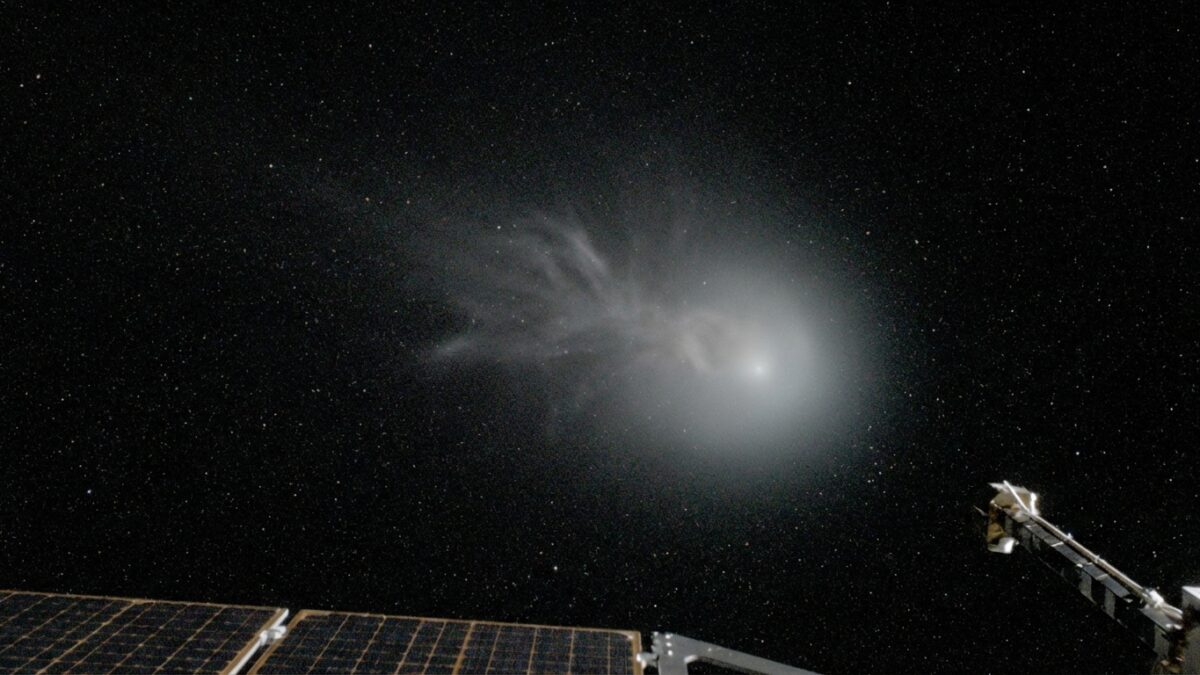
A spacecraft on its way to Jupiter has captured a remarkable image of an interstellar visitor passing through our solar system, revealing unprecedented details about one of the most extraordinary objects ever observed by astronomers. Comet 3I/ATLAS, only the third interstellar object ever detected in our cosmic neighborhood, was photographed in stunning detail by ESA’s JUICE mission, showing a glowing halo of gas, a sweeping tail, and hints of jets erupting from its ancient, icy heart. (Source: Universe Today)
A Portrait From Deep Space
The image, described by scientists as superb, was captured as the JUICE spacecraft traveled toward its primary destination at Jupiter’s icy moons. The photograph reveals 3I/ATLAS as far more than a distant point of light, showing complex structure in the comet’s coma, the envelope of gas and dust that surrounds its solid nucleus, as well as detailed features in its tail that can help researchers understand the object’s composition and behavior. (Source: Universe Today)
Interstellar objects are exceptionally rare visitors. The first, 1I/Oumuamua, was detected in 2017 and generated enormous scientific interest but was spotted too late for detailed study. The second, 2I/Borisov, was discovered in 2019 and allowed somewhat more observation. 3I/ATLAS, discovered in mid-2025, has provided the most extensive observational opportunity yet, and having an active spacecraft in a position to photograph it is an extraordinary stroke of scientific good fortune.
What 3I/ATLAS Can Tell Us
Scientists are particularly interested in 3I/ATLAS because interstellar comets carry material from other star systems, offering a window into the chemical and physical conditions present around distant stars. The jets visible in the JUICE image suggest the comet is actively outgassing as solar radiation heats its surface, releasing volatile compounds frozen into its nucleus during formation in a planetary system light-years away.
Continued monitoring of 3I/ATLAS is a scientific priority for 2026, with researchers aiming to isolate observations of the nucleus from the comet’s surrounding emissions as its activity decreases during its outbound journey. Ground-based telescopes and space observatories including the James Webb Space Telescope are expected to contribute additional data in the coming months. (Source: SETI Institute)
A Banner Year for Space Science
The 3I/ATLAS observation is just one highlight in what is shaping up to be an extraordinary year for space science. ESA and the Chinese Academy of Sciences plan to launch the SMILE mission on April 8, which will provide the first global images of how Earth’s magnetic field interacts with solar wind. NASA’s Nancy Grace Roman Space Telescope, an infrared survey telescope that will produce images nearly 200 times larger than Hubble’s, is targeted for launch in October. (Source: NASASpaceFlight)
In planetary exploration, China’s Tianwen-2 sample-return mission will reach asteroid Kamoʻoalewa in early summer, while Japan’s Hayabusa2 will conduct a high-speed flyby of asteroid Torifune. The ESA-JAXA BepiColombo mission will enter orbit around Mercury after a seven-year journey, and ESA’s Hera mission will arrive at the Didymos-Dimorphos asteroid system to study the impact site created by NASA’s DART mission. (Source: SETI Institute; Scientific American)
New Eyes on the Universe
The Vera C. Rubin Observatory in Chile is ramping up operations, and its Legacy Survey of Space and Time is expected to dramatically increase the rate of transient detections, identifying objects that change brightness, position, or appear suddenly. This will require rapid follow-up from coordinated observation networks, creating a new paradigm of time-sensitive astronomical science. (Source: SETI Institute)
Grant Tremblay, the federal astrophysicist at the Smithsonian Astrophysical Observatory, described 2026 as a year that reflects both the rivalries and shared ambitions of space exploration today. Competition is real, he wrote, but so is cooperation at a scale that would have been hard to imagine a generation ago. (Source: Astronomy.com)
New Telescopes and Observatories
The year 2026 will also dramatically expand observational capabilities. NASA’s Nancy Grace Roman Space Telescope, targeted for launch in October, will perform sky surveys with Hubble-level resolution covering areas nearly 200 times larger. The telescope will study dark energy, search for exoplanets, and observe galaxy distribution across vast stretches of the universe. (Source: NASASpaceFlight)
The Vera C. Rubin Observatory in Chile is ramping up its Legacy Survey of Space and Time, which will repeatedly image the entire visible sky to detect transient phenomena. The system will process enormous volumes of data nightly, requiring coordinated rapid follow-up from observatories worldwide. (Source: SETI Institute)
The ESA-JAXA BepiColombo mission, after a seven-year journey, will enter orbit around Mercury in 2026, providing the most detailed study of the innermost planet since NASA’s MESSENGER mission ended in 2015. The dual-spacecraft mission will study Mercury’s magnetic field, surface composition, and interior structure.
These telescopes and missions represent billions of dollars in investment by multiple space agencies and will generate datasets that scientists will mine for discoveries for decades. The year 2026 may well be remembered as a turning point in observational astronomy, when humanity’s eyes on the cosmos grew dramatically sharper and wider simultaneously.
China’s Chang’e 7 mission, expected to launch in mid-2026, will head to the Moon’s south pole with an orbiter, lander, rover, and a small flying hopper designed to leap into permanently shadowed craters where sunlight never reaches. These craters are thought to harbor water ice, a resource that could one day support astronauts or be converted into rocket fuel. The mission highlights how planetary science and human exploration are becoming increasingly intertwined. (Source: Astronomy.com)