A famously resilient bacterium may be tough enough to survive one of the most violent events imaginable on Mars, according to new research published in early March 2026 that lends fresh scientific weight to the ancient and provocative idea that life could travel between worlds. The study found that certain extremophile organisms can endure the extreme pressures generated by asteroid impacts on Mars, potentially being blasted into space and surviving the journey to Earth. (Source: ScienceDaily)
Surviving the Impossible
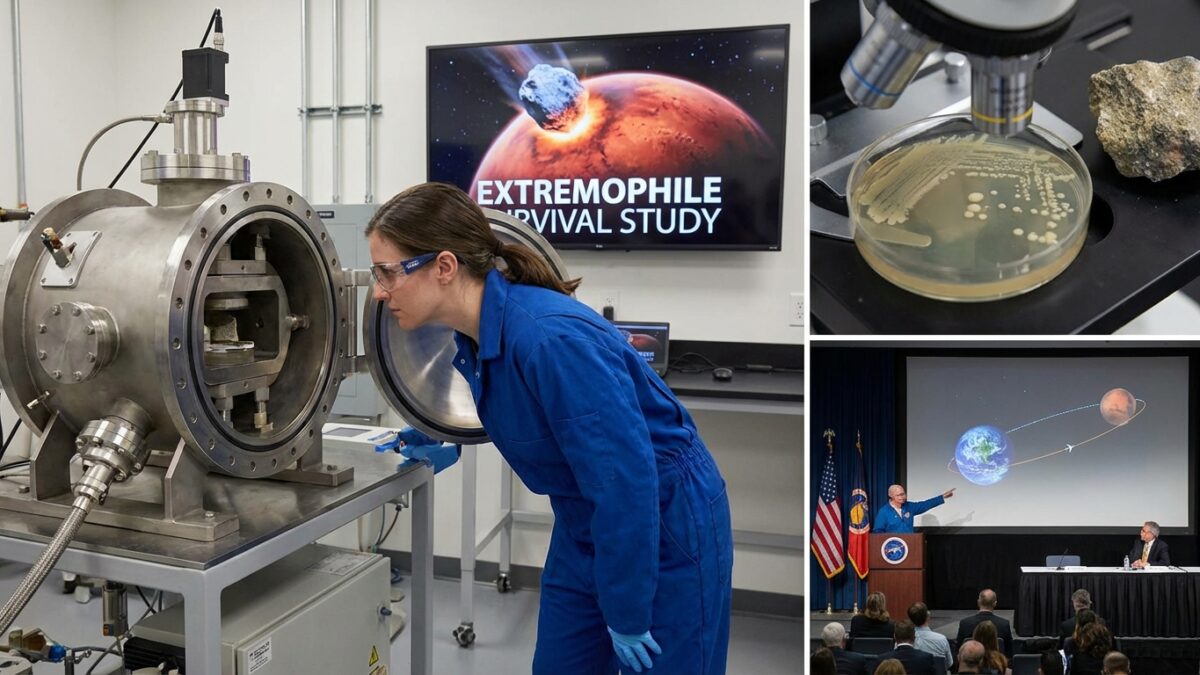
The research focused on organisms known as extremophiles, bacteria and archaea that thrive in conditions lethal to most life forms: extreme heat, cold, radiation, pressure, or acidity. Scientists subjected these organisms to the kinds of shock pressures that would be generated during a major asteroid impact on Mars, simulating the violence of a collision that could eject chunks of Martian rock into space.
The results showed that at least one type of Earthly extremophile can survive these extreme conditions, maintain its biological viability after being blasted into simulated space environments, and potentially endure the journey between planets. The findings do not prove that life has traveled between Mars and Earth, but they demonstrate that the physical mechanism is plausible from a biological survival standpoint. (Source: ScienceDaily)
The Panspermia Hypothesis
Panspermia, the idea that life could be distributed through the universe by meteoroids, asteroids, and other space debris, has been debated by scientists for over a century. The concept gained renewed scientific attention after studies confirmed that Martian meteorites found on Earth were indeed ejected from the Red Planet by ancient impacts and survived the journey through space to land on our surface. If rocks can make the trip, the question becomes whether biology within those rocks can survive.
The new research addresses a critical gap in the panspermia argument: whether organisms can survive the initial launch event, which subjects them to enormous temperatures, pressures, and acceleration forces. Previous studies had examined survival in space radiation and vacuum conditions, but the impact itself was considered by many scientists to be the most likely sterilization point.
Jupiter’s Moons and the Ingredients for Life
In a related development, separate research published in March 2026 found that Jupiter’s icy moons may have been seeded with the chemical ingredients for life from the very beginning of their formation. The study suggests that the building blocks of biology, including complex organic molecules, were incorporated into the moons during their accretion from the disk of material surrounding the young Jupiter, rather than being delivered later by comets or asteroids. (Source: ScienceDaily)
This finding has significant implications for NASA’s Europa Clipper mission, launched in 2024 and now heading toward Jupiter’s moon Europa, which harbors a subsurface ocean that is considered one of the most promising environments for extraterrestrial life in our solar system.
Hidden Oceans May Be Boiling
Adding to the picture of surprisingly dynamic icy moons, additional research published in March suggests that the subsurface oceans beneath the ice shells of outer solar system moons may be far more turbulent than previously thought. When heat from tidal forces melts ice shells from below, the resulting dynamics can create conditions far more energetic than the calm, dark oceans scientists had envisioned, potentially providing energy sources that could support biological activity. (Source: ScienceDaily)
The Jellyfish Galaxy
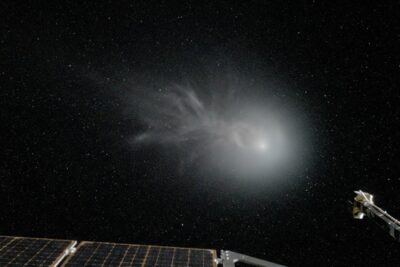
Astronomers using the James Webb Space Telescope reported the discovery of the most distant jellyfish galaxy ever observed, a cosmic oddity that trails long, tentacle-like streams of gas and newborn stars as it moves through intergalactic space. These galaxies form when they fall into galaxy clusters and the surrounding hot gas strips material from them, creating visually striking tails that also serve as star-forming laboratories. The discovery pushes the known timeline for this phenomenon deeper into cosmic history. (Source: ScienceDaily)
What It All Means
Taken together, these findings paint a picture of a universe more hospitable to life than previously imagined. If extremophiles can survive planet-to-planet transit, if moons form with life’s building blocks already present, and if subsurface oceans are more energetic than expected, the conditions for biology may be far more common than scientists dared to hope just a generation ago. The coming decade of space exploration, with missions targeted at Europa, Enceladus, and Mars, may finally begin to answer whether we are alone.
Tektites and Ancient Impacts
Back on Earth, scientists uncovered a vast field of tektites in Brazil, mysterious glassy fragments forged when a powerful asteroid struck Earth approximately 6.3 million years ago. This is the first such discovery in South America, suggesting our understanding of the Southern Hemisphere’s impact history may be incomplete. (Source: ScienceDaily)
Tektites form when the heat and pressure of an asteroid impact melts rock and ejects it into the upper atmosphere, where it cools into glassy droplets that rain across wide areas. The discovery provides new evidence about the frequency of large asteroid strikes in relatively recent geological time.
Astronomers are also making progress on the Hubble tension, a persistent disagreement between methods of measuring how fast the universe is expanding. A faint cosmic hum detected through gravitational wave observations could help resolve this discrepancy, with profound implications for our understanding of dark energy. (Source: ScienceDaily)
A European team has unveiled a mission concept for exploring lava tunnels on the Moon and Mars using three coordinated robots. These hidden tunnels could shelter human explorers, offering natural protection from radiation and micrometeorite impacts. The concept represents growing recognition that sustainable presence on other worlds will likely require going underground. (Source: ScienceDaily)