
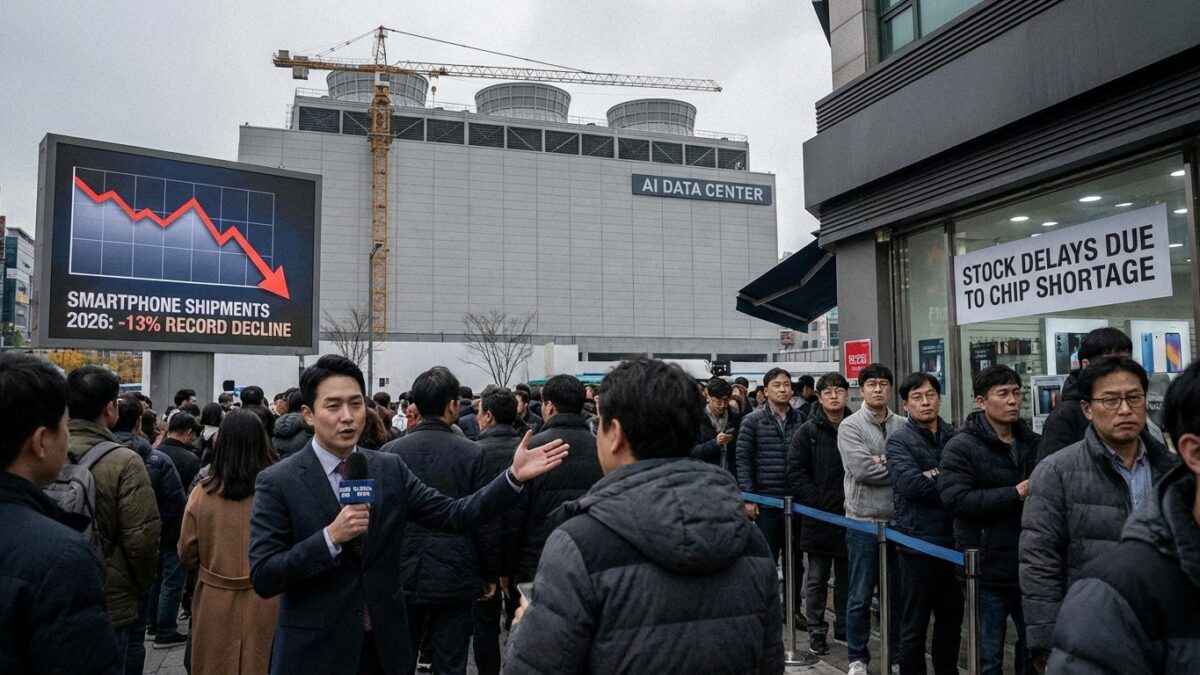
The global smartphone market is headed for its most severe contraction in history in 2026, with the International Data Corporation projecting a 13 percent year-over-year plunge to the lowest sales levels in a decade. The driving force behind the collapse is not weakening consumer demand but an unprecedented diversion of memory chip production toward artificial intelligence data centers, creating a supply chain crisis that is rippling through the entire consumer electronics industry. (Source: Yahoo Finance/IDC)
The Memory Chip Squeeze
At the heart of the downturn is a fundamental resource allocation conflict. Memory chips are essential components in both smartphones and AI data centers, but a small number of global manufacturers, primarily Micron, Samsung, and SK Hynix, produce the vast majority of the world’s supply. Because data center memory commands significantly higher margins than consumer electronics memory, chipmakers have increasingly favored AI customers over smartphone makers.
Francisco Jeronimo, vice president of worldwide client devices at IDC, described the situation in stark terms, calling it not a temporary squeeze but a tsunami-like shock originating in the memory supply chain, with ripple effects spreading across the entire consumer electronics industry. He warned that Android manufacturers face a particularly significant threat, as they compete for components that are being snapped up by hyperscale cloud providers investing tens of billions in AI infrastructure. (Source: IDC via Yahoo Finance)
The AI Infrastructure Gold Rush
The scale of AI investment driving this competition is staggering. OpenAI’s $110 billion funding round, closed in late February, included a $100 billion expansion of its AWS partnership, while the company’s overall compute ambitions target $600 billion in spending by 2030. CoreWeave, an AI cloud-computing company, projected that its capital expenditures would double from $15.4 billion in 2025 to at least $30 billion in 2026. (Source: CNBC; Yahoo Finance)
Nvidia’s dominance in AI processors has made it the centerpiece of this gold rush, with data center operators prioritizing GPU and high-bandwidth memory procurement over all other chip categories. The result is a two-tier market where AI-adjacent products enjoy abundant supply while consumer devices face growing shortages and price increases.
Consequences for Consumers
For everyday consumers, the practical impact is already visible. Flagship smartphone prices have crept upward as manufacturers absorb higher component costs or accept lower-specification memory configurations. Some mid-range devices that previously included premium memory specifications have been downgraded, and delivery timelines for popular models have extended.
The tablet and laptop markets are experiencing similar pressures, though to a lesser degree. PC manufacturers have had somewhat more success securing supply commitments, partly because enterprise customers purchasing AI-capable workstations are willing to pay premium prices that help chip makers justify continued allocation.
Industry Response
Samsung and SK Hynix have both announced plans to expand memory production capacity, but new fabrication facilities typically require two to three years to come online. In the interim, the industry is exploring architectural innovations that could reduce AI’s memory intensity, including more efficient model compression techniques and novel chip designs that optimize data throughput with less raw memory.
Meanwhile, Apple’s approach of designing its own chips and maintaining tight supply chain relationships has somewhat insulated it from the worst effects, though even the iPhone maker faces constraints in memory procurement. The company announced a new lower-cost iPhone model in early March, a move some analysts interpret as a strategic response to pricing pressures across the market. (Source: Yahoo Finance)
A Structural Shift
The 2026 smartphone decline may represent something more profound than a cyclical downturn. As AI increasingly competes with consumer electronics for the same foundational components, the tech industry faces a structural rebalancing that could permanently alter the economics of personal devices. The question for manufacturers, investors, and consumers is whether the insatiable appetite of AI infrastructure will moderate before the consumer electronics ecosystem sustains lasting damage.
The Geopolitical Dimension
The smartphone market’s decline intersects with growing geopolitical tensions over semiconductor supply chains. U.S. export restrictions on advanced chip technology to China have complicated the global market, while China’s domestic chip industry continues to make progress despite constraints. The result is a fragmented supply chain where geopolitical considerations increasingly influence component allocation decisions alongside market economics.
Taiwan Semiconductor Manufacturing Company, which produces the majority of the world’s most advanced processor chips, remains a critical bottleneck and strategic vulnerability. Any disruption to TSMC’s operations would amplify the component shortage while simultaneously threatening AI infrastructure buildout.
The CHIPS Act investments are beginning to bring new domestic fabrication capacity online, but new facilities typically require two to three years to reach full production. In the interim, the industry is exploring architectural innovations including more efficient model compression techniques and novel chip designs that optimize data throughput with less raw memory.
For consumers, the practical impact is straightforward: expect higher smartphone prices, potentially reduced specifications at given price points, and longer wait times for popular models. The silver lining is that the quality of existing devices continues to improve through software updates, meaning extending the life of current hardware is more viable than in previous technology cycles.