The rocks that twelve astronauts carried home from the Moon fifty years ago have fundamentally rewritten our understanding of lunar history, according to new research published in March 2026. A comprehensive reanalysis of Apollo samples has resolved one of the most stubborn debates in planetary science about how the Moon’s surface formed and evolved, and the answer turns out to be one that neither side of the long-running argument was entirely right about. (Source: Universe Today)
The Decades-Long Debate
Since the Apollo program returned 382 kilograms of lunar material between 1969 and 1972, scientists have debated fundamental questions about the Moon’s geological evolution. One camp argued that the lunar surface was shaped primarily by a single catastrophic event, the so-called Lunar Magma Ocean hypothesis, in which the young Moon was almost entirely molten and its crust crystallized from this global ocean of magma. The opposing view held that the Moon’s geology was more complex, shaped by multiple smaller-scale volcanic and impact events over a longer timeframe.
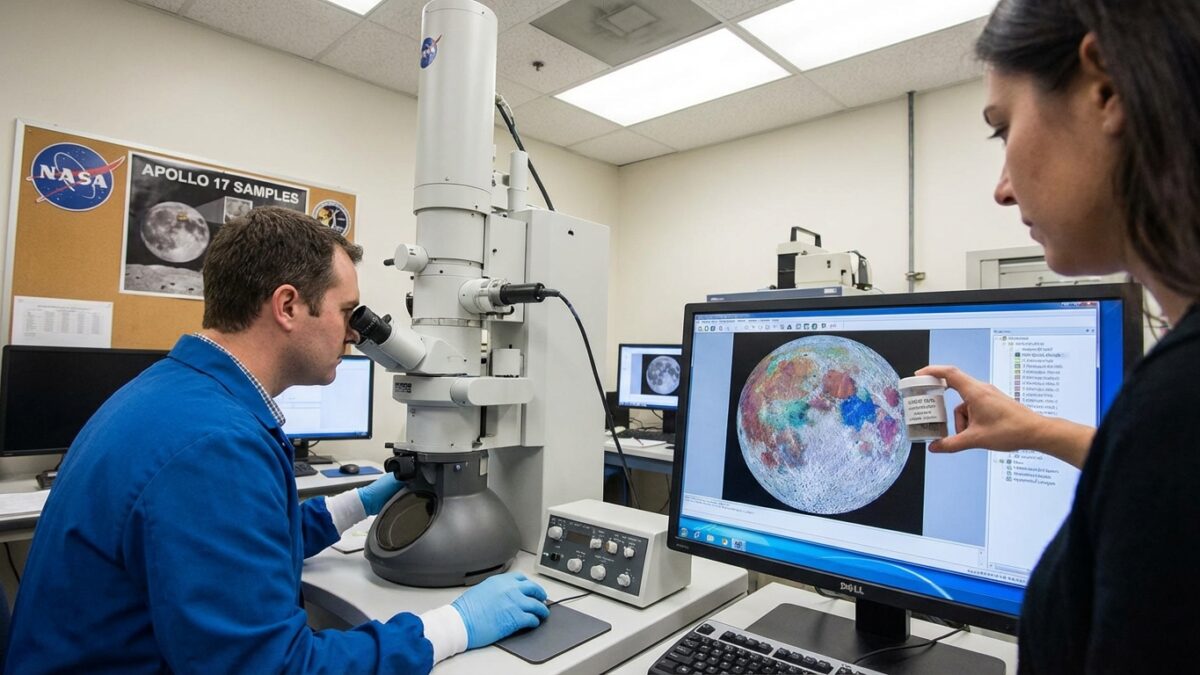
The new analysis employed analytical techniques that did not exist when the samples were first studied, including advanced mass spectrometry, synchrotron X-ray analysis, and AI-assisted mineral identification that can detect trace elements and isotopic signatures at parts-per-billion sensitivity. The results indicate that while a Magma Ocean did exist, it was neither as extensive nor as simple as the original hypothesis proposed. (Source: Universe Today)
Implications for Artemis
The findings have direct relevance for NASA’s Artemis program. Understanding the Moon’s geological history informs where future missions should land and which features are most scientifically valuable to study. As Artemis II prepares for a crewed lunar flyby and Artemis III plans the first landing since Apollo, the revised geological framework will help mission planners target locations that can answer remaining questions about lunar evolution, resource distribution, and the early history of the inner solar system. (Source: NASA)
The research also connects to parallel discoveries. Scientists have turned simulated lunar dirt into extremely durable structures using laser 3D printing, potentially paving the way for more sustainable construction in space. A European team has proposed using three coordinated robots to explore lava tunnels that could shelter future human inhabitants from radiation and micrometeorite impacts. These hidden tunnels represent some of the most promising locations for permanent lunar settlements. (Source: Universe Today; ScienceDaily)
The Broader Context
The Apollo sample reanalysis is part of a larger trend in planetary science where new technologies are extracting surprising information from materials collected decades ago. NASA and other agencies have deliberately preserved portions of Apollo samples for future analysis, recognizing that technology would eventually enable discoveries impossible with the instruments available at the time of collection. This foresight is now paying dividends as each new analytical technique reveals layers of information that bring scientists closer to understanding how our closest celestial neighbor formed and evolved. (Source: Universe Today)
China’s Chang’e 7 mission, targeting the Moon’s south pole in mid-2026 with an orbiter, lander, rover, and a small flying hopper, will add new samples and data to this understanding. The mission aims to explore permanently shadowed craters thought to harbor water ice, a resource critical for future sustained human presence. Together with Artemis and commercial lunar missions from Blue Origin, Intuitive Machines, and Astrobotic, 2026 is poised to be the most active year in lunar exploration since the Apollo era itself. (Source: Astronomy.com; NASASpaceFlight)
Technology Enabling Discovery
The reanalysis employed advanced mass spectrometry, synchrotron X-ray analysis, and AI-assisted mineral identification that can detect trace elements and isotopic signatures at parts-per-billion sensitivity. These tools simply did not exist when the samples were first studied in the 1970s. NASA’s foresight in preserving portions of Apollo samples for future analysis is now paying extraordinary dividends, with each new analytical technique revealing information that brings scientists closer to a complete understanding of lunar evolution.
The findings also have implications for understanding Earth’s own geological history. The Moon formed from debris generated by a massive collision between the early Earth and a Mars-sized body approximately 4.5 billion years ago. By reconstructing the Moon’s thermal and geological evolution with greater precision, scientists can better constrain models of the early Earth-Moon system and the conditions that prevailed when life first emerged on our planet. The interconnection between lunar science and terrestrial geology makes these Apollo sample studies relevant far beyond the narrow question of how the Moon formed, touching on fundamental questions about the conditions that made Earth habitable and whether similar conditions might exist elsewhere in the solar system.
The study found evidence of volcanic activity that was more sustained and complex than either hypothesis predicted. The Moon appears to have experienced episodic volcanism over a longer timeframe than previously believed. These findings challenge the view of the Moon as geologically dead and suggest its interior retained heat far longer than standard models predicted. For future missions, results provide crucial guidance on landing sites. Areas of recent volcanic activity would contain materials that record the Moon’s thermal evolution most completely. The south polar region, targeted by Chang’e 7 and future Artemis missions, may contain volcanic deposits beneath its water ice. The intersection of fundamental science with exploration planning makes Apollo reanalysis directly relevant to the multi-billion-dollar investments being made by the United States, China, Japan, India, and commercial companies in lunar exploration.