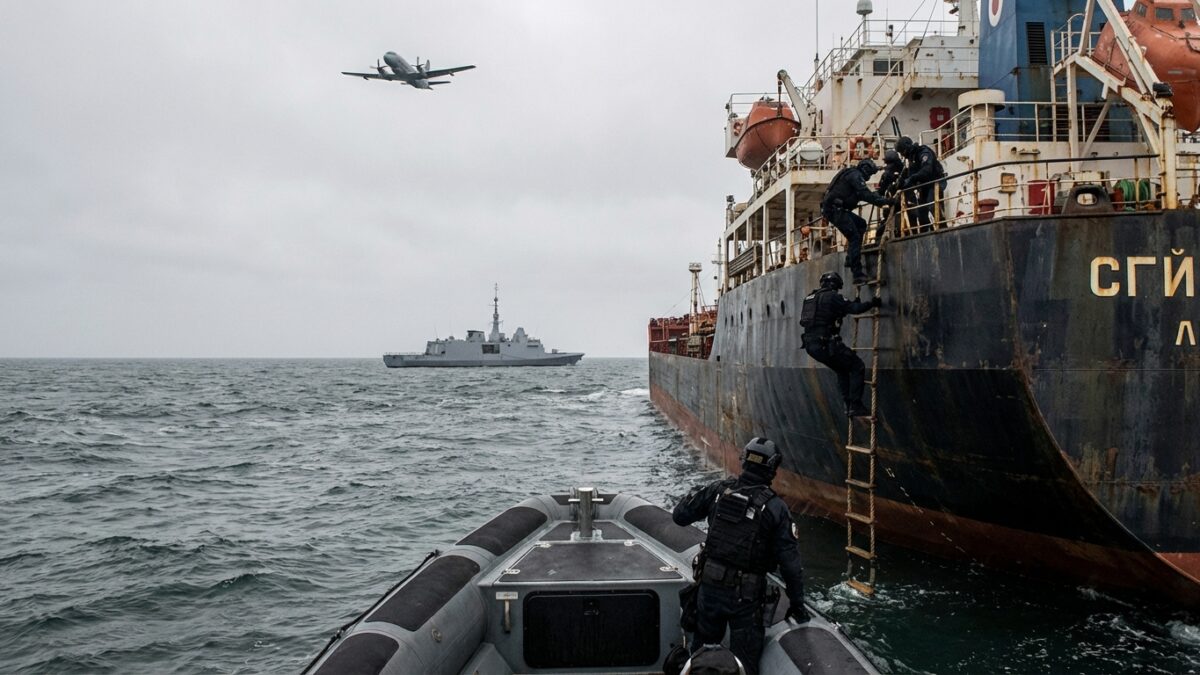
Belgian special forces, supported by the French Navy, seized a Russian shadow fleet oil tanker in the North Sea in early March 2026, marking one of the most significant enforcement actions against the network of aging, poorly insured vessels that Russia has assembled to circumvent Western sanctions on its oil exports. The operation represents a new phase in the West’s efforts to close loopholes that have allowed Moscow to continue generating revenue from oil sales despite sweeping restrictions imposed after the 2022 invasion of Ukraine. (Source: Le Monde; Wikipedia)
The Shadow Fleet Problem
Russia has built an extensive shadow fleet of tankers, estimated at 600 to 800 vessels, that operate outside Western insurance, classification, and regulatory frameworks to transport Russian crude oil to buyers willing to circumvent sanctions. These vessels, often decades old and lacking adequate insurance, pose significant environmental and safety risks as they transit some of the world’s busiest and most ecologically sensitive waterways, including the Baltic Sea, the English Channel, and the Mediterranean.
The shadow fleet has been extraordinarily effective at maintaining Russian oil revenues. Despite the G7 price cap of $60 per barrel imposed in December 2022, Russia has sold the majority of its oil above the cap by using shadow fleet vessels and non-Western insurance. The fleet represents a direct challenge to the sanctions architecture that Western nations constructed to pressure Moscow over its war in Ukraine.
The Seizure Operation
Details of the operation remain limited for security reasons, but Le Monde reported that Belgian commandos boarded the tanker in international waters of the North Sea with French naval support. The vessel was escorted to a Belgian port for inspection. The operation was conducted under European Union regulations that prohibit the transport of Russian oil above the price cap without Western insurance and that empower member states to enforce these rules against vessels transiting European waters.
The action comes amid broader European concern about shadow fleet vessels. Denmark and Sweden have raised alarms about aging tankers transiting the narrow straits connecting the Baltic Sea to the North Sea, where a spill would have catastrophic environmental consequences. Finland and Estonia have reported suspicious anchor chain damage to undersea cables, which some investigators have linked to shadow fleet vessels dragging anchors, though the connection remains unproven. (Source: Le Monde)
Operation Arctic Endurance
The tanker seizure follows Denmark’s January 14 launch of Operation Arctic Endurance, in which multiple European countries deployed troops to Greenland in response to U.S. President Trump’s threats regarding the island. The parallel actions demonstrate European nations’ growing willingness to take independent military and enforcement measures in their geographic neighborhood, even when those actions create friction with allies or adversaries. (Source: Wikipedia)
The seized tanker’s fate will be determined by Belgian and EU legal proceedings, but the operation sends a clear signal that European enforcement of Russia sanctions is escalating from financial measures to physical interdiction. If more seizures follow, the economic viability of shadow fleet operations could be significantly undermined, closing one of the most important loopholes in the Western sanctions regime and potentially reducing the revenue Russia can generate from its primary export commodity during a period of simultaneous conflicts in Ukraine and the broader Middle East.
The broader context includes European concern about infrastructure security. Finland and Estonia reported suspicious cable damage potentially linked to shadow fleet vessels dragging anchors. The combination of environmental risk, sanctions evasion, and potential sabotage has elevated the shadow fleet from niche enforcement issue to top-tier security concern. The operation also demonstrates European nations developing coordinated military capabilities for maritime enforcement independent of NATO command structures, a trend accelerated by Ukraine war and Atlantic alliance uncertainties. If more seizures follow, shadow fleet economics could be significantly undermined, closing one of the most important sanctions loopholes.
For Russia, the seizure raises the cost-benefit calculation of the shadow fleet. If European nations demonstrate willingness to physically interdict vessels, operational costs increase substantially. Russia may respond by routing exports through Arctic passages or Asian ports, adding transit time and cost. The enforcement action represents a strategic signal that could reshape global oil transport. Energy analysts noted the effective closure of the Strait of Hormuz combined with shadow fleet enforcement creates unprecedented double constraint on Russian exports. The operation demonstrates European nations developing maritime enforcement capabilities independent of NATO, a trend accelerated by the Ukraine war and uncertainties about the Atlantic alliance’s durability under changing U.S. leadership.
The environmental dimension of shadow fleet operations has also drawn attention from Scandinavian governments. Several shadow fleet vessels are decades old and lack the double-hull construction required of modern tankers, meaning any grounding or collision could result in catastrophic oil spills in ecologically sensitive waters. The Baltic Sea, through which many shadow fleet vessels transit, is one of the world’s most heavily trafficked and most vulnerable marine environments. Denmark and Sweden have called for EU-wide measures to prohibit single-hull tankers from transiting European territorial waters, a regulatory step that would force shadow fleet operators to either upgrade their fleets or find alternative routes entirely.