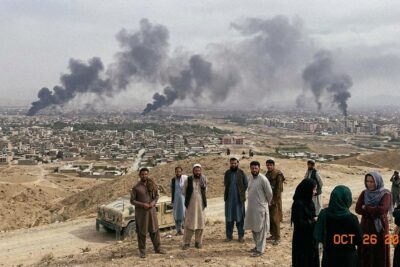
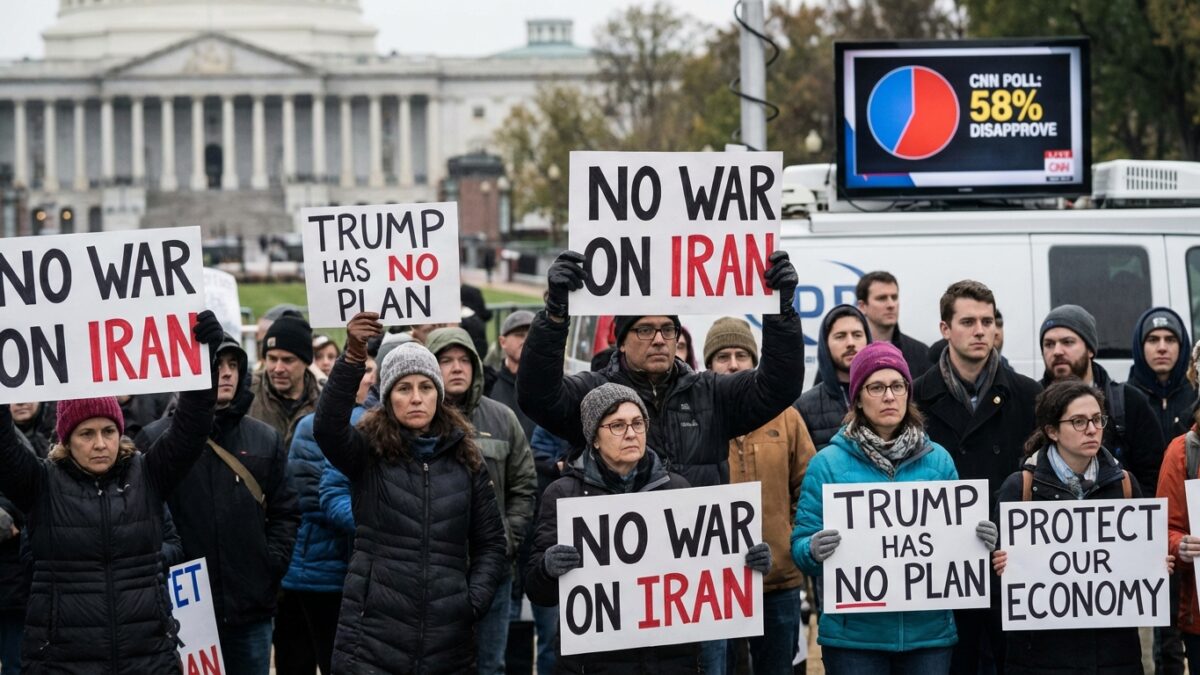
Nearly six in ten Americans disapprove of the U.S. decision to take military action in Iran, and most say a long-term military conflict between the two nations is likely, according to a CNN poll conducted by SSRS in the immediate aftermath of the strikes that began February 28. The survey, released March 3, reveals significant public doubt about President Trump’s handling of the crisis, with 60 percent saying they do not believe he has a clear plan and 62 percent saying he should seek congressional approval for further action. (Source: CNN/SSRS)
A Trust Deficit
The poll found that most Americans lack trust in Trump to make the right decisions about the use of force in Iran, a striking finding given that the president framed the strikes as necessary to prevent Iran from developing nuclear weapons. Only 27 percent of respondents felt the United States made sufficient effort at diplomacy before resorting to military force, while 39 percent said the U.S. did not try hard enough and 33 percent were unsure. (Source: CNN)
Economic Anxiety
The poll numbers are particularly concerning for the administration because economic anxiety is amplifying foreign policy opposition. With gasoline prices jumping 19 cents in a single day and the Dow plunging over 1,000 points, the tangible domestic consequences of the Iran conflict are impossible for ordinary Americans to ignore. The administration had built much of its political messaging around low energy prices and economic growth, both of which are now threatened by the very military action the president ordered. (Source: Deseret News; NBC News)
Representative Marjorie Taylor Greene’s public criticism of the strikes tested the MAGA movement’s core commitment to an America First foreign policy that explicitly promised no new wars. Senator Tim Kaine called for emergency hearings on the legal basis for the operation. The bipartisan nature of the criticism, spanning both anti-interventionist Republicans and constitutional-authority Democrats, suggests that congressional opposition could grow if the conflict continues without clear progress toward resolution.
Historical Context
Public opinion polling on military actions tends to follow predictable patterns: initial rally-around-the-flag effects that boost presidential approval, followed by erosion as costs accumulate and objectives remain unfulfilled. The Iran poll is unusual because the rally effect appears muted from the outset, with disapproval immediately exceeding approval. This suggests that the American public’s appetite for Middle Eastern military engagement has fundamentally shifted since the early 2000s, creating a political environment where even a president with strong base support faces immediate headwinds.
The poll did find areas of division along partisan lines, with Republican respondents more supportive of the strikes than Democrats or independents. However, even within Republican ranks, a notable minority expressed concern about the scope and duration of the operation. The coming weeks will reveal whether the administration can shift public opinion through military success, or whether the combination of economic pain, casualty reports, and unclear strategy will deepen the trust deficit that the CNN poll reveals. For a president who campaigned on ending foreign entanglements, the Iran conflict represents perhaps the most significant test of political capital since taking office. (Source: CNN; GoLocalProv)
The partisan breakdown reveals nuance. Republicans remain more supportive but even within the party, a notable minority expressed concern about scope and duration. The America First vision explicitly promised disengagement from Middle Eastern conflicts, making Iran a direct test of whether the base follows Trump in contradicting their stated preferences. Historical patterns suggest support erodes as costs accumulate. The Iran poll is unusual because the rally effect appears muted from the outset, suggesting fundamentally shifted public appetite for Middle Eastern engagement. Congressional authorization remains a flashpoint, with the Constitution granting war powers to Congress while presidents increasingly act unilaterally. The coming weeks will determine whether military success shifts these numbers or whether economic pain and unclear strategy deepen the trust deficit the data reveals.
The economic dimensions may prove most politically consequential. Rising gasoline prices remind every household of the conflict at every refueling. Declining portfolios threaten retirement savings. Shipping disruptions raise grocery costs, bringing the war to kitchen tables. These tangible consequences create a feedback loop deepening opposition daily. For the administration, the challenge is existential: achieve rapid military objectives justifying economic pain, or face a public whose patience has been tested by two decades of Middle Eastern engagements and is unwilling to extend further credit to foreign operations lacking clear endpoints. Congressional authorization remains a flashpoint with constitutional implications that court challenges could amplify in the months ahead.
The poll also surfaced generational divides, with younger Americans expressing significantly stronger opposition to military action than older cohorts who lived through the September 11 era. This generational shift suggests that the political calculus around Middle Eastern military intervention has fundamentally changed, with a growing majority of the electorate having no personal memory of the events that originally justified American engagement in the region. For the administration, rebuilding public support for a conflict that most Americans did not want to begin requires demonstrating clear, tangible progress toward defined objectives, a standard that open-ended military operations historically struggle to meet.