The subsurface oceans beneath the frozen shells of moons orbiting Jupiter and Saturn may be far more turbulent and potentially habitable than scientists previously believed, according to new research published in March 2026 that challenges long-standing assumptions about these alien worlds. The findings suggest that tidal heating from their giant planet hosts creates conditions more energetic than the calm, dark oceans scientists had envisioned, potentially providing the energy sources necessary to support biological activity. (Source: ScienceDaily)
Boiling Beneath the Ice
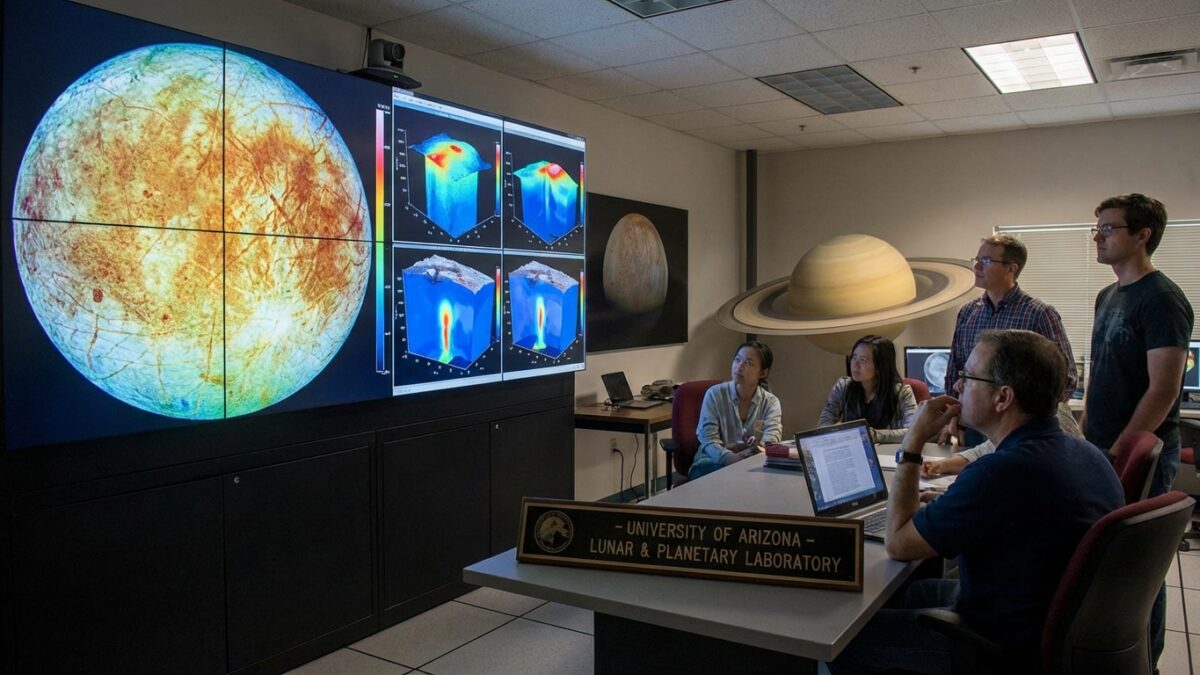
When heat from tidal forces melts the ice shells from below, the resulting dynamics can create conditions far more energetic than previously modeled. The research shows that the interaction between rising heat, melting ice, and the resulting circulation patterns generates turbulence and chemical mixing that could sustain biochemical processes. This overturns the image of these oceans as stagnant, lightless bodies of water and replaces it with a picture of dynamic environments where energy and chemistry interact in ways potentially conducive to life. (Source: ScienceDaily)
The findings are particularly significant for Europa, Jupiter’s moon that harbors a global ocean beneath a shell of ice estimated at 15 to 25 kilometers thick. NASA’s Europa Clipper mission, launched in 2024, is now en route to Jupiter to perform detailed investigations of the moon’s ocean through gravity measurements, magnetic field analysis, and surface geology. The new research on ocean dynamics will directly inform how scientists interpret Clipper’s data when it arrives at Europa in the early 2030s.
Jupiter’s Moons Born With Life’s Ingredients
In a separate but related discovery, research published in March found that Jupiter’s icy moons may have been seeded with the chemical ingredients for life from the very beginning of their formation. The study suggests complex organic molecules were incorporated into the moons during their accretion from the disk of material surrounding young Jupiter, rather than being delivered later by comets or asteroids. This means the building blocks of biology may have been present since these moons first formed billions of years ago. (Source: ScienceDaily)
Combined with the new understanding of dynamic ocean environments, the picture emerges of worlds that possessed both the raw materials and the energy sources for biology from their earliest days. While possessing ingredients is not the same as having life, the conditions are far more favorable than scientists estimated even a few years ago.
Saturn’s Enceladus
Enceladus, Saturn’s small but remarkable moon, continues to fascinate astrobiologists. The Cassini mission discovered geysers erupting from cracks in Enceladus’s south polar ice, spraying water vapor, ice particles, and organic molecules into space. Analysis of this material revealed hydrogen gas, a potential food source for microbial life, and complex organic compounds. The new research on tidal heating dynamics applies equally to Enceladus, suggesting its internal ocean may also be more energetic than previously modeled.
Plans for future missions to Enceladus include concepts for spacecraft that could fly through the geysers and directly sample the ocean material without landing, dramatically reducing mission complexity while still searching for biosignatures. NASA’s Dragonfly mission to Saturn’s moon Titan, while targeting a different moon, will also provide context for understanding the Saturn system’s habitability. (Source: ScienceDaily)
The Search for Life
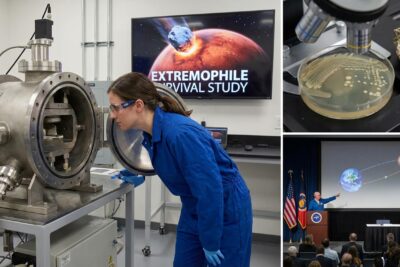
The convergence of multiple discoveries, including dynamic oceans, primordial organic chemistry, and resilient extremophile biology on Earth, is reshaping the scientific consensus about life in the universe. The question is shifting from whether habitable conditions exist beyond Earth to where and when they might be found. The coming decade of planetary exploration, with Europa Clipper, Dragonfly, and proposed Enceladus missions, may finally begin to answer humanity’s oldest question: are we alone? For now, the research suggests the answer may be more encouraging than most scientists dared to hope a generation ago.
The research team used advanced computational fluid dynamics to model ice shell melting, revealing circulation patterns far more complex than simple vertical convection previously assumed. The interactions between warm water, melting ice, and chemical gradients create turbulent mixing zones that could concentrate ingredients necessary for biological processes, functioning like hydrothermal vents on Earth’s ocean floor which support ecosystems independent of sunlight. Saturn’s Enceladus presents a compelling case, with Cassini-discovered geysers erupting water vapor, ice particles, and organic molecules. Plans include spacecraft that could fly through geysers to sample ocean material. NASA’s Dragonfly mission to Titan provides complementary data. Together these discoveries paint a picture of a solar system far more hospitable to life than imagined a decade ago, with the coming era of planetary exploration poised to test whether biology exists beyond Earth.
Enceladus presents a compelling near-term target. The geysers effectively deliver ocean samples into space, meaning a spacecraft would not need to land to analyze composition. This dramatically reduces mission complexity compared to Europa. Several concepts under study would fly through plumes with instruments detecting amino acids, lipids, and biological markers. If funded, such a mission could launch within the next decade and provide definitive evidence about habitability of an ocean world, potentially answering whether life exists beyond Earth sooner than expected. The convergence of dynamic oceans, primordial chemistry, and resilient extremophile biology is reshaping the consensus about life in the universe. The question is shifting from whether habitable conditions exist to where and when they might be found.