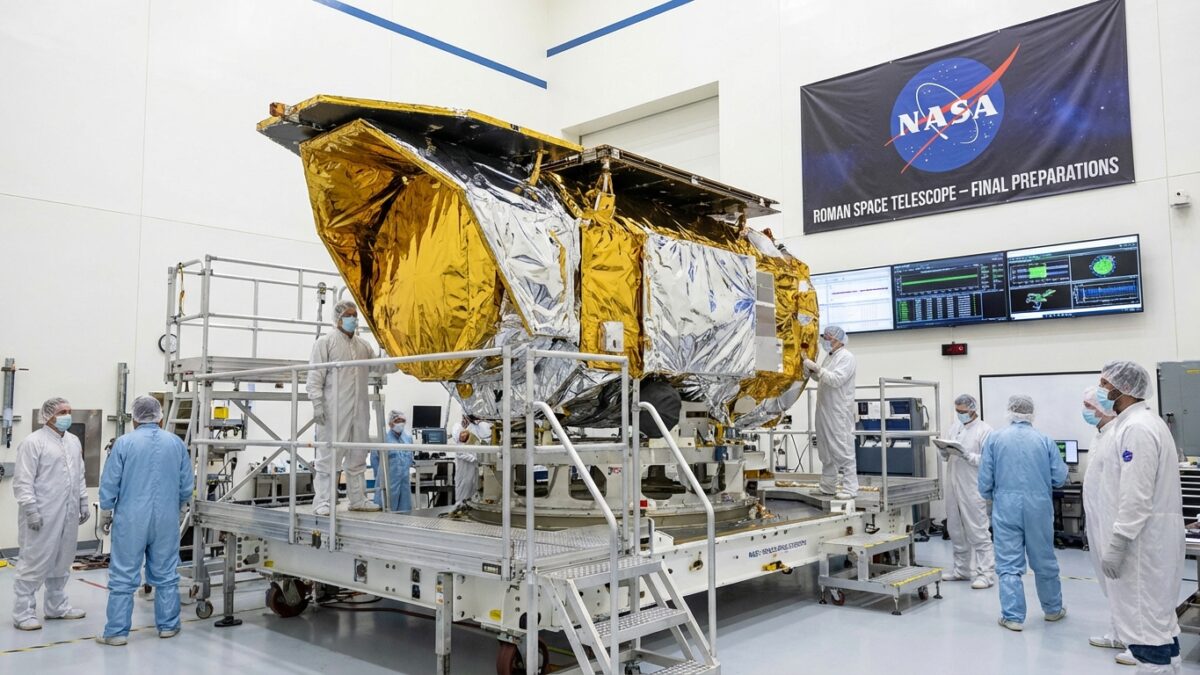
NASA’s Nancy Grace Roman Space Telescope, one of the most anticipated astronomical instruments of the decade, is entering final preparations for an October 2026 launch aboard a SpaceX Falcon 9 rocket. The infrared wide-field survey telescope will produce images with Hubble-level resolution but covering areas nearly 200 times larger, enabling the kind of comprehensive cosmic census that has never before been possible and promising transformative discoveries across dark energy research, exoplanet detection, and galactic structure. (Source: NASASpaceFlight)
Unprecedented Capability
Roman’s 288-megapixel Wide Field Instrument camera represents a quantum leap in survey astronomy. Where Hubble’s deep-field images captured exquisite detail of tiny patches of sky, Roman will sweep across vast swaths of the cosmos at comparable resolution, mapping the distribution of galaxies, measuring the expansion rate of the universe, and searching for rogue planets wandering between stars. The telescope’s coronagraph instrument will also directly image exoplanets orbiting nearby stars, a capability that could identify worlds with conditions potentially suitable for life. (Source: NASASpaceFlight; Scientific American)
Bobby Braun, head of the space exploration sector at Johns Hopkins Applied Physics Laboratory, expressed excitement about Roman’s launch, noting that the telescope will operate alongside the James Webb Space Telescope to provide complementary views of the universe. While JWST excels at detailed observations of individual targets, Roman will provide the wide-field context that tells scientists where to look. (Source: Johns Hopkins APL)
Dark Energy and the Expanding Universe
One of Roman’s primary science goals is to constrain the nature of dark energy, the mysterious force driving the universe’s accelerating expansion. By measuring the distances and distribution of millions of galaxies and supernovae, Roman will provide data that could distinguish between competing theoretical models of dark energy, potentially answering whether the acceleration is constant, changing, or an artifact of our incomplete understanding of gravity. (Source: NASASpaceFlight)
The telescope will also contribute to resolving the Hubble tension, the persistent disagreement between different methods of measuring the universe’s expansion rate. A faint cosmic hum detected through gravitational wave observations in early 2026 offered one potential path to resolution, and Roman’s massive datasets could provide independent constraints that help determine whether the discrepancy reflects measurement errors or new physics. (Source: ScienceDaily)
A Banner Year for Space Telescopes
Roman joins a remarkable year for new astronomical capabilities. The ESA-Chinese Academy of Sciences SMILE mission launched April 8 will image Earth’s magnetic interactions with solar wind. The Vera C. Rubin Observatory in Chile is ramping up its Legacy Survey of Space and Time. The ESA-JAXA BepiColombo mission enters Mercury orbit after seven years of travel. Together, these observatories represent the most significant expansion of humanity’s ability to observe the cosmos in a generation. (Source: NASASpaceFlight; SETI Institute)
For the scientific community, Roman represents both a culmination and a beginning. Its development has spanned over a decade and survived multiple budget challenges. When it reaches its operational orbit at the Sun-Earth Lagrange point 2, approximately 1.5 million kilometers from Earth, it will begin a primary mission of at least five years that scientists expect will reshape our understanding of the universe’s structure, history, and future.
Roman will contribute to resolving the Hubble tension, the persistent measurement disagreement. Its massive datasets could provide independent constraints determining whether the discrepancy reflects errors or new physics. The telescope’s exoplanet capabilities extend to microlensing surveys detecting planets impossible to find through transit methods, including rogue planets. Named after NASA’s first chief astronomer who was instrumental in developing the Hubble program, Roman represents both culmination and beginning. Combined with JWST’s detailed observations and Vera Rubin’s ground-based surveys, the three instruments create an unprecedented observational network covering infrared, optical, and wide-field survey astronomy simultaneously, enabling discoveries no single telescope could achieve alone. For the global astronomical community, 2026 marks the year humanity’s eyes on the cosmos grew dramatically sharper and wider, with Roman as the crown jewel.
The coronagraph instrument represents a technological frontier. Designed to block overwhelming starlight, it will directly image exoplanets, a capability considered science fiction two decades ago. While JWST studies atmospheres through transit spectroscopy, Roman captures actual images enabling detailed compositional study and potentially identifying biosignatures including water vapor and oxygen. Combined with wide-field surveys, this makes Roman uniquely versatile. For astronomers who spent careers developing these capabilities, the launch marks a watershed moment. Together with JWST and Vera Rubin Observatory, the three instruments create an unprecedented observational network enabling discoveries no single telescope could achieve alone. The telescope’s infrared sensitivity also allows it to peer through dust clouds that obscure visible-light observations, revealing stellar nurseries and galactic structures hidden from other instruments.
Roman’s mission design incorporates lessons from previous space telescope programs. Its position at the L2 Lagrange point provides thermal stability and uninterrupted viewing, while its wide-field design means it can survey the equivalent of thousands of Hubble deep fields in a fraction of the time. The telescope will also monitor gravitational microlensing events to conduct a census of exoplanets throughout our galaxy, including those too distant or too faint for other detection methods. This population survey will provide the statistical basis for estimating how common habitable planets are, a fundamental question for astrobiology.
The ground-based Vera C. Rubin Observatory, operating in parallel with Roman, will conduct the Legacy Survey of Space and Time, repeatedly imaging the visible sky to detect transient phenomena. The coordinated operation of Roman’s infrared surveys, JWST’s targeted observations, and Rubin’s rapid-cadence optical monitoring creates an astronomical toolkit of unprecedented power. When Roman detects an interesting transient or anomaly in its wide-field data, JWST can be redirected for detailed follow-up within days, while Rubin provides continuous monitoring in optical wavelengths. This three-telescope synergy, enabled by modern data-sharing infrastructure and rapid communication between observatories, transforms astronomy from a discipline of patient observation into one of responsive, real-time investigation.