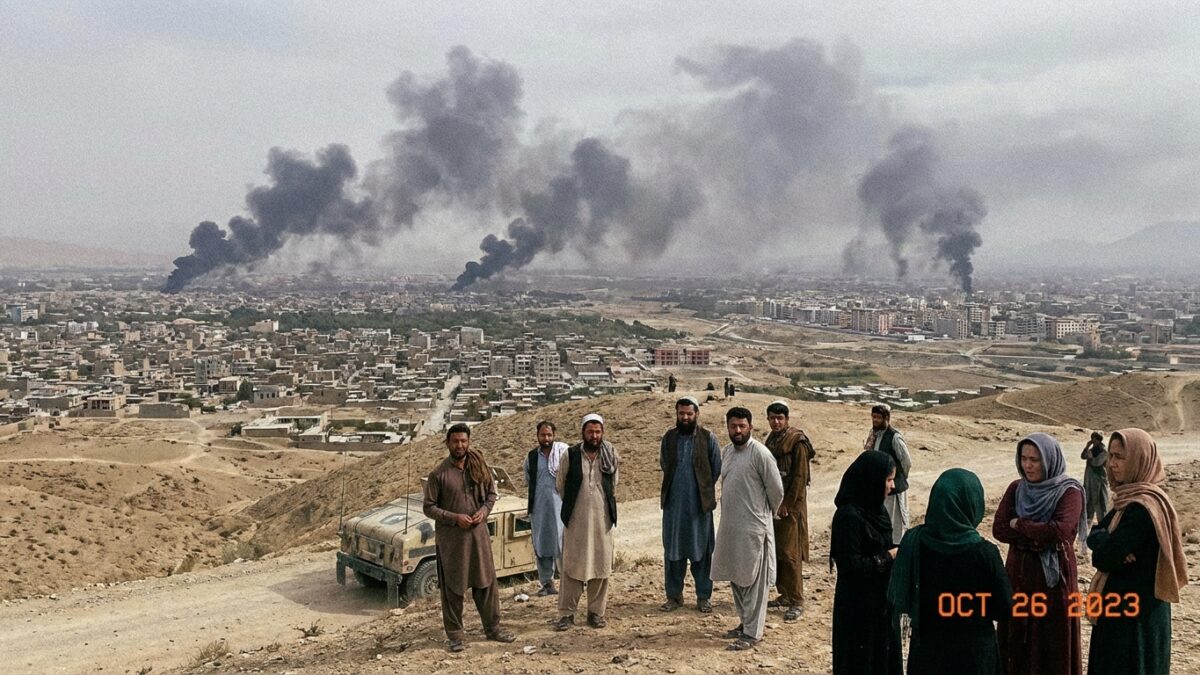
Pakistan launched devastating airstrikes against targets in Afghanistan’s capital Kabul, the southern stronghold of Kandahar, and multiple border provinces on February 27, 2026, in what Defence Minister Khawaja Asif declared an act of open war against the Taliban-run government. The strikes marked the most serious military confrontation between the two nuclear-armed neighbors in decades, following months of escalating border skirmishes and a wave of terrorist attacks inside Pakistan that Islamabad attributes to militant groups operating from Afghan soil. (Source: Al Jazeera)
The Breaking Point
The immediate trigger was a series of attacks by Afghan Taliban forces against Pakistani military positions along the Durand Line on February 26. Pakistani officials said their patience had run out after the Taliban government repeatedly failed to curb militant activity from its territory. Defence Minister Asif wrote on social media that Pakistan’s cup of patience had overflowed and declared it open war. (Source: CNN)
Pakistan’s military launched Operation Ghazab Lil Haq, translated as Righteous Fury. In the first 24 hours, the armed forces reported destroying 130 Taliban border posts, capturing 26 others, and destroying 171 tanks and armored vehicles belonging to Afghan Taliban forces. The Pakistan Air Force targeted 41 locations across Afghanistan, including military headquarters in Nangarhar and Kandahar provinces. Pakistan’s information minister confirmed strikes hit Kabul, striking the Bagram airbase that previously served as the main U.S. military installation in the country. (Source: Wikipedia; Al Jazeera)
Kabul Under Fire
A Kabul resident described to CNN being jolted awake by a loud explosion, saying she was terrified and could see flames rising from her apartment window. Lights across neighboring buildings remained on through the night as families braced for further strikes. Afghanistan responded with drone strikes against Pakistani military positions and deployed anti-aircraft and missile defence systems against Pakistani jets entering Afghan airspace. (Source: CNN; Al Jazeera)
Taliban spokesperson Zabiullah Mujahid accused Pakistan of striking civilian areas, including a farmer’s home in Jalalabad that killed most of his family and a religious school for children in Paktika. The Afghan Ministry of Defence claimed 55 Pakistani soldiers were killed and several captured. Pakistan countered that it had killed 274 Afghan Taliban fighters and injured 400. Independent verification of casualty figures from the remote border regions has been impossible. (Source: Al Jazeera)
Root Causes
The conflict stems from Pakistan’s longstanding accusation that Afghanistan harbors the Tehrik-e-Taliban Pakistan and other militant groups. February 2026 saw a Balochistan Liberation Army campaign that killed nearly 50 people, a suicide bombing at a Shia mosque in Islamabad killing 36, and a checkpoint attack in Bajaur killing 11 soldiers. Elizabeth Threlkeld of the Stimson Center told Al Jazeera the clashes were not surprising given months of frayed tensions, noting a shift toward more aggressive kinetic attacks from Pakistan. (Source: Al Jazeera; The Diplomat)
The underlying dispute over the Durand Line, drawn in 1893 through ethnic Pashtun areas and never recognized by any Afghan government, adds deep historical grievance. Afghanistan was the only country to vote against Pakistan’s admission to the United Nations in 1947 over this territorial disagreement. Chatham House warned that with the world distracted by war in the Middle East, de-escalation would need to come from Kabul and Islamabad directly. (Source: Chatham House)
Regional Dynamics and International Response
Pakistan has accused India of using Afghanistan as a proxy, with Defence Minister Asif alleging India wants to engage in a low-intensity war with Pakistan through Kabul. India dismissed this as another attempt to externalize internal failures, though India’s relations with the Taliban improved markedly in 2025, with a Taliban diplomat taking charge of the Afghan embassy in New Delhi in January 2026. (Source: The Diplomat)
Iran, China, Russia, the United Kingdom, and the United Nations have urged de-escalation. Iran’s Foreign Minister called on both sides to resolve differences through dialogue during Ramadan. Despite Taliban signals of openness to negotiations, Pakistan has rejected dialogue. The Pakistani prime minister’s foreign media spokesman stated flatly that there would be no talks, no dialogue, and no negotiation, with Pakistan’s sole demand being an end to Afghanistan-based terrorism. (Source: Al Jazeera; JURIST)
The forced repatriation of Afghan refugees compounds the humanitarian crisis, with 2.7 million Afghans returning from Pakistan and Iran in 2025 alone. Pakistan’s closure of the Afghan border in October and suspension of all trade has squeezed Afghanistan’s economy as a landlocked state. As fighting entered its second week, Pakistani forces reportedly held a 32-square-kilometer area of Afghan territory, raising the prospect of a prolonged occupation that neither side’s military or economy can sustain.
The Humanitarian Toll
The United Nations Assistance Mission in Afghanistan reported at least 42 civilian casualties in the first days of fighting. Pakistan’s military has claimed that its airstrikes exclusively targeted militant infrastructure, but the Afghan government has produced evidence of strikes on residential areas, refugee settlements, and educational facilities. The forced repatriation of millions of Afghan refugees from Pakistan over the past year has created an enormous displaced population with nowhere to turn as the conflict intensifies.
Pakistan has also deployed ground forces along the border, with reports of Pakistani troops occupying approximately 32 square kilometers of Afghan territory in the Zhob sector. The Taliban has responded by dispatching reinforcements from the 203rd Mansouri Corps in Paktia province. The fighting shows no signs of de-escalation, and analysts at Chatham House have warned that without urgent diplomatic intervention, the conflict risks becoming a prolonged regional crisis with catastrophic humanitarian consequences for both countries. Abdul Basit of Singapore’s S Rajaratnam School of International Studies noted that armed warfare would not favor Afghanistan, which lacks a military comparable to Pakistan’s, explaining why the Taliban is resorting to unconventional methods including drone strikes and asymmetric attacks targeting Pakistani urban centers.