
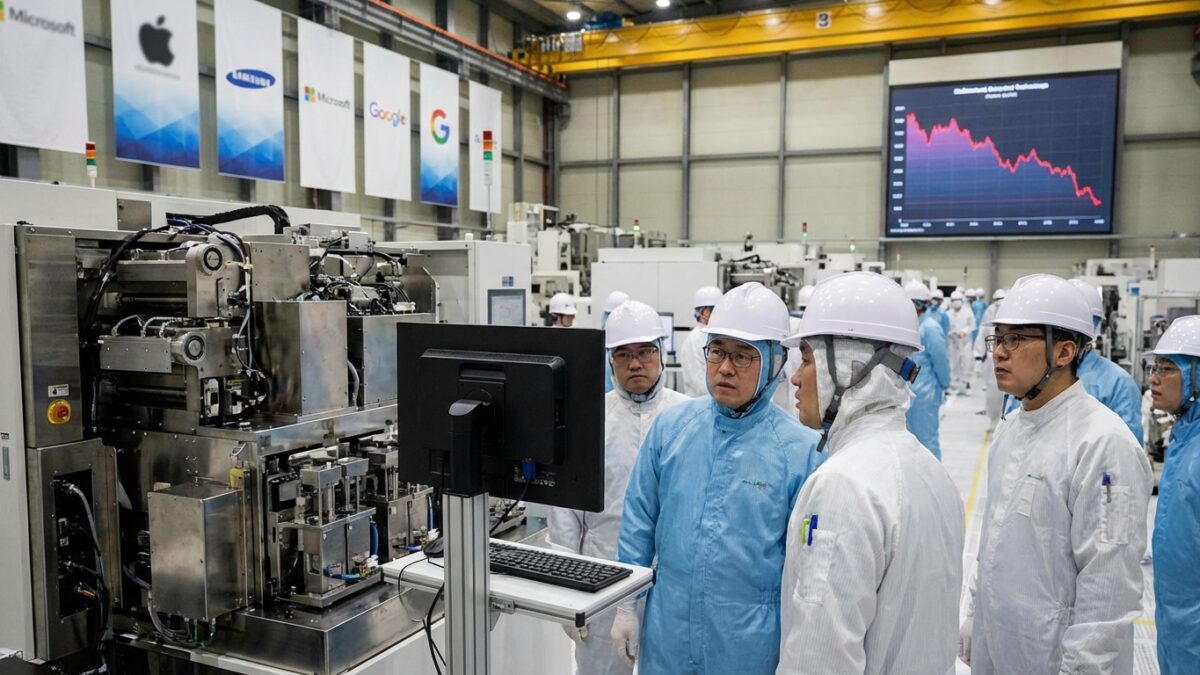
The AI industry is digesting the implications of a Bloomberg report that the Trump administration is considering requiring permits for artificial intelligence chip sales that are currently allowed under existing export rules. The proposal, which sent semiconductor stocks tumbling on March 5, could significantly slow the global AI infrastructure buildout at a moment when companies are racing to deploy computing capacity worth hundreds of billions of dollars. Industry leaders warn that additional bureaucratic hurdles could benefit Chinese competitors while undermining American technological leadership. (Source: Bloomberg)
The Stakes for AI Companies
OpenAI’s recent $110 billion funding round committed the company to consuming at least 2 gigawatts of AWS Trainium compute and expanding its cloud partnership by $100 billion over eight years. These commitments depend on a functioning global semiconductor supply chain that delivers chips from fabrication plants in Taiwan, South Korea, and the United States to data centers worldwide. Any regulatory friction that slows chip delivery timelines directly affects the pace at which AI capabilities can be scaled. (Source: CNBC; TechCrunch)
The proposal also complicates the competitive dynamics between American and Chinese AI development. Five new frontier-class AI models were released by Chinese companies in March alone, with MiniMax’s M2.5 reportedly rivaling top Western models at significantly lower cost. Chinese AI labs have adapted to existing export restrictions by developing more efficient architectures that achieve competitive performance with less powerful hardware. Additional U.S. restrictions could paradoxically accelerate this innovation by further incentivizing efficiency. (Source: MIT Technology Review)
Data Center Investment at Risk
The proposed permit requirement arrives during the largest data center construction boom in history. CoreWeave projected capital expenditures would double from $15.4 billion in 2025 to at least $30 billion in 2026. Nvidia’s GPUs are the critical bottleneck in this buildout, and any regulatory delay in chip deliveries would cascade through construction timelines, employment plans, and revenue projections for the entire AI infrastructure ecosystem. (Source: Yahoo Finance)
Cloud providers including Amazon, Microsoft, and Google have made enormous capital commitments predicated on a predictable chip supply timeline. AWS committed to using Amazon’s custom Trainium chips alongside Nvidia GPUs, but Trainium production is not yet at a scale that could replace Nvidia hardware if export restrictions slow GPU deliveries. The interdependencies within the AI infrastructure supply chain mean that a regulatory bottleneck at any point can propagate delays throughout the system.
Industry Response
Nvidia CEO Jensen Huang has consistently argued that overly restrictive export controls push customers toward Chinese alternatives. At CES in January, Huang stated that America’s semiconductor leadership depends on maintaining the commercial scale that funds research and development. The Semiconductor Industry Association has lobbied against permit requirements that add processing time to sales that are currently approved by default, arguing that the delays would erode customer relationships without meaningfully slowing Chinese AI development. (Source: Bloomberg)
For the AI industry broadly, the potential chip export permits represent another variable in an increasingly complex operating environment that already includes Iran war-driven market volatility, memory chip shortages affecting consumer electronics, and intensifying competition from open-source Chinese models. The outcome of the policy deliberation could shape the pace and geography of AI development for years to come, determining whether the global buildout proceeds at full speed or is slowed by the same geopolitical tensions that are reshaping energy markets, military alliances, and international trade. (Source: Bloomberg; TheStreet)
The scale of data center investment at stake is enormous. OpenAI committed to consuming at least 2 gigawatts of AWS Trainium compute alongside Nvidia GPUs, while CoreWeave projected capital expenditures doubling to $30 billion in 2026. Any regulatory friction slowing chip delivery timelines would cascade through construction schedules, employment plans, and revenue projections across the entire AI infrastructure ecosystem. Cloud providers including Amazon, Microsoft, and Google have made capital commitments predicated on predictable supply, and permit-driven delays could force costly adjustments to multi-year deployment plans. (Source: CNBC; Yahoo Finance)
The Semiconductor Industry Association has lobbied against permit requirements that add processing delays to currently approved sales, arguing that they erode customer relationships without meaningfully slowing Chinese AI development. Nvidia CEO Jensen Huang has consistently maintained that America’s semiconductor leadership depends on commercial scale that funds research and development. For the administration, the challenge is calibrating restrictions tight enough to slow adversary capability development without undermining the commercial ecosystem that makes American technological leadership possible in the first place. The outcome of this deliberation will shape the pace and geography of AI development for years to come. (Source: Bloomberg; CNBC)
For enterprise customers evaluating their AI infrastructure strategies, the regulatory uncertainty introduces a planning variable that complicates multi-year technology roadmaps. Companies building AI applications on cloud platforms that depend on specific chip architectures face the risk that regulatory changes could affect the availability or cost of the computing resources their products require. This uncertainty may push some enterprises to diversify across multiple chip vendors and cloud providers as a hedge against regulatory disruption, adding complexity and cost to AI deployment plans. (Source: Bloomberg; CNBC)