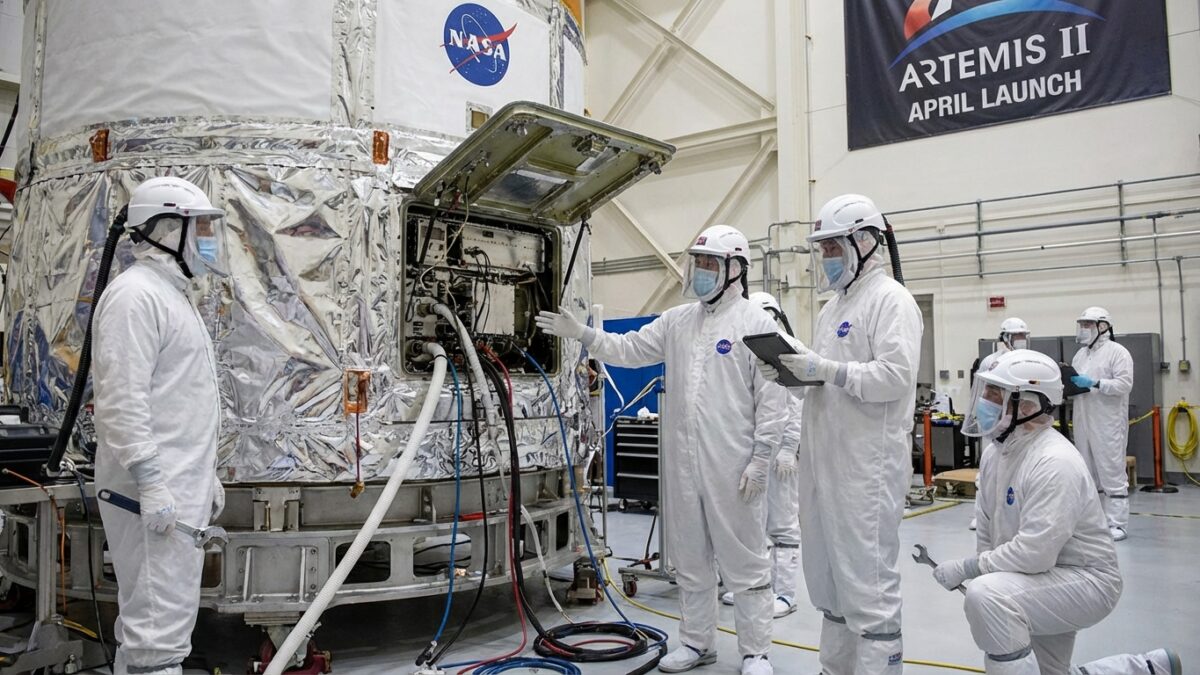
NASA technicians have accessed the components responsible for a helium flow problem that forced the Artemis II rocket back to the Vehicle Assembly Building on February 25, and engineers are cautiously optimistic about preserving the April launch window for what would be the first crewed mission around the Moon since Apollo 17 in 1972. The agency announced on March 3 that engineers had determined the source of the issue in the launch vehicle stage adapter and were working on repairs that could allow rollback to the launch pad within weeks. (Source: NASA)
The Helium Problem
The issue was discovered on February 21, after the second successful wet dress rehearsal on February 19. Helium is used to pressurize the upper stage’s fuel tanks and purge the engine of residual hydrogen and oxygen. While the systems functioned normally during the rehearsal itself, operators could not establish proper helium flow during post-rehearsal reconfiguration. The problem was traced to the interface between ground and rocket helium lines in the launch vehicle stage adapter. (Source: NASA; Adler Planetarium)
With the rocket now in the VAB, technicians are also replacing batteries on the upper stage, core stage, and solid rocket boosters, and servicing the flight termination system. The available April launch dates include April 1, 3, 4, 5, 6, and 30, with additional backup opportunities extending the window if needed. The crew of four, astronauts Reid Wiseman, Victor Glover, Christina Koch, and Canadian Space Agency astronaut Jeremy Hansen, were released from quarantine after the March launch window was lost and will re-enter quarantine approximately two weeks before the next targeted launch date. (Source: NASA; The Planetary Society)
The Program’s Momentum
Despite the near-term delays, NASA announced on February 27 that it is increasing the cadence of Artemis missions, adding an additional mission in 2027 and standardizing vehicle configurations to accelerate the program. Administrator Jared Isaacman has described the current era as a Golden Age of exploration and discovery, and the agency’s long-term commitment to returning humans to the Moon appears firm even as individual mission timelines slip. (Source: NASA)
The commercial lunar ecosystem continues to grow alongside Artemis. Blue Origin is preparing its first Blue Moon Mark 1 lunar landing attempt. Intuitive Machines plans its third Nova C mission in the second half of 2026. Astrobotic’s Griffin lander, carrying the revived VIPER rover to search for water ice at the lunar south pole, is scheduled for July. China’s Chang’e 7 mission targets the lunar south pole in mid-2026 with an orbiter, lander, rover, and hopping probe. (Source: NASASpaceFlight; Astronomy.com)
What Artemis II Will Test
The 10-day mission will carry its crew farther from Earth than any humans have traveled, on a free-return trajectory around the Moon. Victor Glover will become the first person of color, Christina Koch the first woman, and Jeremy Hansen the first non-American to leave Earth orbit. The mission will validate the Orion spacecraft’s life support, navigation, and communication systems in deep space, setting the stage for Artemis III’s planned crewed lunar landing. (Source: NASA; The Planetary Society)
The heat shield concerns from Artemis I’s reentry, where engineers observed spalling of the AVCOAT material, have been addressed by eliminating the planned skip reentry in favor of a steeper direct entry profile. Design changes addressing the underlying heat shield issue are planned for Artemis III. For now, the program’s focus is on the helium system repair, and every day that technicians make progress brings the first crewed lunar voyage in over half a century closer to reality. (Source: Wikipedia; NASA)
The commercial lunar ecosystem continues expanding alongside Artemis. Blue Origin is preparing its Blue Moon Mark 1 lunar landing attempt aboard New Glenn. Intuitive Machines plans its third Nova C mission carrying payloads for NASA, ESA, and the Korea Astronomy and Space Science Institute. Astrobotic’s Griffin lander is scheduled for July with the revived VIPER rover to search for water ice at the lunar south pole. China’s Chang’e 7 targets the south pole with an orbiter, lander, rover, and flying hopper designed to leap into permanently shadowed craters. The cumulative effect is a lunar exploration program that is more active and internationally diverse than at any point since the Apollo era. (Source: NASASpaceFlight; Astronomy.com)
For the four Artemis II crew members, the cycle of quarantine and release continues as NASA works through the technical challenges. As Administrator Isaacman stated, the agency will only launch when ready to undertake this historic mission safely. The crew’s patience and resilience in the face of repeated delays mirrors the broader program’s journey from concept to reality. When they finally fly around the Moon, the significance will be measured not just in the distance traveled but in the decades of work that made it possible and the generations of explorers who will follow. (Source: NASA; The Planetary Society)
The mission builds on the success of Artemis I in 2022, which demonstrated the SLS rocket and Orion spacecraft’s capabilities in an uncrewed flight around the Moon. The heat shield concerns from that mission’s reentry, where engineers observed spalling of the AVCOAT material, have been addressed by eliminating the planned skip reentry in favor of a steeper direct entry profile. Design changes addressing the underlying heat shield issue are planned for Artemis III. (Source: Wikipedia; NASA)