
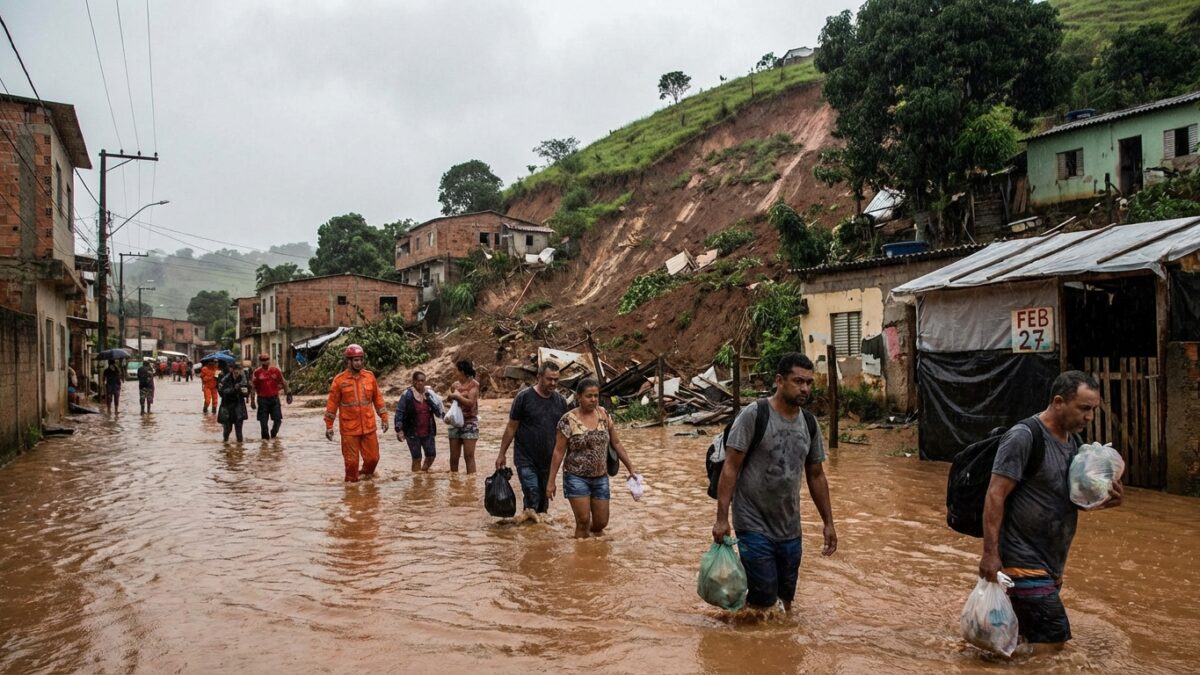
Catastrophic floods and landslides swept through the Zona da Mata region of Minas Gerais state in southeastern Brazil on February 27, 2026, killing at least 70 people and displacing thousands in one of the country’s deadliest natural disasters in recent years. The disaster struck as heavy rains overwhelmed drainage systems and triggered mudslides that buried homes, destroyed roads, and isolated entire communities from emergency services. The Brazilian government declared a state of emergency and deployed military rescue teams to the affected areas. (Source: Wikipedia)
The Scale of Destruction
The Zona da Mata region, named for the Atlantic Forest that once covered the area, is characterized by hilly terrain that is particularly vulnerable to landslides during heavy rainfall. Multiple municipalities were affected, with some communities completely cut off as roads and bridges were destroyed. Rescue operations were hampered by ongoing rain, unstable terrain, and the remoteness of many affected areas. Brazilian civil defense authorities warned that the death toll could rise as rescue teams reached isolated communities.
President Luiz Inacio Lula da Silva visited the affected region and pledged federal assistance for rebuilding. The disaster follows a pattern of increasingly severe flooding events across Brazil, including catastrophic floods in Rio Grande do Sul in 2024 that killed over 180 people and displaced hundreds of thousands. Climate scientists have linked the increasing frequency and intensity of these events to rising global temperatures, which increase atmospheric moisture content and alter precipitation patterns in ways that amplify extreme rainfall. (Source: Wikipedia)
Climate Context
Brazil has experienced a series of devastating climate-related disasters in recent years that have challenged the country’s infrastructure and emergency response capabilities. The Atlantic Forest region, of which Zona da Mata is a part, has lost more than 85 percent of its original tree cover to agriculture and urbanization, reducing the landscape’s natural ability to absorb rainfall and prevent erosion. Reforestation programs have struggled to keep pace with continued deforestation pressure.
The disaster occurred on the same day that Pakistan launched airstrikes on Afghanistan, meaning it received minimal international media attention despite its severity. This pattern of climate disasters being overshadowed by geopolitical events reflects a broader challenge in maintaining public attention on the slow-building crisis of climate change amid the urgent demands of military conflicts and political upheaval.
Infrastructure and Prevention
Engineers and urban planners have identified systematic failures in land use planning and infrastructure maintenance that contribute to the recurring flood disasters. Many communities in Brazilian hill regions have expanded into areas prone to landslides, driven by housing shortages and economic pressure. Drainage systems designed for historical rainfall patterns are inadequate for the more intense storms that climate change is delivering. The cost of retrofitting infrastructure to withstand current conditions is enormous, but the cost of inaction, measured in lives lost and communities destroyed, is proving even greater. (Source: Wikipedia)
For the families in Minas Gerais mourning loved ones and surveying the ruins of their homes, the scientific debates about climate attribution are secondary to the immediate need for shelter, clean water, and the resources to rebuild. The Brazilian government’s response will be measured not just by the speed of rescue operations but by the longer-term investments in infrastructure, land use planning, and climate adaptation that could prevent future tragedies of this scale.
The disaster follows a devastating pattern. Rio Grande do Sul experienced catastrophic flooding in 2024 that killed over 180 people and displaced hundreds of thousands, demonstrating that Brazil’s current infrastructure and emergency response capabilities are inadequate for the increasingly severe weather events that climate change is delivering. The Atlantic Forest region, which includes Zona da Mata, has lost more than 85 percent of its original tree cover, reducing the landscape’s natural capacity to absorb rainfall and prevent erosion. Reforestation programs have not kept pace with continued deforestation pressure from agricultural expansion. (Source: Wikipedia)
Climate scientists have established clear links between rising global temperatures and the increasing intensity of precipitation events in tropical regions. Warmer atmosphere holds more moisture, leading to heavier rainfall when storms do occur. The combination of deforested hillsides, inadequate drainage infrastructure designed for historical rainfall patterns, and communities that have expanded into landslide-prone areas creates conditions where each major storm has the potential to become a catastrophe. For Brazil’s government, the challenge is not merely responding to individual disasters but fundamentally redesigning land use, infrastructure, and emergency systems for a climate that no longer matches the assumptions on which existing systems were built. (Source: Wikipedia)
International attention to the Zona da Mata disaster was minimal because it occurred on the same day Pakistan launched airstrikes against Afghanistan and as the Iran conflict dominated news cycles. This pattern of climate disasters being overshadowed by geopolitical events is itself a concern, as it reduces the political pressure for the kind of sustained investment in adaptation and prevention that could save lives in future events. For Brazilian officials, the challenge is maintaining public attention and funding commitment for infrastructure improvements during quiet periods rather than only responding after catastrophe strikes. (Source: Wikipedia)