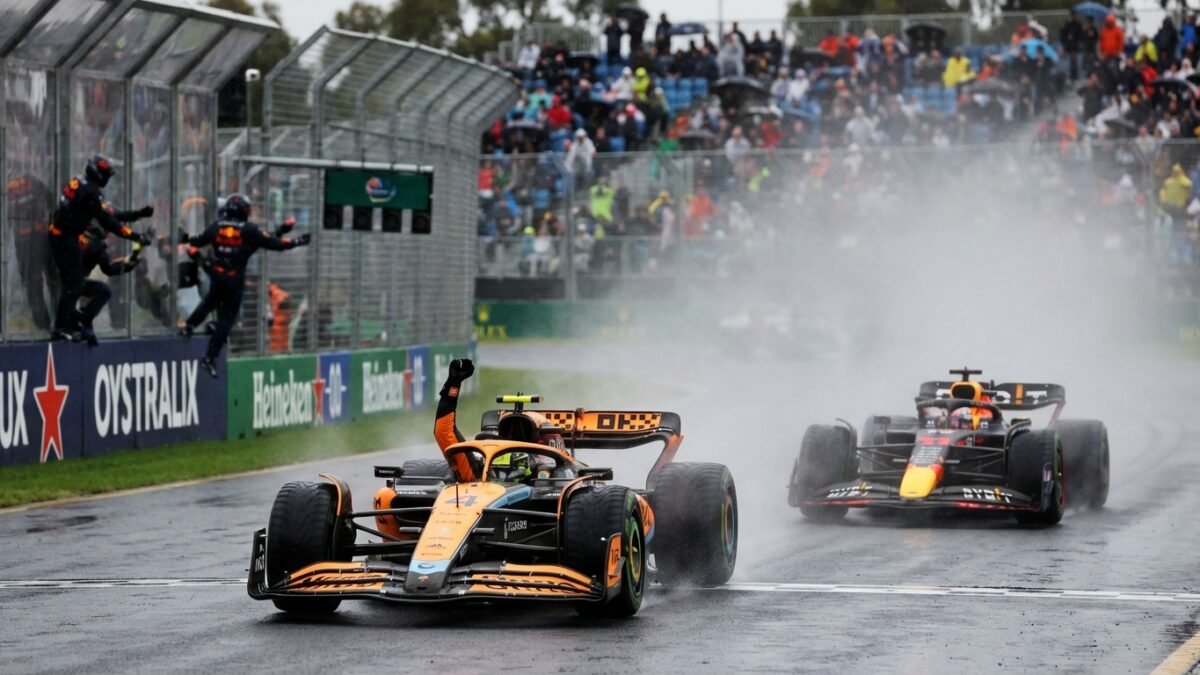
Lando Norris emerged from a wild, rain-disrupted Australian Grand Prix on March 8 to win the opening race of the 2026 Formula One season at Melbourne’s Albert Park Circuit, laying down an early title marker in a race that delivered on the promise of the sport’s sweeping new technical regulations. Red Bull’s Max Verstappen finished second, with Mercedes’ George Russell completing the podium in what proved to be one of the most dramatic season-opening races in recent memory. (Source: ESPN; Formula1.com)
Chaos in the Rain
The race was defined by changing conditions that tested the adaptability of the radically redesigned 2026 cars. Rain arrived mid-race, creating treacherous conditions that caught several drivers off guard. On lap 44, Norris ran through the gravel ahead of the penultimate corner before his McLaren teammate Oscar Piastri followed him off the road and onto the grass. While Piastri recovered only to finish ninth, Norris, even with a damaged car, held off Verstappen by just 0.8 seconds to claim a nail-biting victory. (Source: ESPN)
Mercedes rookie Kimi Antonelli finished an impressive fourth in his debut race for the team, one place ahead of Lewis Hamilton, who started eighth and finished tenth in a disappointing first outing for Ferrari. The seven-time champion’s struggles highlighted the adjustment challenges of the new regulations, which have fundamentally changed how the cars behave, particularly in wet conditions where the active aerodynamic elements must adapt in real-time to varying grip levels. (Source: ESPN)
The New Regulations in Action
The 2026 technical regulations, the most significant overhaul since the ground-effect era began in 2022, delivered on their promise of closer racing and more unpredictable outcomes. The active aerodynamic elements, increased electrical power components, and revised dimensions produced cars that behaved differently from anything drivers had previously experienced. Teams that excelled in pre-season testing found the dynamic conditions of a real race far more challenging than controlled test sessions. (Source: Formula1.com; Wikipedia)
Cadillac, making its Formula 1 debut as the eleventh team on the grid, showed competitive pace in its first race, finishing both cars inside the points. The American manufacturer’s entry, backed by General Motors, represented the most significant new team debut since Haas in 2016. Audi’s transformation of the former Sauber operation also showed promise, though both new entries acknowledged significant development work remains ahead. (Source: Wikipedia)
Championship Implications
Norris’s victory extended his reputation as a driver who thrives in chaotic conditions and established McLaren as the early pace-setters for the 2026 championship. Verstappen’s second place confirmed that Red Bull remains competitive under the new regulations, while Mercedes’ strong showing with both Russell and Antonelli suggests a genuine three-way title fight may be developing. Ferrari’s struggles are likely temporary rather than fundamental, with the team possessing the resources and talent to develop its way to competitiveness as the season progresses. (Source: ESPN; Formula1.com)
With 23 races remaining across six continents, the 2026 championship promises to be one of the most competitive in the sport’s history. The combination of new regulations, new teams, and new driver pairings has created a level of unpredictability that the sport has been seeking for years, and Melbourne’s dramatic opener suggests the promise may be fulfilled. (Source: Formula1.com)
The new regulations’ impact on racing was immediately visible. Cars behaved differently in wet conditions than anything drivers had previously experienced, with the active aerodynamic elements requiring real-time adaptation to varying grip levels. Teams that had excelled in controlled testing conditions found the unpredictability of a real race far more challenging. The increased electrical component of the hybrid power units added a new strategic dimension, with energy management decisions affecting not just speed but battery preservation and regeneration across the race distance. (Source: ESPN; Formula1.com)
The weekend also marked the debut of both Formula 2 and Formula 3 on the 2026 calendar, with feeder series races providing a full program of open-wheel racing alongside the main event. The FIA’s updated scrutineering procedures for active aerodynamic components received their first real-world test, with several teams requiring adjustments during Friday practice to comply with the new rules. For the 24 races that follow Melbourne on the 2026 calendar, the opening round has established that unpredictability and close racing are genuine features of the new regulations rather than testing anomalies, validating the multi-year development effort that produced the 2026 rule set. (Source: Formula1.com; Wikipedia)
Hamilton’s struggles at Ferrari were the weekend’s most discussed storyline. The seven-time champion started eighth after a difficult qualifying session and finished only tenth, raising questions about how quickly he can adapt to a fundamentally different car after 12 years at Mercedes. Ferrari team principal Fred Vasseur urged patience, noting that the new regulations demand a learning process that cannot be rushed. The competitive picture will become clearer over the next several races as teams bring upgrades and drivers accumulate experience with the new car behavior. (Source: ESPN; Formula1.com)
The weekend also provided the first competitive data on how Cadillac and Audi, the two new constructor entries, perform against established teams. Both newcomers finished races and scored points, a strong debut given the complexity of the new regulations and the challenge of competing against organizations with decades of Formula 1 experience and engineering infrastructure.