
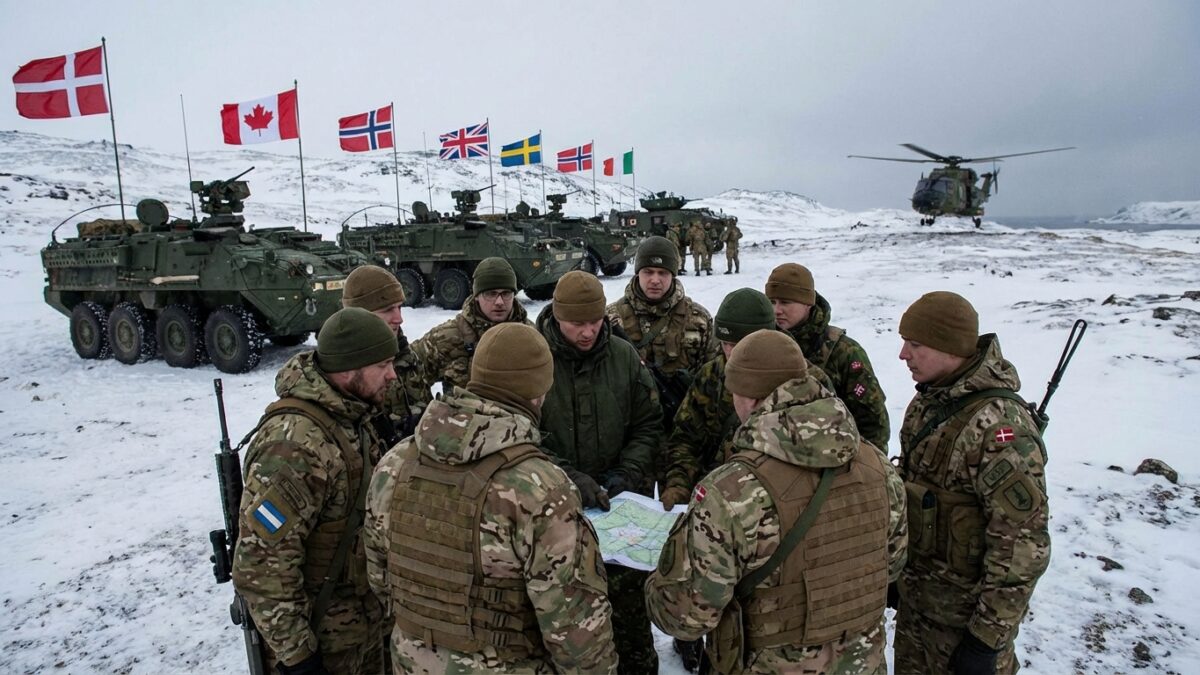
Denmark’s year-long military exercise in Greenland, known as Operation Arctic Endurance, has grown into one of the most consequential European defense operations of the decade, deploying troops from at least eight NATO nations to the world’s largest island in a carefully calibrated response to President Trump’s repeated threats to acquire the territory. The operation, which began in January 2026 and is scheduled to continue throughout the year, walks a diplomatic tightrope: demonstrating European solidarity and Arctic defense capability while avoiding open confrontation with the United States, a fellow NATO ally. (Source: Danish Defence Command)
The Trump Catalyst
President Trump has repeatedly expressed interest in the United States acquiring Greenland, an autonomous territory of the Kingdom of Denmark, citing its strategic importance in the Arctic and its vast mineral resources. In January 2026, Trump announced an additional 10 percent tariff on Denmark, the UK, and six other European countries whose troops deployed to Greenland, threatening to increase the tariff to 25 percent by June. He described the deployment as a very dangerous situation and said the tariffs would apply until a deal was reached for the complete and total purchase of Greenland. (Source: UK House of Commons Library)
Greenlandic Prime Minister Jens-Frederik Nielsen responded emphatically, stating that if Greenland had to choose between the United States and Denmark, it chose Denmark. French Foreign Minister Jean-Noel Barrot declared that no intimidation nor threat would influence European nations. The eight participating countries, Denmark, France, Germany, Sweden, Norway, the Netherlands, Finland, and the United Kingdom, issued a joint statement affirming their solidarity with the Kingdom of Denmark and the people of Greenland. (Source: Chicago Council on Global Affairs; French Foreign Ministry)
The Military Footprint
Denmark had approximately 150 troops stationed in Greenland before the operation began, primarily under the Joint Arctic Command. Major-General Soren Andersen, commander of JACMD, confirmed that an additional 100 soldiers arrived in Nuuk in mid-January, with similar numbers deployed in Kangerlussuaq. The troops brought a contingency stock of live ammunition. The Danish air defense frigate HDMS Peter Willemoes joined the naval component, and the French frigate Bretagne participated in exercises near Iceland. (Source: Danish Defence; Wikipedia)
France sent up to 15 soldiers drawn from the 27th Mountain Infantry Brigade. President Macron said an initial team was already on site and would be reinforced by land, air, and sea. Germany, Sweden, Norway, Finland, the Netherlands, and Belgium all contributed reconnaissance teams or planning personnel, while Estonia suggested mobilizing five to ten military personnel if requested. Marc Jacobsen of the Royal Danish Defence College noted that the exercise both deters rash action and answers Washington’s criticisms of Danish defense spending. (Source: Danish Defence; EU Perspectives)
The Tripwire Logic
Outside analysts have described the European deployment as functioning as a tripwire force, similar in concept to the small allied garrisons that defended West Berlin during the Cold War. The troops cannot repel a full-scale military operation, but their presence means that any aggressive action against Greenland would involve attacks on soldiers from multiple NATO nations, dramatically raising the political cost of any such move. The Chicago Council on Global Affairs observed that in deploying troops, Europeans are handing the president a gift: a pretense for backing down, since both sides could claim victory. (Source: Chicago Council on Global Affairs; EU Perspectives)
Italy notably refused to participate after being asked by Denmark. Prime Minister Giorgia Meloni stated that the operation must be conducted within the NATO framework and with U.S. involvement, adding that it must not be perceived as hostile toward the United States. Luxembourg similarly declined to send troops while supporting the operation politically. (Source: Wikipedia)
Arctic Security and the Broader Picture
The operation addresses genuine Arctic security concerns beyond the Trump dispute. The Danish Defence Command stated that the exercise aims to strengthen NATO’s ability to operate in Arctic conditions, protect critical infrastructure, and maintain readiness against Russian activity in the region. Climate change is opening new shipping lanes and exposing resources that are attracting attention from Russia, China, and commercial interests worldwide. Denmark’s deputy prime minister said the goal is to establish a more permanent military presence with a larger Danish contribution. (Source: Danish Defence; Bloomberg)
The operation has been integrated into the broader NATO framework under the name Arctic Sentry as of February 2026, providing institutional cover while maintaining Denmark’s operational leadership. For the soldiers training in temperatures well below freezing on the Greenlandic ice sheet, the diplomatic complexities are secondary to the immediate challenge of operating in one of the most demanding environments on Earth. For the alliance they serve, Operation Arctic Endurance represents a test of whether European nations can defend their sovereignty while managing the most unpredictable American president in NATO’s 77-year history. (Source: Danish Defence)
The operation extends well beyond symbolic deployment. Danish soldiers from the Engineer Regiment and the Jutland Dragoon Regiment trained in critical infrastructure protection, winter warfare, and patrol operations in both Nuuk and Kangerlussuaq. Sweden sent Air Force Rangers specializing in counter-special forces operations and combat search and rescue, while the French contingent from the 27th Mountain Infantry Brigade brought alpine warfare expertise. The Danish Defence leased a hotel ship to accommodate international soldiers without overstressing civilian infrastructure in Nuuk, a city of only 19,000 residents. (Source: Danish Defence)
In February 2026, the Danish-led exercise was folded into the NATO framework under the name Arctic Sentry, providing institutional cover while maintaining Denmark’s operational leadership. The Danish Jaeger Corps’ newly developed Arctic Specialists capability proved its value in operations across high-alpine terrain in northeast Greenland, areas that are among the most inaccessible in the world. Seahawk helicopters deployed specialists to remote locations for the first time. For the alliance, Arctic Endurance demonstrates that European nations can organize and execute complex multinational military operations quickly when their sovereignty is at stake, a capability that may prove as valuable for future European security challenges as it is for the immediate Greenland situation. (Source: Danish Defence)