
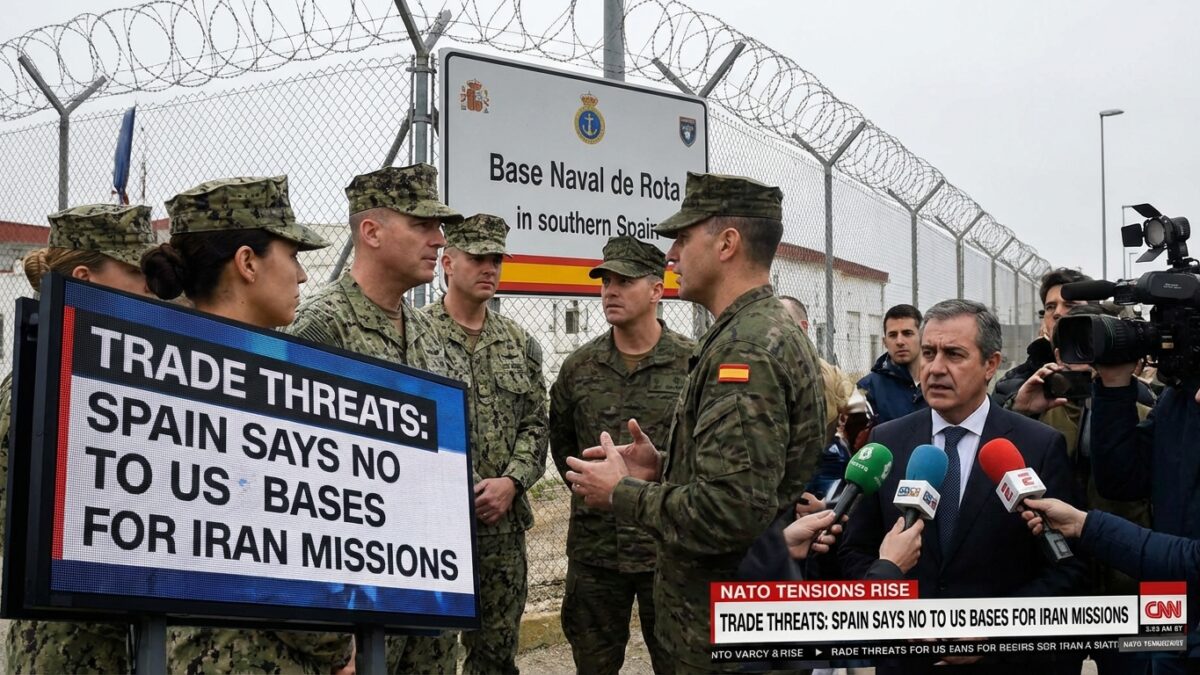
Spain’s decision to deny the United States access to its military bases for operations against Iran has escalated into a full diplomatic confrontation, with President Trump threatening to cut off trade with the NATO ally and Spanish Prime Minister Pedro Sanchez responding with a defiant no to war message. The dispute highlights deepening fractures within NATO as the Iran conflict forces alliance members to choose between supporting American military operations and their own populations’ opposition to the war. (Source: CNBC; CBS News)
The Base Access Dispute
Spain hosts several U.S. military installations, including Naval Station Rota, which supports the Sixth Fleet and provides a critical logistics hub for Mediterranean and Middle Eastern operations. The Spanish government’s refusal to allow these facilities to be used for Iran operations represents one of the most significant bilateral military disagreements between NATO allies since France’s opposition to the 2003 Iraq War. Sanchez framed the decision as a matter of principle, stating that Spain would not participate in a war that it believes lacks adequate legal justification and UN authorization.
Trump’s response was immediate and characteristically blunt. While addressing reporters alongside German Chancellor Friedrich Merz, Trump praised the response of some European nations to the strikes but singled out Spain for criticism. The president threatened tariffs and trade restrictions, adding Spain to the growing list of allies facing economic pressure from the administration over defense and foreign policy disagreements. (Source: CNBC)
NATO’s Stress Test
The Spain dispute is the most visible manifestation of a broader NATO tension. France authorized the U.S. to use French bases and sent its aircraft carrier toward the Mediterranean. The United Kingdom permitted use of British bases for defensive purposes. Germany has supported the operations diplomatically while navigating domestic opposition. But other alliance members, including Turkey and several Eastern European nations, have expressed reservations about the scope and justification of the military campaign. (Source: CNN; CBS News)
The situation is particularly awkward because the Iran operation was not undertaken under NATO auspices. Article 5, the alliance’s collective defense provision, was not invoked, meaning member nations have no treaty obligation to participate. The U.S. relied instead on bilateral agreements and the goodwill of individual allies, making each country’s decision to cooperate or refuse a matter of sovereign choice rather than alliance commitment.
Domestic Politics
Sanchez faces strong domestic opposition to the war from a Spanish public that vividly remembers the political fallout from Spain’s participation in the Iraq War. The 2004 Madrid train bombings, which killed 193 people and were claimed by al-Qaeda in retaliation for Spain’s Iraq involvement, remain a defining moment in Spanish national consciousness. The subsequent election, which swept Sanchez’s predecessor from power, demonstrated the political risks of joining American-led Middle Eastern military campaigns. (Source: CNBC)
The tariff threat adds economic pressure to an already complex situation. Trump had previously imposed a 10 percent tariff on countries participating in Operation Arctic Endurance in Greenland, demonstrating his willingness to weaponize trade policy against allies. Spain’s economy, still recovering from pandemic-era disruption, is vulnerable to trade restrictions that could affect its automotive, agricultural, and tourism sectors. For NATO as an institution, the Spain dispute raises fundamental questions about alliance cohesion when a member state undertakes military operations that other members consider illegitimate. (Source: CNBC; UK House of Commons Library)
The diplomatic fallout from Spain’s refusal extends beyond bilateral relations. Other European NATO members face similar domestic opposition to the war and are watching how the U.S. responds to Spain’s decision. If Trump follows through on trade threats, it could deter other allies from refusing future American requests, effectively establishing an economic enforcement mechanism for military cooperation that has no precedent in NATO’s history. Conversely, if Spain faces no meaningful consequences, other allies may feel empowered to set their own boundaries on military cooperation. (Source: CNBC; CBS News)
The dispute also affects NATO’s operational planning. If member states begin selectively refusing base access based on domestic political considerations, the alliance’s ability to project power globally is significantly constrained. The U.S. military has relied on a network of bases across Europe and the Middle East to support operations since the Cold War, and any erosion of access to that infrastructure forces costly and time-consuming adjustments to logistics, force projection, and contingency planning. For NATO’s institutional leadership, the challenge is preserving alliance cohesion while respecting member sovereignty, a balance that the Iran conflict has made more difficult than at any point since the 2003 Iraq War fractured European unity. (Source: CNBC)
For Sanchez, the political calculation involves weighing Trump’s economic pressure against domestic political survival. Spanish public opposition to Middle Eastern military intervention is deeply rooted in the national trauma of the 2004 Madrid train bombings, which killed 193 people and were claimed by al-Qaeda in retaliation for Spain’s Iraq War participation. The subsequent election that swept Sanchez’s predecessor from power demonstrated the political costs of joining American-led military campaigns in the region. (Source: CNBC)