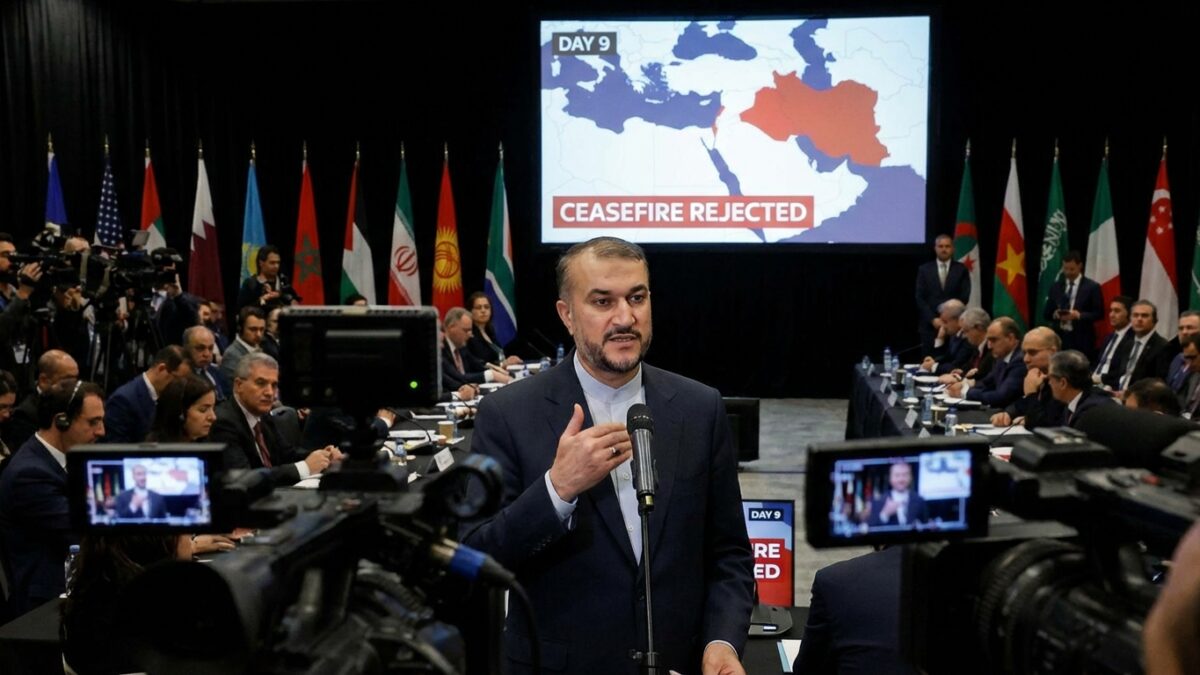
Iran’s Foreign Minister Abbas Araghchi publicly rejected all calls for a ceasefire on March 8, telling NBC News’ Meet the Press that Iran needs to continue fighting for the sake of our people as the war entered its ninth day with no diplomatic off-ramp in sight. The death toll has surpassed 1,200 in Iran, with at least 400 killed in Lebanon and six U.S. service members dead. Araghchi insisted that only a permanent end to the war, not a temporary ceasefire, would be acceptable, citing the failure of last year’s Twelve-Day War ceasefire as evidence that temporary truces do not work. (Source: NBC News; The National)
Araghchi’s Defiance
Speaking from Tehran amid ongoing U.S. and Israeli bombardment, Araghchi accused Washington and Tel Aviv of killing girl students and attacking hospitals. He pointedly referenced the ceasefire that ended the June 2025 Twelve-Day War, saying Israel and the U.S. had shattered that agreement and launched the current campaign during active nuclear negotiations. When pressed about conditions for ending the war, Araghchi said Iran would not even consider a ceasefire until the U.S. and Israel justified their aggression. He dismissed Trump’s claims that Iran was developing missiles capable of reaching the United States as misinformation, stating there is no evidence, no intelligence, nothing to indicate that. (Source: NBC News; The National)
In a separate interview with NBC Nightly News anchor Tom Llamas, Araghchi expressed confidence that Iran could withstand a ground invasion, while refusing any negotiations with the United States. He pointed to the 171 children killed in the Minab school strike and attributed responsibility squarely to U.S. and Israeli forces. His defiant tone reflected a government that appears to have calculated that resistance, rather than diplomacy, offers its best path to survival. (Source: NBC News)
Russia’s Role Emerges
In a significant escalation of the conflict’s geopolitical dimensions, four sources told NBC News on March 7 that Russia was providing intelligence to Iran on the location of U.S. military assets in the region. When pressed about Russian support on Meet the Press, Araghchi confirmed that Russia was helping Iran in many different directions, though he declined to specify the nature of the assistance. The revelation raises the specter of a proxy dimension to the conflict that extends far beyond the Middle East, with Russia potentially using the war to complicate American military operations while avoiding direct confrontation. (Source: NBC News)
The widening scope of Iranian retaliation continued to draw in countries across the region. Bahrain accused Iran of damaging a desalination plant. Kuwait said drones targeted fuel tanks at its international airport and declared force majeure on crude oil production. Saudi Arabia reported its first war fatalities after a projectile struck a residential area. Iran launched strikes against Azerbaijan for the first time, which Iran denied but which Azerbaijan condemned and said it reserved the right to retaliate against. (Source: NCRI; Reuters)
The Humanitarian Toll
The Iranian Red Crescent Society reported that at least 1,230 people had been killed in Iran by March 8, though the actual number is believed significantly higher due to disrupted communications and overwhelmed medical facilities. UNICEF confirmed at least 181 children among the dead. The WHO reported fatalities across multiple countries: approximately 400 in Lebanon, 11 in Israel, and dozens more across Gulf states. Israel announced its first soldier deaths of the war in southern Lebanon. Lebanon’s displacement crisis has reached catastrophic proportions, with over 517,000 people fleeing their homes. (Source: Al Jazeera; Democracy Now!)
Israeli strikes set major fuel storage facilities ablaze in and around Tehran, producing thick black smoke that Iranian officials warned could cause acid rain and toxic air contamination. Iran’s Foreign Ministry spokesman described the attacks on petroleum infrastructure as intentional chemical warfare. The strikes hit residential buildings, parking structures, petrol stations, and schools across at least 174 Iranian cities. (Source: NCRI; Al Jazeera)
Military Escalation
Israel’s military chief announced the country was moving to the next phase of the war after carrying out 2,500 strikes with more than 6,000 weapons. Israeli forces launched a ground offensive into Lebanon, capturing positions along the border and issuing evacuation orders covering entire neighborhoods of southern Beirut home to more than half a million people. The U.S. military said it was using a number of new capabilities in its campaign, with Defense Secretary Pete Hegseth warning that the escalation had only just begun. The Center for Strategic and International Studies estimated the first 100 hours cost the U.S. $3.7 billion. (Source: CNN; CSIS)
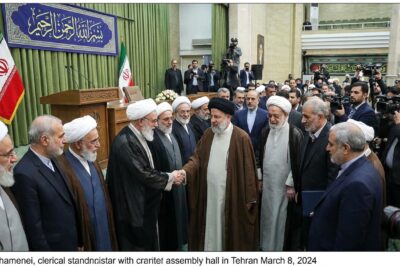
For the region’s civilian populations, the ninth day of war brought no hope of respite. With Araghchi’s rejection of any ceasefire and Trump’s insistence that Iran’s military and leaders must be wiped out, the diplomatic space for ending the conflict has effectively collapsed. The appointment of Mojtaba Khamenei as supreme leader signals institutional continuity rather than a desire for compromise. The world watches as the most destructive Middle Eastern conflict in decades grinds on with no end in sight.
The diplomatic vacuum remains the conflict’s most dangerous feature. With Araghchi rejecting all ceasefire proposals and insisting that Iran would only consider a permanent end to the war, and Trump demanding involvement in choosing Iran’s next leader while threatening that Mojtaba Khamenei would not last long, the space for negotiation has effectively collapsed. Qatar, which had served as a key mediator during previous rounds of Iran-U.S. tensions, saw its own infrastructure targeted by Iranian drones, complicating its ability to play a neutral role. Gulf states that might normally facilitate back-channel diplomacy are themselves under attack, leaving no credible intermediary capable of bridging the divide between parties who appear more committed to escalation than resolution. (Source: NBC News; The National)