
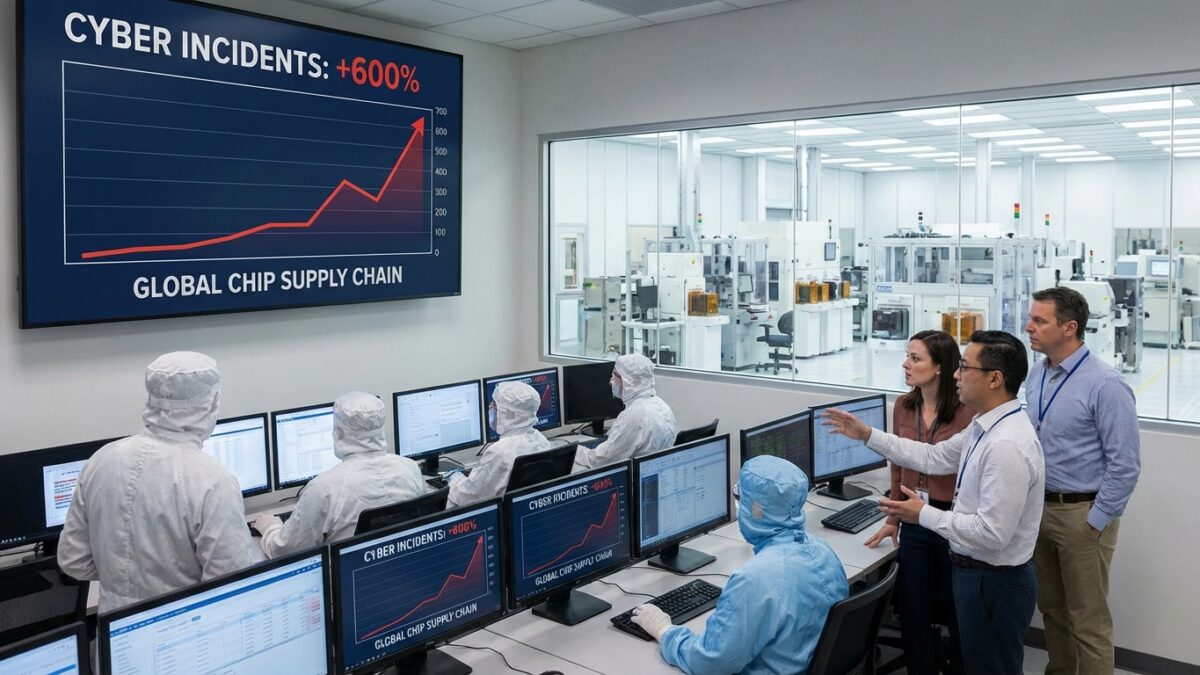
The global semiconductor industry, the backbone of virtually every modern technology from smartphones to military systems, is facing an unprecedented surge in ransomware attacks that has exposed critical vulnerabilities in the chip supply chain and prompted urgent calls for a rethinking of how the industry approaches cybersecurity.
Cyberattacks targeting semiconductor companies and their suppliers have increased roughly 600 percent since 2022, according to multiple industry analyses, with the frequency and sophistication of attacks accelerating sharply in 2025 and early 2026. The most recent high-profile incident involved Japanese semiconductor testing equipment maker Advantest, which disclosed a breach on February 15, 2026, joining a growing list of chip industry victims that includes TSMC, Applied Materials, and numerous smaller firms in the supply chain. (Sources: Dragos, SecurityWeek, Advantest)
Why Semiconductors Are a Prime Target
The semiconductor supply chain represents an extraordinarily attractive target for cybercriminals and state-sponsored threat actors alike. The industry operates on just-in-time manufacturing principles with extremely long lead times, meaning that even a brief disruption can cascade into months of production delays. The intellectual property stored in chip design files is enormously valuable, and the industry’s complex global supply chain creates numerous potential points of entry for attackers.
The concentration of advanced chip manufacturing, with TSMC alone producing more than 90 percent of the world’s most advanced semiconductors, means that a successful attack on a single chokepoint could have outsized effects on global technology production. This vulnerability has not been lost on geopolitical rivals, with cybersecurity firms tracking sustained campaigns attributed to state-sponsored groups targeting semiconductor intellectual property. (Source: Mandiant)
The CHIPS Act Security Gap
The U.S. CHIPS and Science Act allocated $52.7 billion to revitalize domestic semiconductor manufacturing, but cybersecurity experts have pointed out a significant gap in the legislation’s approach to supply chain security. Only approximately $500 million has been directed specifically toward supply chain security measures, and that funding is administered through the State Department rather than being integrated into the domestic industrial base defense strategy. (Source: CHIPS Act analysis, Semiconductor Industry Association)
This gap has drawn criticism from cybersecurity professionals who argue that building new fabrication facilities without adequately securing the digital infrastructure that supports them is building on a foundation of sand. The industry’s reliance on legacy operational technology systems, many of which were designed without modern security considerations, creates additional exposure.
The Attack Surface Expands
Modern semiconductor manufacturing facilities, known as fabs, are among the most automated industrial environments on Earth, with thousands of interconnected systems controlling everything from photolithography processes to chemical deposition and wafer handling. The convergence of information technology and operational technology in these environments creates an expansive attack surface that traditional IT security tools are not equipped to protect.
Industrial cybersecurity firm Dragos has documented a marked increase in threat groups specifically targeting semiconductor manufacturing operations, noting that attackers are increasingly moving beyond traditional ransomware to target the operational technology systems that control production processes. A successful attack on these systems could not only halt production but potentially cause physical damage to multi-billion-dollar equipment. (Source: Dragos)
Industry Response
The Semiconductor Equipment and Materials International organization has been developing cybersecurity guidelines specific to the semiconductor manufacturing environment, recognizing that generic IT security frameworks are insufficient for the industry’s unique operational requirements. Major chip manufacturers have significantly increased their cybersecurity spending, with some firms doubling or tripling their security budgets since 2023.
International coordination is also intensifying. The United States, Japan, South Korea, and the Netherlands, home to the most critical nodes in the global semiconductor supply chain, have established bilateral and multilateral frameworks for sharing threat intelligence and coordinating incident response. (Source: SEMI)
But experts warn that the industry’s security posture remains inadequate relative to the threat. As geopolitical tensions elevate semiconductors to the status of strategic assets alongside energy and food, the question of who protects the chip supply chain and how is no longer just a technology question. It is a matter of national and economic security.
Geopolitical Dimensions
The cybersecurity challenge is inseparable from the geopolitical context in which the semiconductor industry operates. The concentration of advanced manufacturing capacity in a small number of countries, particularly Taiwan, South Korea, and increasingly the United States, makes these facilities attractive targets for state-sponsored cyber operations. Intelligence agencies have warned that adversarial nations view chip manufacturing disruption as a potential asymmetric warfare capability.
The current conflict with Iran has added another dimension to these concerns, as Iranian-linked cyber groups have historically targeted critical infrastructure in retaliation for military and economic pressure. While no specific semiconductor-related attacks have been attributed to Iranian actors in the current crisis, cybersecurity firms have raised alert levels and are monitoring for potential retaliatory operations targeting technology supply chains. (Source: CISA)