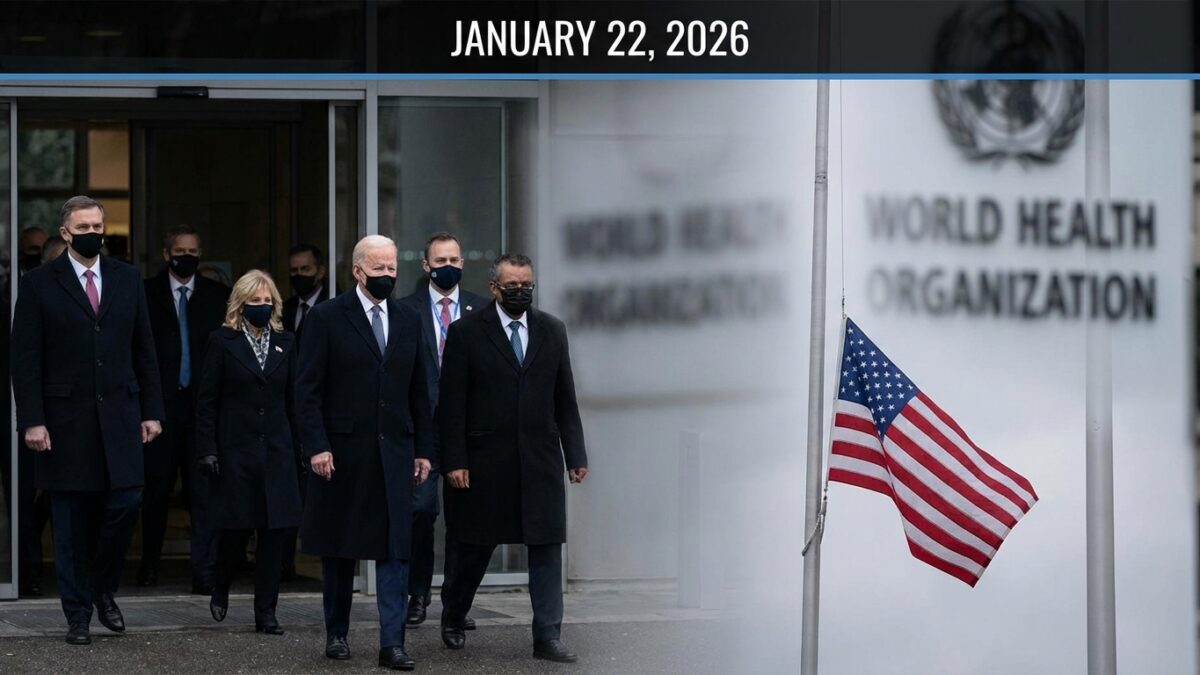
The United States formally completed its withdrawal from the World Health Organization on January 22, 2026, becoming the most significant nation to ever leave the 78-year-old body and creating a funding and leadership vacuum that experts warn could undermine decades of progress in fighting infectious disease, managing pandemics, and coordinating international health responses. (Source: U.S. Department of Health and Human Services)
The Final Step
The withdrawal fulfilled Executive Order 14155, signed by President Trump on his first day in office on January 20, 2025, which initiated a one-year notice period required under the terms of U.S. membership. Health and Human Services Secretary Robert F. Kennedy Jr. and Secretary of State Marco Rubio issued a joint statement citing the WHO’s mishandling of the COVID-19 pandemic, its failure to adopt reforms, and its inability to demonstrate independence from political influence of member states. (Source: CDC)
All U.S. government funding to the WHO has been terminated, and personnel and contractors who had been assigned to or embedded with the organization worldwide have been recalled. The withdrawal places the United States alongside Liechtenstein as the only UN member countries not in the WHO. (Source: Science/AAAS)
A Year of Health Policy Upheaval
The exit caps a turbulent year of health policy changes under the Trump administration. In January 2026, the U.S. government reduced its list of recommended vaccines from 17 to 11, removing universal recommendations for hepatitis A and B, influenza, meningococcal disease, and chickenpox while keeping polio, measles, mumps, rubella, diphtheria, and tetanus. The administration cited Denmark’s 10-vaccine schedule as a model, though critics argued that health policy cannot be transplanted between countries with different disease profiles. (Source: Euronews)
The Agency for International Development, which channeled much of America’s $71.9 billion in annual foreign aid to 209 countries, was shuttered entirely on Trump’s orders. The combined effect of the WHO withdrawal and USAID closure has left massive gaps in global health infrastructure.
Financial and Strategic Consequences
The U.S. has historically been the WHO’s largest funder, contributing between $160 million and $815 million annually through assessed and voluntary contributions. Michael Osterholm, director of the Center for Infectious Disease Research and Policy at the University of Minnesota, called the withdrawal one of the most penny-wise and billion-dollar-foolish moves imaginable. (Source: TIME)
Shortly after the withdrawal, the Trump administration proposed spending $2 billion per year to duplicate the kinds of global disease surveillance systems it had helped build and accessed at a fraction of that cost through its WHO membership, raising questions about the fiscal logic of the decision. (Source: Wikipedia)
Judd Walson, chair of international health at the Johns Hopkins Bloomberg School of Public Health, warned that the absence of the U.S. creates room for countries like India, Saudi Arabia, Russia, and China to exert more influence over global health priorities and policy guidelines. (Source: TIME)
Impact on Disease Programs
The WHO budget has already undergone significant revisions. Director-General Tedros Adhanom Ghebreyesus implemented a recruitment freeze, reductions in travel, mandatory virtual meetings, and limits on technical support missions to countries shortly after the withdrawal announcement. The Doctors Without Borders organization warned of life-threatening consequences for humanitarian efforts and global health coordination. (Source: Wikipedia/Executive Order 14155)
Experts are particularly concerned about the impact on polio eradication efforts, childhood immunization programs, and pandemic preparedness. The WHO’s Expanded Program on Immunization, supported by billions of dollars from USAID since 1985, helped raise global childhood immunization levels to 80 percent by the early 1990s. Without sustained U.S. support, those gains are now at risk. (Source: The Conversation)
A Door Left Open
Ghebreyesus has signaled that the WHO remains open to working with the United States and hopes the country will reconsider. The American flag continues to fly outside WHO headquarters in Geneva, a deliberate gesture of continued openness. Whether a future administration will seek to rejoin remains an open question, but for now, the world’s most powerful country stands outside the global health system it helped create.
Cascading Effects on Research
The withdrawal has particularly alarmed the biomedical research community. The NIH, which funds approximately $47 billion in annual medical research, has already implemented significant policy changes under Kennedy’s HHS leadership, including signals that it will deemphasize studying both sexes in clinical research. Given that females have historically been understudied, experts worry this will widen existing knowledge gaps.
International research collaborations that relied on WHO coordination are scrambling to establish alternative frameworks. The WHO’s Global Influenza Surveillance and Response System, which monitors flu strains worldwide to inform vaccine composition, has lost its most significant contributor. The timing is concerning given ongoing H5N1 avian influenza outbreaks in U.S. dairy cattle and poultry that have caused 71 human cases and two deaths since 2024.
Public health scholars at Georgetown University’s O’Neill Institute have warned that the U.S. will now need to negotiate bilateral agreements with individual countries for disease data sharing, a process that is slower, more expensive, and less comprehensive than multilateral collaboration through the WHO. The proposed $2 billion annual spending on duplicative surveillance has been criticized as vastly insufficient to replace the global network built over seven decades of membership.
For the 194 remaining WHO member states, the challenge is both financial and structural. The organization must find new funding sources while maintaining the technical capacity that has made it the world’s primary coordinator for disease outbreaks, vaccination campaigns, and health emergencies. Whether China, India, and other nations can fill the leadership void remains one of the most consequential questions in global health governance.