
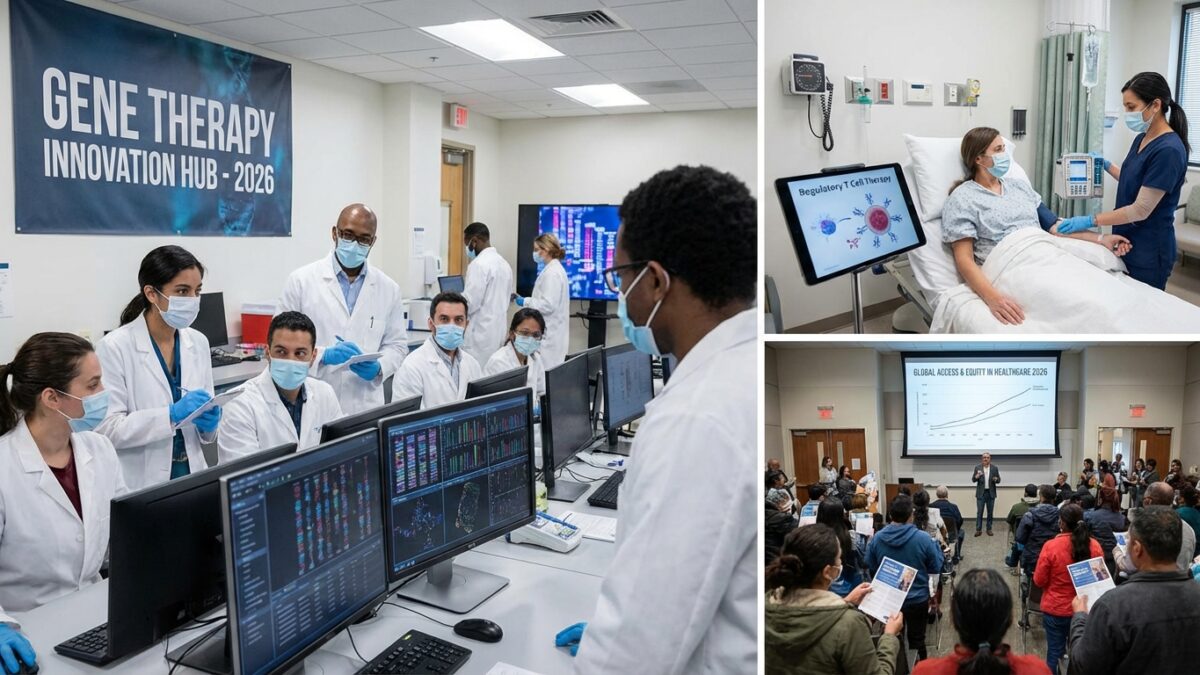
The promise of treating disease at its genetic roots is rapidly becoming reality in 2026, as CRISPR-based gene therapies advance from one-size-fits-all treatments to truly personalized interventions designed for individual patients. With regulatory milestones approaching, clinical trials expanding, and new AI tools accelerating development timelines, the field stands at an inflection point that could transform how medicine approaches everything from rare genetic disorders to cancer. (Source: Scientific American)
From Breakthrough to Bedside
The groundwork for this moment was laid in 2025, when a six-year-old child named KJ Muldoon became the first person to receive a fully personalized CRISPR treatment, dramatically reducing his need for medication and proving that individualized genetic medicine is achievable. The two CRISPR therapies approved prior to his treatment were standardized, requiring cells to be removed, edited in a laboratory, and reinfused into the body. Muldoon’s treatment represented a leap forward in complexity and precision. (Source: Live Science)
Stanford researchers also unveiled CRISPR-GPT in mid-2025, an artificial intelligence system that can design CRISPR experiments in months rather than years, potentially compressing the timeline from discovery to clinical application. The tool integrates machine learning with genomic data to predict which genetic edits will be most effective and safe for specific patients.
Regulatory T Cell Therapies on the Horizon
The FDA could approve the first regulatory T cell therapy as early as spring 2026, targeting graft-versus-host disease in bone marrow transplant recipients. This complication, which develops when transplanted marrow attacks its new host, has long been one of the most dangerous consequences of life-saving transplants. The potential approval builds on the 2025 Nobel Prize-winning discovery of immune peacekeeper cells and could open the door to similar therapies for autoimmune diseases. (Source: Scientific American)
Researchers at Mass General Brigham have predicted that human cellular models will become the backbone of precision neurology in 2026, with advances allowing scientists to study how individual genetic backgrounds influence disease and to measure therapeutic response in human-relevant systems. (Source: Mass General Brigham)
Cancer Treatment Revolution
In oncology, gene-based approaches are transforming care on multiple fronts. Dana-Farber Cancer Institute highlighted menin inhibitors as one of the most significant advances for blood cancers, with drugs now being tested in combination therapies that could deliver substantial survival benefits for patients with acute myeloid leukemia. The research was led in part by Scott Armstrong, whose foundational work identified menin as a therapeutic target. (Source: Dana-Farber Cancer Institute)
Novel protein degraders, a class of drugs that can selectively destroy cancer-driving proteins, are advancing in clinical trials. Dana-Farber’s Eric Fischer and colleagues are developing next-generation degraders with potential applications across many forms of cancer. Meanwhile, a RAS inhibitor for pancreatic cancer is showing promising early results in a phase III trial led by Brian Wolpin, offering hope for one of the most difficult-to-treat malignancies. (Source: Dana-Farber Cancer Institute)
Liquid Biopsies and Early Detection
Blood-based cancer screening is emerging as another breakthrough area. Multi-cancer early detection tests, which analyze circulating tumor DNA fragments in the bloodstream, are being studied in Dana-Farber-led clinical trials to determine who might benefit most. These liquid biopsies offer the prospect of catching cancer at its earliest, most treatable stages without invasive procedures. (Source: Dana-Farber Cancer Institute)
City of Hope has predicted that 2026 will mark the year AI moves from promise to integrated, measurable impact in personalized cancer care, with algorithms analyzing complex datasets spanning imaging, molecular, and clinical information to guide treatment decisions in real time. (Source: City of Hope)
Challenges and Access
Despite the scientific momentum, concerns about access and equity remain pressing. Gene therapies carry enormous development costs, and pricing can reach six or seven figures per patient. The dismantling of federal health infrastructure, including deep cuts at the NIH and CDC, has raised questions about whether the regulatory and research ecosystem can keep pace with scientific advances. As Live Science health editor Nicoletta Lanese noted, headlines about breakthrough gene therapies will run alongside news of rising infection rates and weakened public health systems, highlighting the tension between cutting-edge medicine and eroding foundations of basic care. (Source: Live Science)
The AI Accelerator
Artificial intelligence is emerging as a transformative force in gene therapy development, with applications spanning target identification, experiment design, and clinical trial optimization. Beyond Stanford’s CRISPR-GPT, multiple research groups are deploying machine learning systems that can predict the off-target effects of gene edits with unprecedented accuracy, addressing one of the most significant safety concerns in the field.
De novo protein design, which allows researchers to create entirely new proteins with functions that do not exist in nature, represents another frontier where AI is accelerating progress. Mass General Brigham researchers predict that 2026 will see enzymes designed from scratch to perform tasks evolution never created, opening possibilities for therapeutic interventions that were previously inconceivable.
The convergence of gene therapy, AI, and precision diagnostics is creating what some researchers call a new paradigm in medicine, one where treatment is not just personalized to a disease but to an individual patient’s unique genetic, molecular, and environmental profile. While significant challenges remain in manufacturing, delivery, and regulatory approval, the pace of progress in early 2026 suggests that this vision is moving from theoretical possibility to clinical reality faster than most experts predicted.