
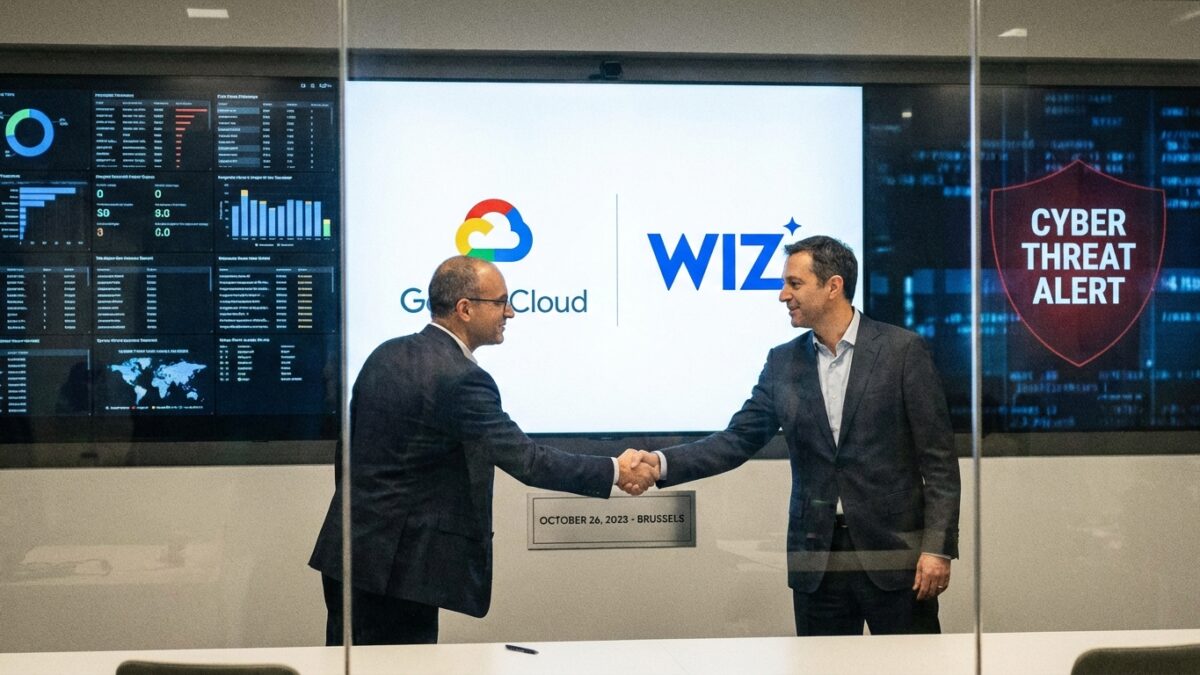
Google has received unconditional approval from the European Commission for its $32 billion acquisition of cybersecurity firm Wiz, completing the tech giant’s largest deal in history and dramatically reshaping the cloud security market. The approval, granted on February 10 after regulators found the transaction would not raise competition concerns, marks a pivotal moment for both Google’s cloud ambitions and the broader cybersecurity industry. (Source: World Economic Forum)
The Deal Takes Shape
The acquisition gives Google access to Wiz’s cloud-native security platform, which has rapidly become one of the most sought-after tools for organizations managing complex multi-cloud environments. Wiz, founded in 2020 by a team of former Microsoft engineers, had reached a $12 billion valuation in 2024 and was generating an estimated $500 million in annual recurring revenue before the deal closed.
EU antitrust chief Teresa Ribera stated in her approval that Google stands behind Amazon and Microsoft in terms of market share in cloud infrastructure, and the assessment confirmed that customers will continue to have credible alternatives and the ability to switch providers. The straightforward regulatory path contrasted with the heightened scrutiny that recent tech mega-deals have faced, suggesting that regulators viewed the competitive dynamics of the cloud security market as sufficiently healthy. (Source: World Economic Forum)
Strategic Implications for Google Cloud
For Google, the deal addresses a critical gap in its cloud platform’s security capabilities. While Amazon Web Services and Microsoft Azure have invested heavily in native security tools, Google Cloud Platform has relied more heavily on third-party integrations. Wiz’s platform, which provides comprehensive visibility across cloud workloads, containers, and serverless architectures, immediately elevates Google’s competitive position in enterprise security.
The acquisition comes at a time when cybersecurity spending is accelerating sharply. The World Economic Forum’s Global Cybersecurity Outlook 2026 report, based on surveys of 800 global leaders, found that 87 percent of executives now view AI-related vulnerabilities as the fastest-growing cyber risk, while 91 percent of organizations with over 100,000 employees have evolved their security strategy in response to geopolitical volatility. (Source: World Economic Forum)
The Broader Cybersecurity Landscape
The Wiz deal lands amid a surge of cybersecurity incidents that underscore the urgency of robust cloud protection. In March 2026, Google itself disrupted a significant Chinese cyberespionage campaign that used advanced GridTide malware to target 53 organizations across 42 countries, highlighting the scale of nation-state cyber operations. (Source: Mean CEO/Cybersecurity News)
The early months of 2026 have seen a string of high-profile breaches. Restaurant chain Panera Bread faces multiple class-action lawsuits after a January breach exposed personal information for 5.1 million customer accounts, with the ShinyHunters hacking group claiming responsibility. Newsletter platform Substack disclosed in February that roughly 670,000 users had their data exposed in a breach that went undetected for four months. And CISA flagged multiple zero-day vulnerabilities under active exploitation, including a critical Cisco SD-WAN flaw and a VMware Aria Operations vulnerability. (Source: Security Magazine; SWK Technologies)
What It Means for Enterprises
For organizations evaluating their security posture, the Google-Wiz combination creates a compelling integrated offering. Enterprises already running workloads on Google Cloud will benefit from deeper native security capabilities, while Wiz’s existing multi-cloud customers can expect continued support across AWS and Azure environments, at least in the near term.
However, competitors are already positioning their responses. Microsoft has accelerated its own cloud security investments, while CrowdStrike and Palo Alto Networks have expanded their cloud protection platforms. The deal may trigger further consolidation in the cybersecurity space as companies race to build comprehensive, AI-enhanced security platforms capable of addressing the increasingly complex threat landscape. (Source: The Hacker News)
As Drew Bagley, CrowdStrike’s vice president for privacy and cyber policy, noted, if AI is going to continue to be embraced at this rapid speed without there being visibility into what is going out the door with AI, then you have another attack surface. The integration of advanced security into the cloud platform itself, rather than relying on bolted-on solutions, may prove to be the defining trend of enterprise cybersecurity in 2026 and beyond. (Source: Federal News Network)
India’s Smartphone Security Push
Beyond the Google-Wiz deal, the cybersecurity landscape is being shaped by regulatory proposals around the world. India has proposed 83 security standards that could require smartphone manufacturers to share source code with the government, representing one of the most aggressive approaches to device security seen globally. (Source: World Economic Forum)
For Google specifically, the Wiz acquisition positions the company to offer integrated security solutions that address cloud infrastructure and the increasingly complex endpoint landscape including smartphones, IoT devices, and AI applications. The combination of Wiz’s cloud-native platform with Google’s existing threat intelligence creates what could become the most comprehensive security offering in the cloud market.
Security industry analysts note that the deal may accelerate the trend toward security consolidation, as enterprises prefer integrated platforms over best-of-breed point solutions. The complexity of modern environments spanning multiple cloud providers, hybrid architectures, and AI workloads makes managing dozens of separate security tools increasingly untenable. Google’s bet appears to be that embedding security deeply into the cloud platform itself is the future of enterprise protection.