
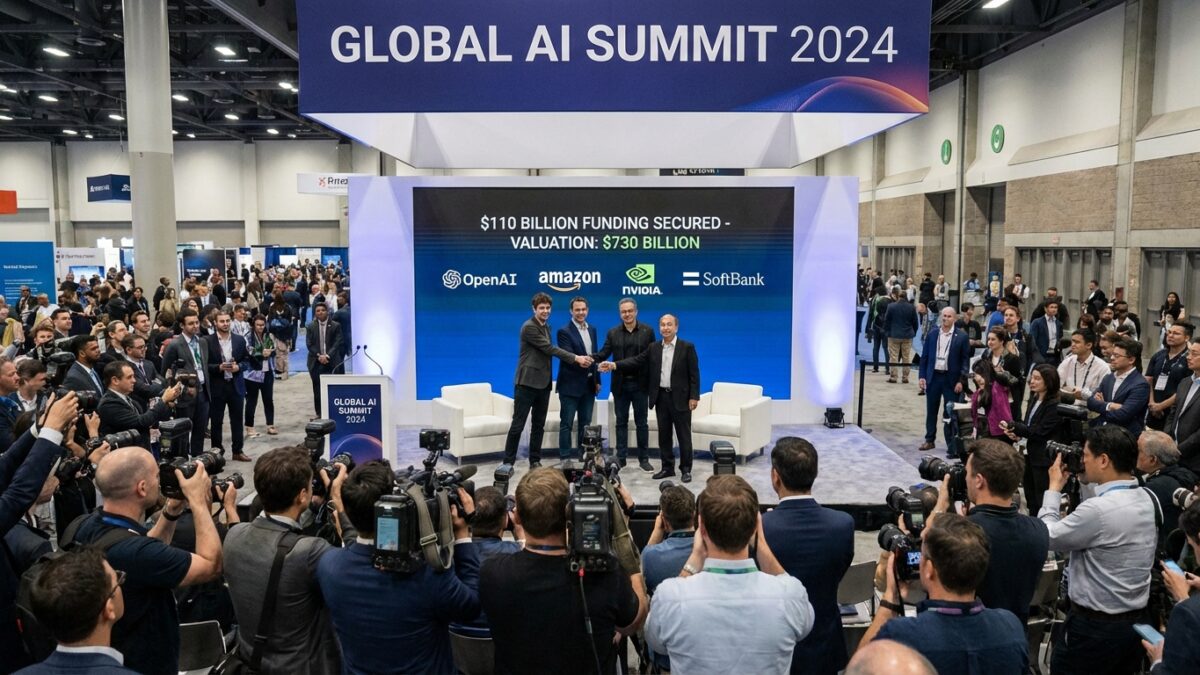
OpenAI has closed the largest private funding round in technology history, raising $110 billion at a pre-money valuation of $730 billion. The financing, announced February 27, is backed by three corporate giants: Amazon at $50 billion, Nvidia at $30 billion, and SoftBank at $30 billion. The deal comes with a sweeping strategic partnership with Amazon and signals a new phase in the AI industry’s capital-intensive evolution. (Source: CNBC)
The Anatomy of a Mega-Round
Amazon’s $50 billion commitment is the largest investment any company has made in a single private tech firm. The e-commerce and cloud giant will provide an initial $15 billion, with an additional $35 billion contingent on OpenAI meeting certain performance milestones. The investment comes alongside a multiyear strategic partnership in which OpenAI will develop customized AI models to power Amazon’s consumer-facing applications. (Source: CNBC)
OpenAI is also expanding its existing $38 billion agreement with Amazon Web Services by $100 billion over eight years, with AWS serving as the exclusive third-party cloud distribution provider for OpenAI’s enterprise platform Frontier. Amazon CEO Andy Jassy said on CNBC’s Squawk Box that it was so early in the AI space and that OpenAI is off to an amazing start. (Source: CNBC)
Nvidia’s $30 billion participation resolved months of speculation about the chipmaker’s relationship with OpenAI. Nvidia CEO Jensen Huang had previously dismissed reports that the company was backing away, stating in January that he believed in OpenAI and that the work they do is incredible. A prior $100 billion financing arrangement between the two companies had reportedly broken down over internal concerns at Nvidia, but the equity investment appears to have replaced that structure. (Source: TechCrunch; Bloomberg)
The Microsoft Question
Notably absent from the round is Microsoft, OpenAI’s longest-standing and largest cumulative backer. The two companies issued a joint statement saying their existing partnership remains unchanged and that the Amazon deal does not alter the core terms of their relationship. However, the deepening Amazon-OpenAI relationship inevitably raises questions about Microsoft’s strategic position, particularly as AWS gains exclusive cloud distribution rights for OpenAI’s enterprise platform. (Source: Axios)
What the Money Buys
OpenAI has been telling investors it is targeting roughly $600 billion in total compute spending by 2030, with projected revenue exceeding $280 billion annually by that date, split roughly equally between consumer and enterprise businesses. The company currently has more than 9 million paying business users and reports that weekly Codex users have more than tripled since the start of the year to 1.6 million. (Source: OpenAI; CNBC)
The funding also strengthens the OpenAI Foundation, the nonprofit entity that oversees the company’s mission. The new valuation increases the Foundation’s stake to over $180 billion, making it one of the most well-resourced nonprofits in history with expanded capacity to fund initiatives in health breakthroughs and AI resilience. (Source: OpenAI)
Competitive Context
The round comes amid intensifying competition in the AI industry. Anthropic, which has seen its Claude model overtake ChatGPT in some usage metrics, is reportedly pursuing its own massive funding round with potential IPO plans for the second half of 2026. Google’s Gemini models continue to advance, and Chinese AI firms including MiniMax, Alibaba, and ByteDance are releasing competitive models at significantly lower price points. (Source: SiliconANGLE)
Meanwhile, questions about antitrust scrutiny loom. While the deal is structured as an investment rather than a merger, the FTC has previously examined the relationship between OpenAI and Microsoft. The addition of Amazon as a major strategic partner creates complex competitive dynamics across the cloud computing market that regulators may wish to evaluate. (Source: Axios)
What It Means
The $110 billion round answers one of the persistent questions about AI development: who pays for the enormous infrastructure required to build and run frontier models. The answer, at least for now, is that the world’s largest technology companies are willing to make enormous bets on a single company’s vision. Whether that bet pays off depends on whether AI’s current trajectory of rapid improvement continues and whether OpenAI can convert its research leadership into durable commercial advantage.
Implications for the AI Ecosystem
The round’s structure reveals important dynamics about how the AI industry is financing itself. The $100 billion AWS expansion puts OpenAI in an unusual position of being deeply embedded in two competing cloud ecosystems simultaneously, with both Microsoft Azure and Amazon Web Services serving as critical infrastructure partners.
The investment has intensified the conversation about AI industry concentration. With a single company commanding a $730 billion valuation and consuming enormous quantities of compute resources, energy, and talent, questions are growing about whether the AI industry is developing in a way that serves broad public interests.
The OpenAI Foundation’s enhanced resources present an interesting counterpoint. With its stake valued at over $180 billion, the Foundation has the potential to become one of the most significant philanthropic entities in history. However, its ability to ensure that the mission of benefiting all of humanity remains meaningful will depend on governance structures not yet fully tested.
Looking ahead, the round sets the stage for what could be the most consequential period in AI industry history. With OpenAI, Anthropic, and Google all racing to develop increasingly capable systems while building massive computing infrastructure, the competitive dynamics of 2026 will likely determine which companies and approaches dominate the next decade of artificial intelligence development.