
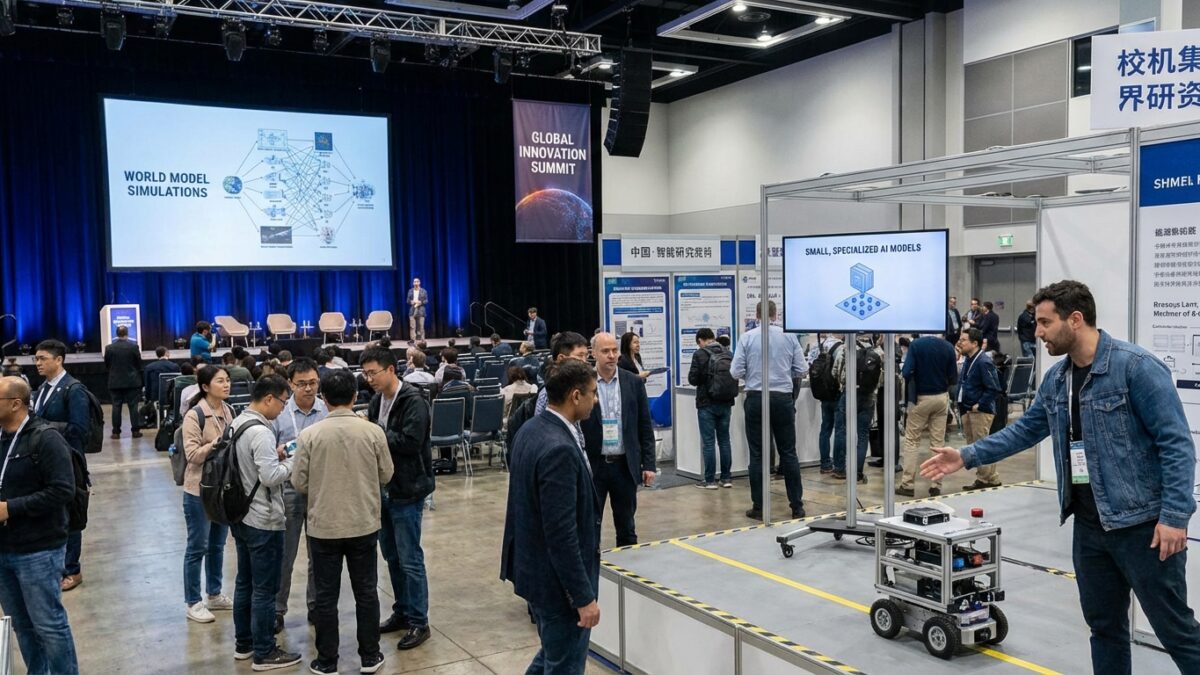
After years of breathless hype and ever-larger language models, the artificial intelligence industry is undergoing a fundamental recalibration in 2026. The focus is shifting from brute-force scaling and flashy demonstrations toward practical deployment, smaller specialized models, and the harder engineering work of making AI systems that integrate cleanly into human workflows. Experts describe it as the year AI sobers up. (Source: TechCrunch)
The Scaling Plateau
The pivot away from pure scaling reflects a growing recognition among researchers that bigger is not always better. Yann LeCun, Meta’s former chief AI scientist, has long argued against overreliance on model size, stressing the need for better architectures. Ilya Sutskever, co-founder of OpenAI, stated in a recent interview that current models are plateauing and pretraining results have flattened, indicating a need for new ideas. (Source: TechCrunch)
AI researcher Afshine Katanforoosh predicted that within the next five years the industry will find a better architecture that is a significant improvement on transformers. Without that breakthrough, he cautioned, further improvement from existing approaches may be limited. (Source: TechCrunch)
The Rise of Small Language Models
While large language models remain the workhorses of consumer AI, the enterprise market is increasingly being driven by smaller, more agile models fine-tuned for domain-specific applications. Andy Markus, AT&T’s chief data officer, told TechCrunch that fine-tuned small language models will be the big trend in 2026, becoming a staple for mature AI enterprises because their cost and performance advantages will drive usage over generic large models. (Source: TechCrunch)
This shift has major implications for how companies deploy AI. Rather than relying on a single massive model for all tasks, organizations are building portfolios of specialized models optimized for specific functions: coding assistants, customer service bots, compliance screening tools, medical diagnostic aids. These smaller models can run on less expensive hardware, respond faster, and be fine-tuned on proprietary data without the privacy concerns of sending information to external APIs.
World Models and Physical Intelligence
One of the most exciting areas of development is world models, AI systems that can understand and simulate physical environments. LeCun left Meta to start his own world model laboratory and is reportedly seeking a $5 billion valuation. Google DeepMind continues developing Genie for interactive world generation, while Fei-Fei Li’s World Labs launched its first commercial world model, Marble, and Runway released its first world model, GWM-1. (Source: TechCrunch)
PitchBook estimates the market for world models in gaming alone could grow from $1.2 billion between 2022 and 2025 to $276 billion by 2030. The technology’s ability to generate interactive environments could transform not just gaming but robotics, autonomous vehicles, and industrial simulation.
The Regulatory Battleground
As AI capabilities advance, the regulatory landscape is becoming increasingly contentious. President Trump signed an executive order in December 2025 aimed at neutralizing state AI laws, setting up a confrontation between federal and state authorities over who controls the governance of AI technology. States like California and Colorado have pushed their own AI safety and transparency requirements, while the industry has lobbied aggressively against what it characterizes as a patchwork of regulations. (Source: MIT Technology Review)
The EU AI Act, which took effect in stages beginning in 2025, provides a regulatory framework that many other countries are watching closely. In the U.S., the question of whether meaningful AI regulation will emerge before the next presidential election remains open.
Chinese Competition Intensifies
Perhaps the most significant development in the global AI landscape is the rapid closing of the gap between Chinese and Western models. Five new AI models were introduced in March 2026 alone by Chinese companies including Tencent, Alibaba, Baidu, and ByteDance. MiniMax’s M2.5 model has drawn particular attention for reportedly rivaling top Western models at significantly lower cost. (Source: Mean CEO/AI News)
Chinese AI firms’ embrace of open-source development has earned them trust in the global developer community. MIT Technology Review predicted that more Silicon Valley applications will quietly adopt Chinese open models, and that the performance gap between Chinese and Western releases will continue shrinking from months to weeks. (Source: MIT Technology Review)
Agentic AI: The Next Frontier
Perhaps the most significant development in practical AI deployment is the emergence of agentic AI systems that operate with increasing autonomy. Huawei showcased its vision for agentic AI at MWC Barcelona 2026, demonstrating network solutions where AI operates autonomously within core telecommunications systems. (Source: Mean CEO/AI Trends)
MIT Technology Review described a near-future scenario where AI personal shoppers recommend gifts, compare products, find deals, and handle purchasing autonomously. Salesforce estimated that AI would drive $263 billion in online purchases during the holiday season, suggesting agentic commerce is already a significant economic force. (Source: MIT Technology Review)
However, the deployment of autonomous AI raises significant safety and liability questions. Several notable cases are heading to trial in 2026, including a lawsuit against OpenAI from the family of a teenager who died by suicide. The outcomes could fundamentally shape how AI companies approach safety. (Source: MIT Technology Review)
The tension between rapid deployment and responsible development remains the central challenge. While enterprise adoption accelerates and coding assistants account for 55 percent of departmental AI spending, the longer-term question of how to build reliably safe, trustworthy AI systems remains unsolved. The pragmatic turn of 2026 may help by refocusing the industry on practical problems, but the fundamental alignment challenge will only grow as systems become more capable.