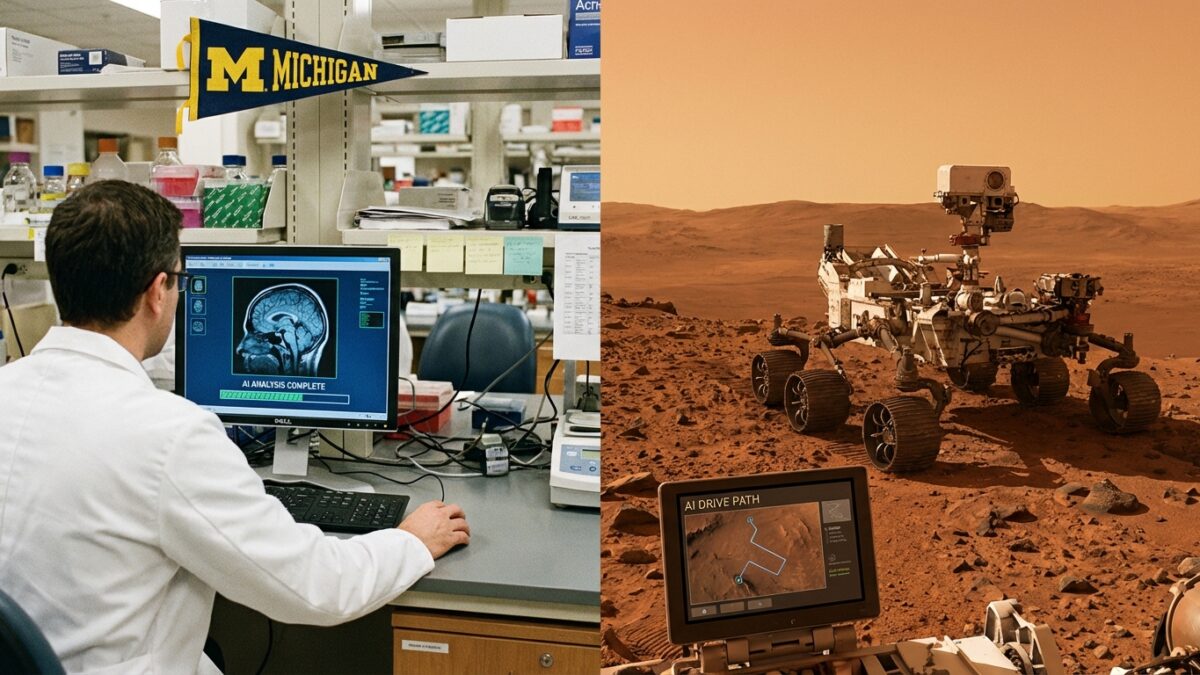
Two landmark demonstrations of artificial intelligence in early 2026 are showcasing the technology’s potential to transform fields as different as emergency medicine and planetary exploration. Researchers at the University of Michigan have built an AI system that interprets brain MRI scans in seconds, while NASA’s Perseverance rover completed the first AI-planned drive on Mars, navigating the Martian surface using routes selected entirely by machine intelligence. (Source: ScienceDaily)
AI Radiologist in Seconds, Not Hours
The University of Michigan team announced in February 2026 that their AI system can accurately identify a wide range of neurological conditions from brain MRI scans and determine which cases need urgent care, all in a matter of seconds. The system was trained on hundreds of thousands of scans and can recognize patterns that even experienced radiologists might miss or take significantly longer to identify. (Source: ScienceDaily)
The implications for emergency medicine are profound. Brain injuries, strokes, and other neurological emergencies are among the most time-sensitive conditions in medicine, where delays of even minutes can mean the difference between recovery and permanent disability or death. Current diagnostic workflows often involve waiting for a radiologist to review scans, a process that can take hours depending on staffing and case volume. An AI system that can provide preliminary readings in seconds could dramatically accelerate triage decisions.
The breakthrough represents a broader trend identified by Mass General Brigham researchers, who predicted that 2026 would see medical AI move from the peak of inflated expectations to the early slope of enlightenment on the Gartner Hype Cycle, as real-world evidence separates tools that genuinely improve outcomes from those that do not. (Source: Mass General Brigham)
Perseverance Takes the Wheel
On February 2, 2026, NASA announced that its Perseverance rover had completed the first AI-planned drive on Mars, using routes generated by artificial intelligence rather than human operators. The AI analyzed the same terrain imagery and elevation data that human rover planners normally use, then independently selected a safe and efficient path across the Martian surface. (Source: ScienceDaily; NASA)
The achievement addresses one of the fundamental bottlenecks in Mars exploration: communication delay. Signals between Earth and Mars take between 4 and 24 minutes to travel one way, making real-time human control impossible. Currently, human planners on Earth study terrain images, plan routes, and send driving commands that the rover executes the following day. An AI system capable of autonomous route planning could allow rovers to travel much farther and faster, covering ground that would take human-planned operations weeks to traverse.
The Perseverance team developed the AI system as part of NASA’s broader push to increase autonomy in robotic exploration, a capability that will be essential for future missions to the outer solar system where communication delays can extend to hours.
AI on Orbit
NASA’s Jet Propulsion Laboratory demonstrated another AI application in February when a spring-loaded deployable antenna, created using 3D printing techniques, successfully deployed from the small commercial spacecraft Mercury One. The JPL Additive Compliant Canister was captured on camera popping out of its container as the spacecraft passed over the Pacific Ocean, demonstrating how AI-designed manufacturing can reduce the cost and complexity of space hardware. (Source: Universe Today)
Sleep as a Diagnostic Window
Stanford researchers have developed an AI system that can predict future disease risk using data from just one night of sleep. The system analyzes detailed physiological signals recorded during sleep, searching for hidden patterns that correlate with the development of conditions including cardiovascular disease, metabolic disorders, and neurological decline. The approach transforms sleep studies from a narrow diagnostic tool into a comprehensive health screening opportunity. (Source: ScienceDaily)
The Broader Pattern
These applications share a common thread: AI excelling not as a replacement for human intelligence but as an amplifier of human capabilities. The brain MRI system does not replace neurologists; it accelerates their workflow and catches cases that might otherwise be delayed. The Mars rover AI does not replace mission planners; it extends their reach across a planet 140 million miles away. As the AI industry moves from hype to pragmatism, these practical, high-impact applications may prove more consequential than the headline-grabbing chatbot wars.
Creativity and Consciousness
In January 2026, researchers tested AI systems against 100,000 humans on creativity tasks, marking one of the most comprehensive comparative assessments ever conducted. The study reflects growing scientific interest in understanding not just what AI can do, but how its cognitive processes compare to human intelligence at a fundamental level.
Scientists at Cambridge have raised philosophical questions about AI consciousness, with philosopher Tom McClelland arguing that there is no reliable way to determine whether AI is conscious. The question has moved from purely academic territory into practical relevance as AI is deployed in contexts where the distinction between genuine understanding and pattern matching has real consequences.
A separate research effort found that AI systems may learn better when allowed to engage in internal self-dialogue combined with short-term memory, helping adapt to new tasks and handle complex challenges. This approach mirrors aspects of human cognitive processing, suggesting future AI architectures may benefit from designs that more closely replicate biological thinking patterns.
Penn State researchers developed a smart synthetic material inspired by octopus skin that can change appearance, texture, and shape on command. While not strictly an AI application, the research demonstrates how biomimicry and machine learning are converging to create materials that blur the line between biological and artificial intelligence, pointing toward a future where AI is embedded in the physical fabric of everyday objects.