
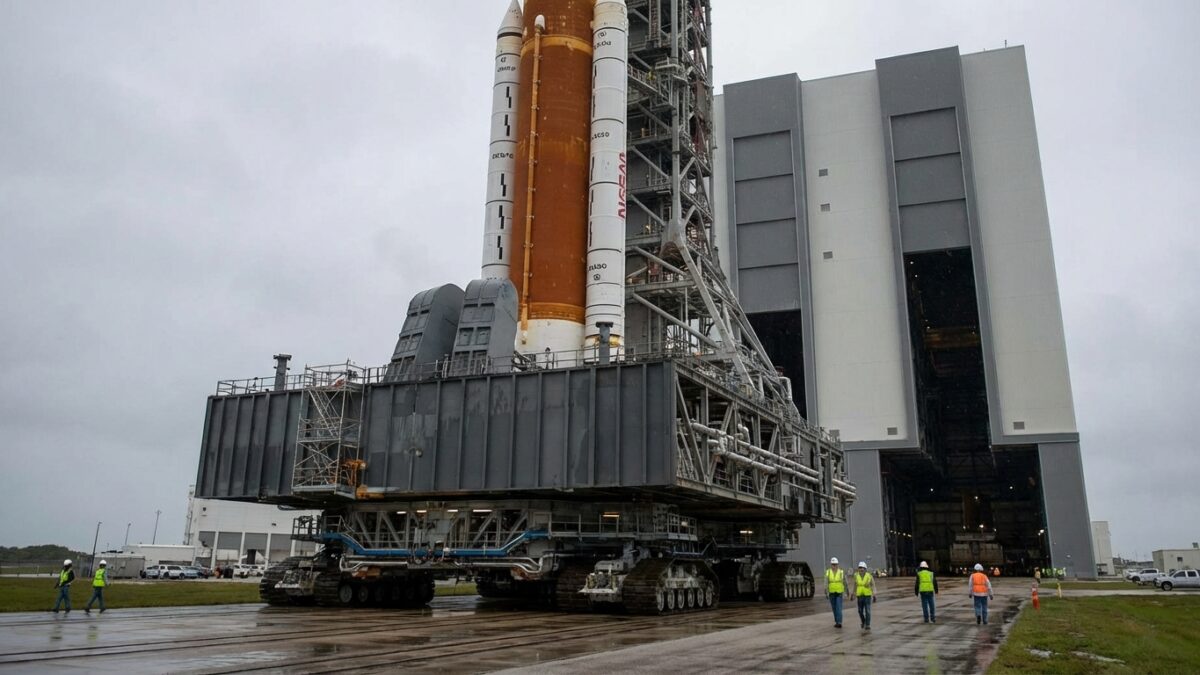
NASA’s highly anticipated Artemis II mission, which aims to send four astronauts around the Moon for the first time since Apollo 17 in 1972, has been pushed to no earlier than April 2026 after engineers discovered a helium flow problem in the rocket’s upper stage. The setback came just days after the agency completed a second successful wet dress rehearsal and had been targeting a March 6 launch date. (Source: NASA)
What Went Wrong
On February 21, following the completion of the second wet dress rehearsal on February 19, teams discovered that helium was not flowing properly to the Space Launch System rocket’s interim cryogenic propulsion stage. The upper stage uses helium to maintain proper environmental conditions for the engine and to pressurize liquid hydrogen and liquid oxygen propellant tanks. While the systems functioned during the rehearsal itself, operators could not establish proper helium flow during normal post-rehearsal reconfiguration. (Source: NASA)
Teams initially explored potential causes including problems in the interface between ground and rocket helium lines, a valve in the upper stage, and a filter between ground and rocket systems. They also reviewed data from Artemis I, which had encountered its own helium-related pressurization challenges before launch. After several days of troubleshooting, NASA made the decision to roll the vehicle back to the Vehicle Assembly Building on February 25. (Source: NASA)
A Pattern of Challenges
The helium issue follows a series of technical challenges that have tested the program’s timeline. The first wet dress rehearsal on February 2 encountered multiple problems, including a liquid hydrogen leak in an interface used to route cryogenic propellant into the core stage, communication dropouts, and weather-related equipment issues. Cold temperatures at Kennedy Space Center delayed tanking operations and forced engineers to troubleshoot for several hours. (Source: NASA; Adler Planetarium)
NASA originally targeted a February launch window, but the first rehearsal’s issues pushed the timeline to March. The crew of astronauts Reid Wiseman, Victor Glover, Christina Koch, and Canadian Space Agency astronaut Jeremy Hansen entered quarantine on January 21 but were released after the February delays, then re-entered quarantine on February 20 when March 6 appeared viable, only to be released again when the helium issue was discovered. (Source: NASA; The Planetary Society)
The Mission’s Significance
If and when it launches, Artemis II will be a historic achievement. The 10-day mission will send its four-person crew farther from Earth than any humans have traveled, on a free-return trajectory around the Moon and back. Victor Glover will become the first person of color, Christina Koch the first woman, and Jeremy Hansen the first non-American to leave Earth orbit and travel around the Moon. (Source: The Planetary Society; Wikipedia)
The mission builds on the success of the uncrewed Artemis I in 2022 and will validate the spacecraft’s life support systems, navigation, and communication capabilities in deep space. The crew will not land on the Moon but will perform observations that could inform planning for Artemis III, the mission intended to return humans to the lunar surface. (Source: NASA)
Heat Shield Questions
The delays have also kept alive questions about the Orion capsule’s heat shield. During Artemis I, engineers observed concerning spalling of the AVCOAT heat shield material during reentry. In response, mission managers eliminated the planned skip reentry profile in favor of a steeper direct entry. NASA Administrator Jared Isaacman stated in January that he supported proceeding with the existing heat shield after reviewing engineering analysis, though some experts continued to object to flying without a redesigned shield. Design changes addressing the heat shield issues are planned for Artemis III. (Source: Wikipedia)
Looking Ahead
With the rocket now in the VAB undergoing helium system repairs and battery replacements, the earliest viable launch dates are April 1, 3, 4, 5, 6, and 30. Meanwhile, NASA announced on February 27 that it is increasing the cadence of Artemis missions, adding an additional mission in 2027 as part of what the agency calls a Golden Age of exploration and discovery. The announcement suggests confidence in the program’s long-term trajectory even as near-term technical challenges persist. (Source: NASA)
The Broader Artemis Strategy
Despite near-term delays, NASA’s long-term commitment appears strong. On February 27, the agency announced plans to standardize vehicle configurations and add an additional mission in 2027, signaling intent to accelerate the lunar cadence rather than allow individual mission delays to slow the program.
The commercial ecosystem continues growing. Blue Origin is preparing its first lunar landing attempt with Blue Moon Mark 1. Intuitive Machines plans its third Nova C mission in the second half of 2026. Astrobotic’s Griffin lander is scheduled for July 2026, carrying the revived VIPER rover to search for water ice at the lunar south pole. (Source: NASASpaceFlight)
Bobby Braun of Johns Hopkins Applied Physics Laboratory has emphasized the importance of increasing focus on space weather prediction in 2026, as events can affect satellites, electrical grids, and communications. The SMILE mission launching in April will provide the first global images of how Earth’s magnetic shield interacts with the solar wind. (Source: Johns Hopkins APL)
For the Artemis II crew, the repeated cycles of quarantine, release, and re-quarantine have tested patience and resilience. As NASA Administrator Isaacman has stated, the agency will only launch when it believes it is as ready as possible to undertake this historic mission. With the April window now in view and technicians accessing helium system components in the VAB, humanity’s return to the Moon continues, one careful step at a time.