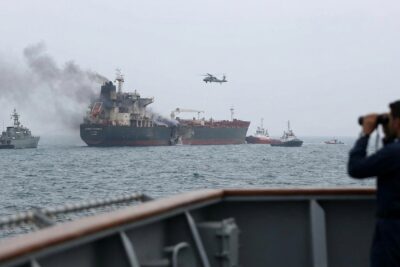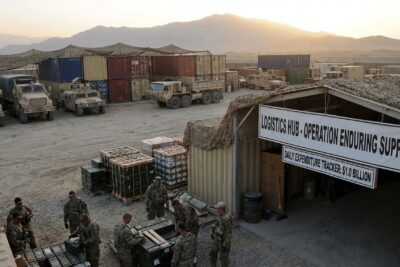
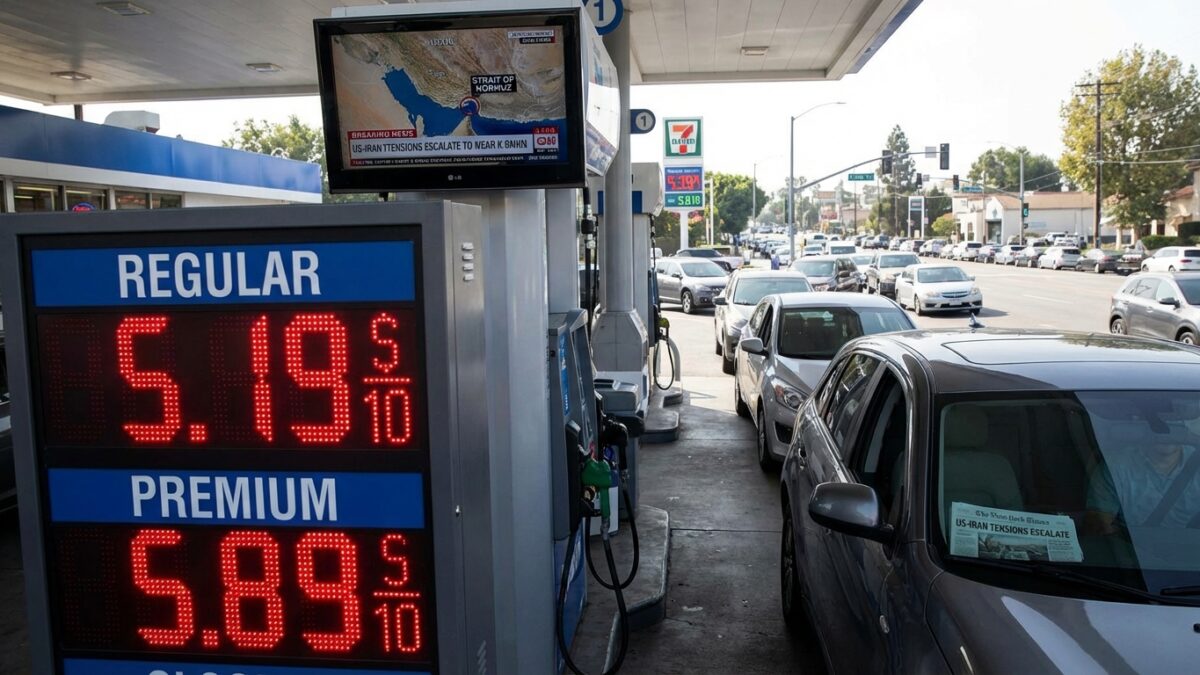
Global oil prices have surged to their highest levels in over eight months as the military conflict between the United States, Israel, and Iran has effectively shut down the Strait of Hormuz, the narrow waterway through which approximately 20 percent of the world’s daily oil consumption flows. Brent crude briefly surpassed $82 per barrel on Monday, March 2, before settling around $79, while U.S. crude jumped more than 7 percent, reflecting acute anxiety about the most significant disruption to Middle Eastern energy infrastructure in decades. (Source: CNN Business)
The Strait Shuts Down
Iran declared the Strait of Hormuz effectively closed following the U.S. and Israeli strikes that began February 28. By the weekend, at least six of the world’s leading cargo shipping companies announced they were halting or diverting vessels originally scheduled to transit the vital waterway. Rystad Energy’s head of geopolitical analysis, Jorge Leon, described the situation as an effective halt of traffic through the strait. (Source: NBC News; Kpler)
The closure has disrupted not just oil flows but also liquefied natural gas shipments. QatarEnergy halted LNG production on Monday and suspended output of other energy products on Tuesday. European natural gas markets surged more than 20 percent in response, though U.S. spot natural gas prices remained within their recent range due to domestic supply. (Source: NBC News)
OPEC+ Responds
In an emergency session convened before the conflict began, eight OPEC+ nations agreed on Sunday to increase production by 206,000 barrels per day starting in April, slightly more than analysts had expected. The countries boosting output include Saudi Arabia, Russia, Iraq, the UAE, Kuwait, Kazakhstan, Algeria, and Oman. While the increase would normally push prices lower, the scale of the current supply disruption has overwhelmed its impact. (Source: Al Jazeera)
The Four-Week Bet
Goldman Sachs head of oil research Daan Struyven provided a mathematical framework for understanding market pricing. He estimated that without sustained supply disruptions, the fair value for Brent crude would be approximately $65 per barrel. The current price around $78 implies that traders are pricing in a disruption lasting about four weeks. (Source: Fortune)
Struyven warned that the impact on oil prices is a convex function of the disruption’s length. A brief conflict would have a disproportionately small impact, since crude oil can simply be stored on land in producing countries. But if the war and strait closure extend beyond four weeks, storage facilities could fill and production would need to be shut down. To generate sufficient demand destruction to rebalance the market, prices might need to rise into triple-digit territory. (Source: Fortune)
Pump Prices Jump
American consumers are already feeling the impact. The national average gasoline price jumped 19 cents in a single day to $3.138 per gallon on Tuesday, the biggest one-day increase since the Russian invasion of Ukraine in 2022. GasBuddy analyst Patrick De Haan predicted prices could reach $3.20 per gallon by the end of the week. Gas prices had previously been falling, reaching levels not seen since 2021 in December, a trend the Trump administration had repeatedly celebrated. (Source: NBC News)
The Broader Economic Risk
JPMorgan Chase analysts identified four key variables that will determine the economic impact: the extent of supply disruption, its duration, whether alternative supply can be mobilized quickly, and what comes next strategically. Goldman Sachs economist Sven Jari Stehn said that a scenario where oil trades around $80 per barrel with a relatively short conflict would have limited global economic impact, but oil rising above $100 would be qualitatively different, producing much larger economic shocks. (Source: CNN Business)
Luis Costa, Citigroup’s global head of emerging markets strategy, noted that historically geopolitical oil shocks fade quickly, but cautioned that if this episode lasts longer, markets may see extended volatility. For now, the world waits to see whether diplomacy or escalation prevails. (Source: NBC News)
New analysis of Apollo lunar samples has rewritten understanding of the Moon’s geological history, resolving a decades-long debate about the formation of the lunar surface. The findings are particularly relevant as NASA prepares for Artemis missions, informing where future crews should land and what features are most scientifically valuable.
A European research team has unveiled a mission concept for exploring lava tunnels on the Moon and Mars using three different robots working in coordination. These hidden tunnels could shelter human explorers, offering natural protection from radiation and micrometeorite impacts that make surface habitation challenging. (Source: ScienceDaily)
Astronomers are also making progress on the Hubble tension through novel gravitational wave detection methods. Any resolution to this disagreement between measurement approaches would have profound implications for our understanding of dark energy and the ultimate fate of the universe. (Source: ScienceDaily)
The concept of life traveling between worlds gains additional support from the ongoing discovery of organic molecules in unexpected environments throughout the solar system. The Europa Clipper mission, now en route to Jupiter, will study whether Europa’s subsurface ocean possesses the chemical building blocks and energy sources necessary to support biology, potentially providing the most definitive evidence yet about the habitability of worlds beyond Earth.
These cumulative discoveries are shifting the scientific consensus about life in the universe from a question of whether to a question of where and when. The coming decade of space exploration, with missions targeted at multiple potentially habitable environments, may finally begin to provide answers that humanity has sought for millennia.