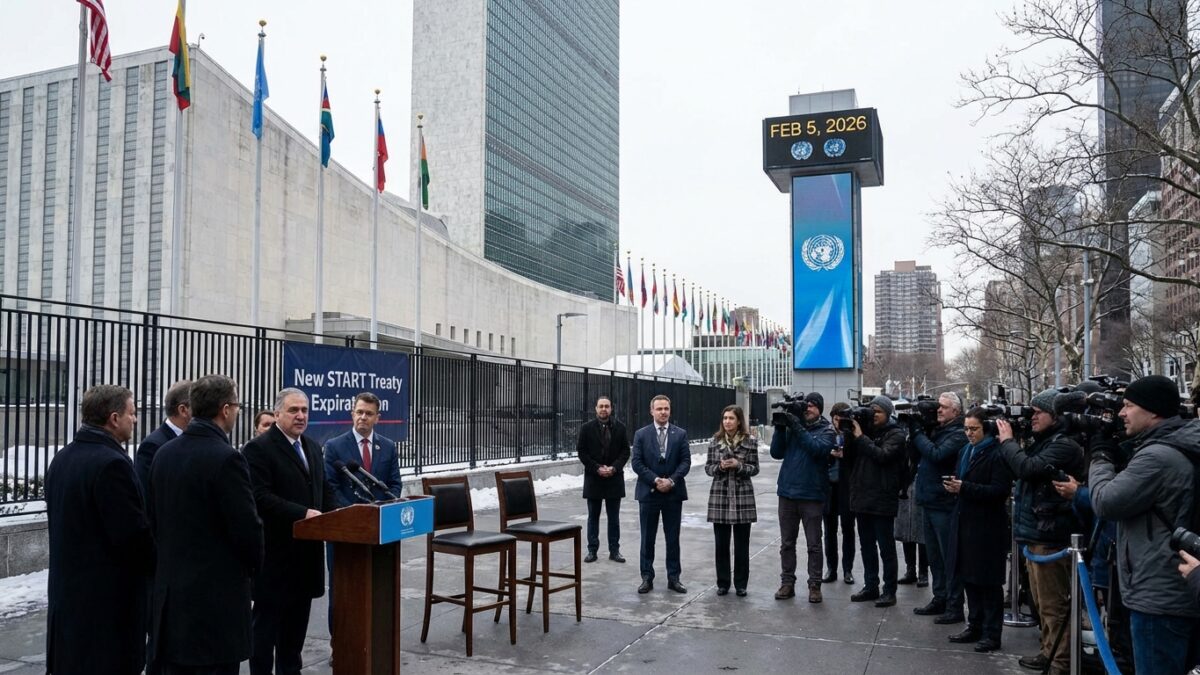
The New Strategic Arms Reduction Treaty, the last remaining agreement limiting the nuclear arsenals of the United States and Russia, officially expired on February 5, 2026, ushering in the first era since the early 1970s without legally binding constraints on the world’s two largest nuclear stockpiles. The lapse has alarmed arms control experts, provoked urgent appeals from the United Nations, and raised the specter of a renewed arms race amid already heightened global tensions. (Source: UN News)
What Was Lost
New START, signed in 2010 by President Obama and Russian President Medvedev, capped each country at 1,550 deployed strategic nuclear warheads and 700 deployed delivery systems including intercontinental ballistic missiles, submarine-launched missiles, and heavy bombers. The treaty also established a verification regime with regular data exchanges, notifications, and up to 18 on-site inspections per year that provided each side with critical transparency into the other’s nuclear posture. (Source: Council on Foreign Relations)
UN Secretary-General Antonio Guterres warned in a statement that the world was entering uncharted territory, saying that for the first time in more than half a century, we face a world without any binding limits on the strategic nuclear arsenals of these two countries. He called the moment a grave one for international peace and security and urged both sides to return to negotiations without delay. (Source: UN News)
A Last-Minute Understanding
In the hours surrounding the expiration, American and Russian negotiators reached a tentative informal understanding on the sidelines of Ukraine talks in Abu Dhabi. Axios reported that Trump envoys Steve Witkoff and Jared Kushner negotiated with Russian officials, agreeing to operate in good faith and start discussions about an updated framework. A source said both nations would observe the deal’s terms for at least six months. Kremlin spokesperson Dmitry Peskov confirmed an understanding had been reached, though it was not formalized in writing and did not include verification provisions. (Source: Axios)
President Trump wrote on Truth Social that rather than extending what he called a badly negotiated deal, nuclear experts should work on a new, improved, and modernized treaty. The statement reflected the administration’s preference for a trilateral agreement including China over a bilateral extension of existing limits. (Source: Northeastern University)
The Verification Gap
Arms control experts identified the loss of transparency as the most immediate and dangerous consequence. The Federation of American Scientists noted that verification regimes allowed each side to distinguish between routine activities and destabilizing preparations. Without them, intelligence assessments rely on indirect indicators, encouraging worst-case assumptions that can fuel arms racing even absent actual expansion. The FAS estimated the U.S. could add 400 to 500 warheads to its submarine force within months if political decisions were made to do so. (Source: Federation of American Scientists)
Stephen Flynn, a national security expert at Northeastern University, warned that the end of the treaty brings us back to scary times and risks an arms race, noting that unlike the bipolar Cold War, today’s nuclear landscape includes China as a formidable force and other countries seeking to join the nuclear club. (Source: Northeastern University)
China and the Trilateral Impasse
The Trump administration has insisted any successor agreement must include China, whose nuclear arsenal is expanding rapidly. However, Beijing has shown no interest in trilateral arms control, arguing that the countries with the two largest arsenals must reduce first. This impasse has stalled progress toward a replacement. The International Campaign to Abolish Nuclear Weapons stated that while New START expired, the legal obligation to negotiate nuclear disarmament under the Nuclear Non-Proliferation Treaty has not. The NPT Review Conference is scheduled for spring 2026 in New York, where nuclear-weapon states must demonstrate disarmament progress. (Source: ICAN; Chatham House)
Russia’s Deputy Foreign Minister Sergei Ryabkov has demanded far-reaching shifts in U.S. relations before engaging in substantive dialogue. The Lowy Institute warned that for the first time in over 50 years, the world’s two largest nuclear powers are unconstrained by any formal framework, making the coming years a critical test of whether restraint can be maintained through informal understandings or whether strategic competition will overwhelm diplomatic prudence. Whether the Abu Dhabi understanding can evolve into something binding remains the defining arms control question of the era. (Source: Lowy Institute)
Practical Consequences
The practical implications are already being felt. The U.S. European Command announced the resumption of military-to-military dialogue with Russia on the day of expiration, a channel that had been suspended since 2021 in the lead-up to Russia’s invasion of Ukraine. This step, also emerging from the Abu Dhabi talks, suggests both sides recognize the danger of operating without communication channels during a period of heightened nuclear risk. On February 4, Russia’s Ministry of Foreign Affairs stated that it considered the treaty’s obligations no longer binding and would determine future actions based on the evolving strategic environment, while remaining open to future diplomatic engagement under appropriate conditions.
Pope Leo XIV called on the treaty parties to do everything possible to prevent a new arms race. The American Friends Service Committee warned that a world with no limits on the two largest nuclear stockpiles is simply a more dangerous world, noting that without verification, nuclear-armed states default to worst-case thinking that increases pressure to build more weapons and signal more aggressively. The risk is not merely theoretical: both Russia and the United States retain the technical capacity to rapidly expand deployed arsenals, creating a dynamic where miscalculation could trigger precisely the catastrophe that arms control was designed to prevent.