
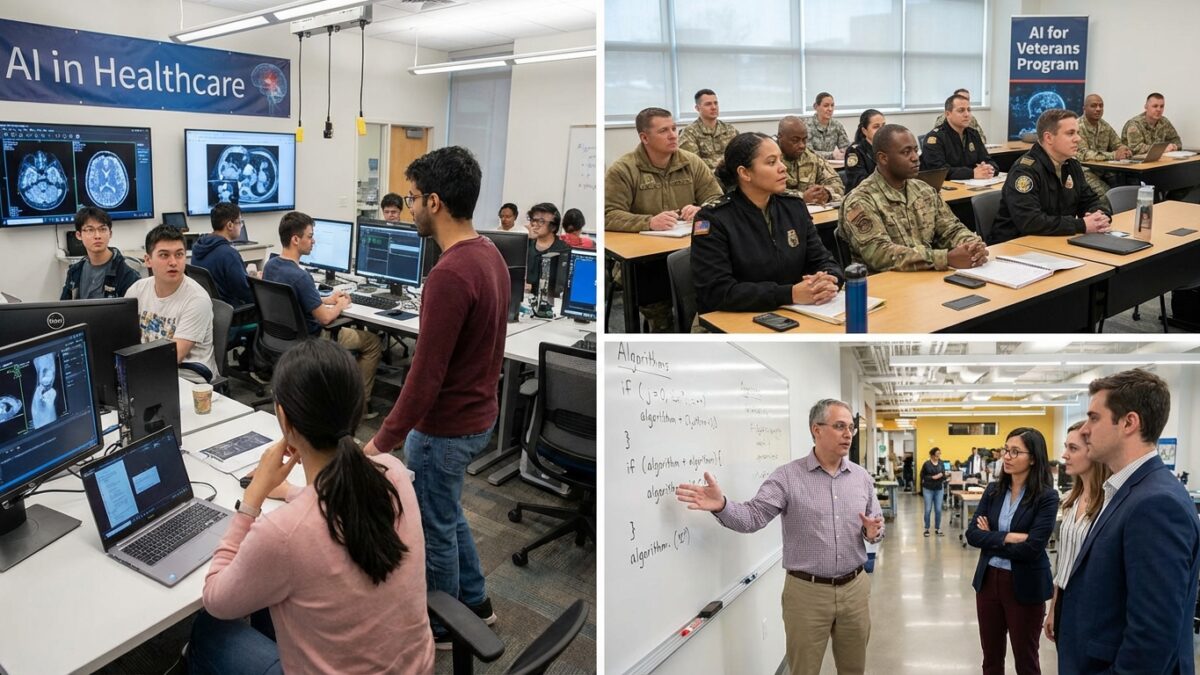
The University of North Texas announced a dedicated undergraduate major in artificial intelligence in early 2026, joining a growing wave of institutions racing to produce graduates capable of designing, building, and governing AI systems. The program, covering machine learning, natural language processing, and AI ethics, was developed in direct response to heavy demand from North Texas employers who increasingly require specialized AI expertise that traditional computer science degrees do not fully address. (Source: AI News Aggregator)
The Talent Gap
Grand Valley State University received $1 million in federal funding to establish a new AI consortium in West Michigan, aimed at helping small and medium-sized businesses integrate AI technologies. Weill Cornell Medicine launched the AI to Advance Medicine program, developing tools for precision medicine including models that predict disease progression and personalize cancer treatment plans. Code Platoon, a nonprofit coding bootcamp for military veterans, unveiled a modernized curriculum integrating AI with full-stack engineering. (Source: Crescendo AI News)
These initiatives reflect a broader recognition that the AI talent gap is not just a problem for Silicon Valley. Every sector from healthcare to manufacturing to agriculture needs professionals who can deploy AI responsibly. India’s hosting of a high-level global summit on AI governance in New Delhi underscored the international dimension of the challenge, with discussions highlighting AI’s dual potential to revolutionize agriculture and education while posing risks from deepfakes and automated warfare. (Source: Crescendo AI News)
Ethical Training as Necessity
What distinguishes the newest AI programs from traditional computer science offerings is their emphasis on ethics, governance, and societal impact. The University of North Texas curriculum includes dedicated coursework in AI ethics that goes beyond the philosophical to address practical questions of bias detection, fairness metrics, algorithmic accountability, and regulatory compliance. The EU AI Act’s implementation has created urgent demand for professionals who understand both the technical and regulatory dimensions of AI deployment. (Source: The Hacker News)
Mass General Brigham researchers have emphasized that AI tools in healthcare must be both ethically sound and clinically validated, noting that 2026 will see medical AI separate hype from substance as real-world evidence grows. Training the next generation of AI practitioners to navigate this validation process is essential if the technology is to deliver on its promise without causing harm. (Source: Mass General Brigham)
Industry-Academic Partnerships
The most effective programs are being developed in close collaboration with industry partners. The GVSU consortium specifically targets collaboration between academia and local businesses. Weill Cornell Medicine’s AIM program fosters partnership between data scientists and clinicians. These models recognize that AI education cannot succeed in isolation from the practical contexts where AI will be deployed, and that training must evolve at the speed of the technology itself. (Source: Crescendo AI News)
For workers already in the workforce, the rapid pace of AI advancement creates both anxiety and opportunity. The World Economic Forum’s AI Industry Trends report for March 2026 emphasized that AI is reshaping jobs by amplifying human skills rather than replacing them. Organizations that invest in upskilling their existing workforce alongside hiring new AI specialists are likely to adapt more successfully than those pursuing either strategy alone. The question is no longer whether AI expertise is needed but how quickly educational institutions can scale to meet demand that shows no signs of plateauing. (Source: World Economic Forum)
The Skills That Matter
Across these programs, common themes are emerging in what constitutes effective AI education. Technical skills in machine learning, deep learning, and neural network architectures remain foundational. But increasingly, programs emphasize prompt engineering, model evaluation, data governance, and the ability to translate business problems into AI-solvable formulations. The integration of AI with domain expertise, rather than AI as a standalone discipline, reflects the reality that the most impactful AI applications come from professionals who understand both the technology and the field where it is being applied.
The financial implications of the AI talent gap are substantial. The World Economic Forum estimates that AI-skilled workers command salary premiums of 30 to 50 percent over comparable positions without AI requirements. Companies unable to attract and retain AI talent risk falling behind competitors who can deploy the technology effectively. This dynamic creates a virtuous cycle for early-adopting educational institutions: graduates of established AI programs are quickly hired, building institutional reputation that attracts more students and industry partnerships. The universities that move fastest to establish credible AI programs will likely cement advantages that persist for years, while institutions that delay risk irrelevance in a job market that increasingly treats AI competency not as a specialization but as a baseline expectation.
The growing importance of AI in scientific research creates demand for specialists who can apply machine learning from drug discovery to climate modeling to materials science. NASA’s use of AI for Mars rover navigation and the University of Michigan’s brain MRI interpretation demonstrate need beyond technology companies. Interdisciplinary programs combining AI with healthcare, environmental science, or aerospace engineering may prove more valuable than pure AI degrees. The pace of change creates permanent educational challenges since by the time four-year programs graduate their first class, the landscape may have shifted dramatically. Programs emphasizing foundational principles, critical thinking, and adaptable skills will serve students better than those focused on current tools. Universities that build bridges between technical training and real-world application will produce graduates who can not only build AI systems but deploy them responsibly in contexts that matter.