
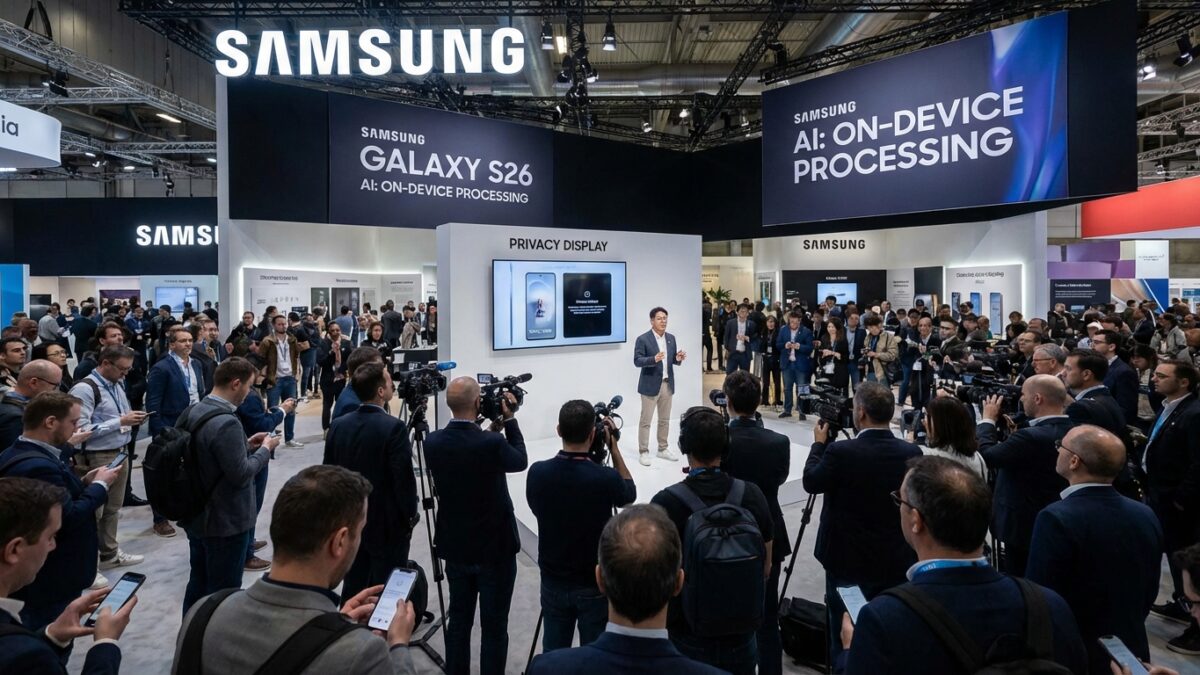
Samsung unveiled its latest Galaxy AI innovations at Mobile World Congress Barcelona 2026, showcasing the Galaxy S26 series with Privacy Display technology, a Snapdragon 8 Elite Gen 5 processor, and an M3 vapor chamber that enables sophisticated on-device AI processing without the performance throttling that plagued earlier attempts at local AI computation. The announcements highlight how on-device artificial intelligence is becoming the primary differentiator in a smartphone market facing its worst annual decline in history. (Source: Mean CEO/AI News)
On-Device AI as Differentiator
Samsung’s Galaxy AI suite processes language translation, photo enhancement, document summarization, and voice transcription entirely on the device without sending data to external servers. This approach addresses growing consumer concern about AI privacy while providing faster response times than cloud-dependent alternatives. The Privacy Display feature uses hardware-level screen technology that limits viewing angles, ensuring that sensitive AI-generated content remains visible only to the user holding the phone.
The Galaxy Buds4 series expanded Samsung’s wearable AI capabilities, introducing real-time language translation through earbuds and health monitoring features that leverage the same AI models running on paired Galaxy devices. The integration of AI across the Samsung ecosystem, from phones to watches to earbuds, creates a cohesive user experience that rivals the tight integration Apple has built across its product line.
The MWC 2026 AI Theme
Samsung was not the only company pushing AI-centric narratives at MWC. Huawei launched enhanced AI-centric network solutions integrating intelligence into every layer of computing infrastructure, including preparations for agentic AI where systems operate autonomously within core telecommunications networks. The company showcased its SuperPoD computing cluster for the first time outside China, positioning it as critical infrastructure for the intelligent world. (Source: Mean CEO/AI Trends)
The broader MWC theme reflected an industry pivoting from 5G connectivity as the primary selling point to AI capability as the must-have feature. Network operators are increasingly positioning their infrastructure not just as data pipes but as AI-enabling platforms, with edge computing capabilities that bring AI processing closer to end users. Qualcomm, MediaTek, and Samsung’s own Exynos division are all racing to build dedicated AI processing units into their mobile chips.
Market Context
The AI push comes as IDC projects the global smartphone market will decline 13 percent in 2026, the largest annual drop in history, driven by memory chip shortages as AI data centers cannibalize the supply chain. Samsung and its competitors are betting that AI features can drive upgrade cycles and premium pricing even as overall unit sales decline. The strategy mirrors what happened with smartphone cameras a decade ago, when computational photography became the primary reason consumers upgraded to newer models. (Source: IDC via Yahoo Finance)
For Samsung, the Galaxy S26 launch represents a critical test of whether AI capabilities can justify premium pricing in a market where consumers are holding onto their devices longer. With Apple advancing its own AI initiatives and Chinese manufacturers offering competitive AI features at lower price points, the smartphone AI race is intensifying across every segment of the market.
The competitive landscape intensifies across every segment. Apple has been advancing Intelligence features. Chinese manufacturers offer competitive AI at lower prices. Google’s Pixel emphasizes AI-first design with deeply integrated Gemini assistant. As AI features become table stakes, Samsung must demonstrate meaningfully superior experiences. The broader implications of on-device AI extend beyond convenience. Processing data locally addresses growing GDPR and data sovereignty requirements. Enterprise customers evaluate smartphones as AI-capable computing platforms for business applications. Samsung’s Knox security platform combined with on-device processing positions Galaxy as an enterprise solution, a strategic positioning that could prove decisive as the smartphone market contracts and differentiation becomes essential for survival.
MWC Barcelona highlighted convergence of telecommunications and AI infrastructure. Network operators position themselves as AI platforms with edge computing bringing processing closer to users. 5G-Advanced networks provide the low-latency connectivity on-device AI requires. For Samsung, integrating AI across its ecosystem from smartphones to wearables to appliances captures value across connected life rather than competing on individual product specs. The approach extends further into enterprise and IoT applications where Samsung’s broader product range provides advantages. The Galaxy ecosystem’s enterprise positioning, combining Knox security with AI processing, may prove decisive as differentiation becomes essential in a contracting market where features alone no longer drive upgrade cycles.
Samsung’s investment in foldable phone technology adds another dimension to its competitive strategy. The Galaxy Z Fold and Z Flip product lines create form factors that competitors have struggled to match at Samsung’s combination of quality and scale. Folding devices provide larger screens in pocketable formats, creating natural advantages for AI-powered multitasking features that benefit from increased display real estate. The convergence of foldable hardware and on-device AI may prove to be Samsung’s most distinctive competitive advantage, creating experiences that neither traditional smartphones nor tablets can replicate.
Looking ahead, Samsung’s AI strategy faces a critical test as the Galaxy S26 competes not just against other smartphones but against an emerging category of AI-dedicated devices and wearables. The rapid improvement of AI capabilities on mobile processors means that within a few product generations, smartphones could serve as the primary computing hub for AI-assisted work, creative tasks, and personal management. Samsung’s investment in on-device processing positions it to capture this future, but execution will determine whether Galaxy AI becomes a genuine competitive advantage or merely a marketing label applied to incremental improvements.
The broader smartphone market dynamics also reflect Samsung’s challenge. With IDC projecting a 13 percent decline in global smartphone shipments in 2026, driven by memory chip shortages as AI data centers cannibalize the supply chain, manufacturers face a contracting market where every upgrade cycle matters. Samsung’s response combines AI differentiation at the premium end with continued presence across mid-range and budget segments, maintaining market share through portfolio breadth while driving revenue through premium device sales. The strategy requires balancing innovation investments that justify high-end pricing with manufacturing efficiency that maintains competitiveness in price-sensitive markets.