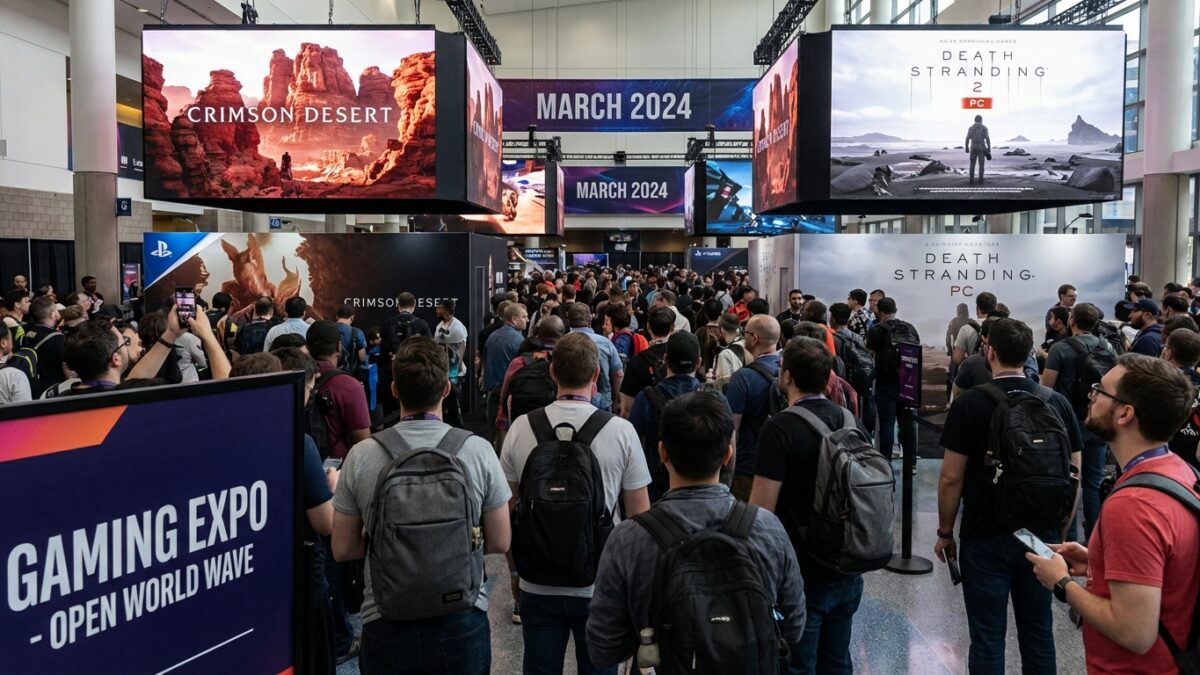
Two of the most anticipated open-world games of 2026 arrive in the latter half of March, with Pearl Abyss’s Crimson Desert promising massive-scale action RPG combat and Kojima Productions’ Death Stranding 2: On the Beach finally reaching PC nine months after its PlayStation 5 debut. Together with earlier March releases including World of Warcraft: Midnight and the upcoming Slay the Spire 2, the month is establishing itself as one of the most densely packed gaming periods in recent memory. (Source: PC Gamer; GameSpot)
Crimson Desert’s Ambitious Vision
Crimson Desert has been in development for years at Pearl Abyss, the South Korean studio behind the popular MMO Black Desert Online. Early previews have generated significant excitement, with PC Gamer’s Harvey Randall describing the combat as a mix between Breath of the Wild and Dragon’s Dogma 2, a comparison that positions it among the most ambitious action RPGs of the generation. The game features a vast open world, narrative-driven progression, and a combat system that blends third-person melee with larger-scale battlefield encounters. (Source: PC Gamer)
The game’s striking visual fidelity has been a major selling point, with Pearl Abyss leveraging its proprietary engine technology developed over years of Black Desert Online’s live service. The transition from MMO development to a single-player focused experience represents a significant creative pivot for the studio.
Death Stranding 2 Arrives on PC
Hideo Kojima’s Death Stranding 2: On the Beach launched on PlayStation 5 in mid-2025 to critical acclaim and divisive player reception, maintaining the auteur director’s reputation for creating experiences that defy conventional genre classification. The PC version, arriving nine months later, includes super ultrawide monitor support, DLSS, FSR, and XeSS integration, giving PC players more control over how they experience Kojima’s latest narrative journey. (Source: PC Gamer)
PC Gamer noted that the nine-month wait was motivated partly by the desire to include proper PC optimization features from launch rather than rushing a port. The original PlayStation 5 version drew criticism for frame rate inconsistencies, and the PC edition aims to address those concerns while providing the graphical flexibility that the PC platform’s diverse hardware ecosystem demands.
The Open-World Saturation Question
The simultaneous arrival of multiple large-scale open-world games raises questions about market saturation in a genre that has dominated triple-A game development for over a decade. Players have finite time and attention, and the investment required to fully experience an open-world RPG, often exceeding 60 to 100 hours, means that most consumers will choose one or two titles rather than purchasing all of them. Publishers are increasingly competing not just for purchase decisions but for the hundreds of hours of engagement that determine long-term success.
March 2026 tests whether the market can sustain this level of open-world output alongside the month’s extraction shooters, MMO expansions, and indie titles. The gaming industry has entered a period where the volume of high-quality releases regularly exceeds the available audience’s consumption capacity, a dynamic that benefits consumers through choice but challenges publishers through fragmented attention. For players with the time and budget, it represents an embarrassment of riches. For publishers, it represents a high-stakes bet that their particular vision of open-world gaming will capture enough attention to justify development budgets that routinely exceed $100 million. (Source: GameSpot)
The modding community remains a vital force extending open-world game longevity. PC versions benefit from community modifications ranging from graphical enhancements to gameplay overhauls. For developers, modders represent free content creation extending commercial life and building dedicated communities. The gaming industry’s March output represents continued genre confidence despite development cost concerns. Whether investments generate sufficient returns will become clear as sales data emerges. The industry’s ability to deliver compelling experiences while managing escalating production costs will define this console generation.
AI-generated content in open-world games is beginning to change player experiences. Procedural quest generation, AI-driven NPC dialogue, and dynamic difficulty systems create responsive, personalized encounters. PitchBook projects the world models market in gaming could reach $276 billion by 2030. The intersection of traditional craftsmanship and AI-powered generation represents the next frontier, promising worlds not just larger but more alive. For the industry, March’s output represents confidence despite cost concerns. Whether investments generate sufficient returns will become clear as sales data emerges. The ability to deliver compelling experiences while managing escalating costs will define this console generation. For players, the abundance of quality choices represents a golden age of gaming content.
The competitive dynamics of March 2026 also raise questions about how games sustain player engagement beyond launch. Both Crimson Desert and Death Stranding 2 are designed as complete single-player experiences that tell their stories within a fixed content boundary, contrasting with live-service models that promise ongoing content updates. The tension between these philosophies continues to define industry debate about the most sustainable approach to game development and monetization. For players, the choice reflects personal preferences about how they engage with entertainment media: as discrete experiences to be savored or as ongoing platforms to inhabit indefinitely.
March 2026’s open-world releases also test the market’s appetite for different approaches to narrative design. Death Stranding 2 continues Kojima’s auteur vision of gaming as cinema, with lengthy cutscenes, celebrity performances, and thematic ambitions that prioritize story over player agency. Crimson Desert takes a more traditional approach, offering player freedom within a densely authored world where emergent gameplay complements scripted encounters. These contrasting philosophies both have passionate audiences, and their simultaneous availability gives players a clear choice about what they value most in their gaming experiences.