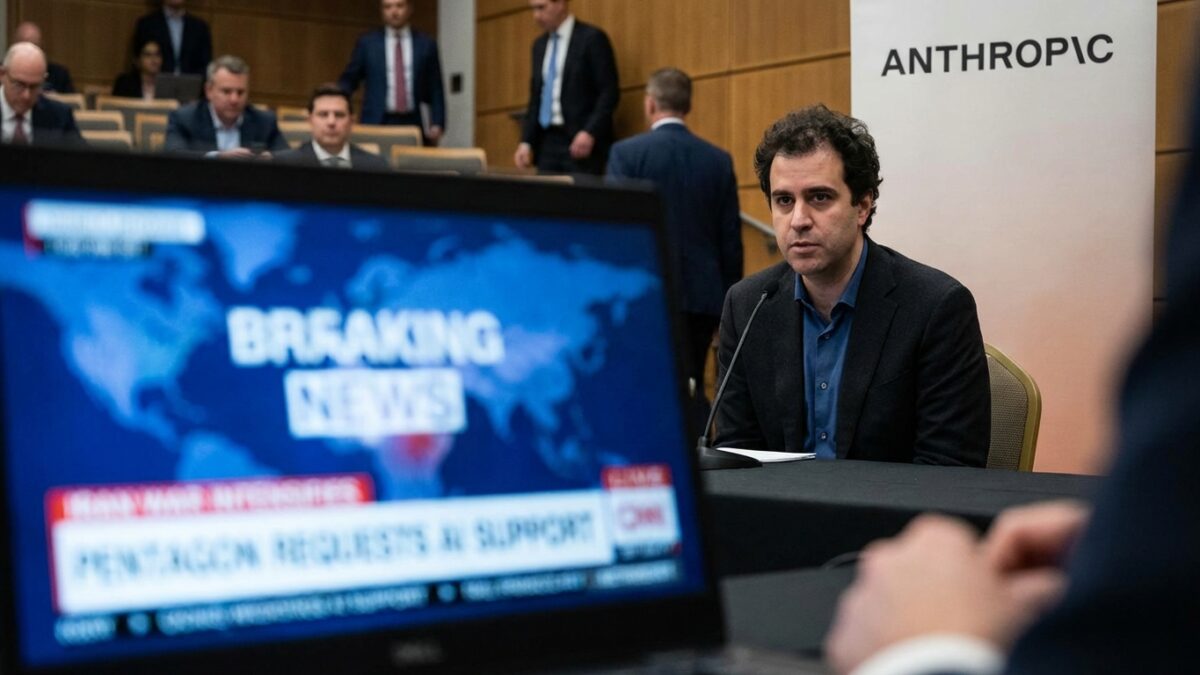
Anthropic CEO Dario Amodei has maintained the company’s refusal to comply with Department of Defense demands for access to its Claude AI models for military applications, intensifying a standoff that has divided the artificial intelligence industry over the ethics and economics of defense contracts. The dispute, which escalated in late February, has drawn attention as the Iran war demonstrates both the military applications of AI technology and the ethical complexities of providing it to governments engaged in active combat operations. (Source: Yahoo Finance; Newcomer)
The Standoff
The Pentagon has sought access to Anthropic’s Claude models for defense applications including intelligence analysis, logistics optimization, and strategic planning. Anthropic, which was founded in 2021 with an explicit focus on AI safety and has positioned itself as the most cautious of the major AI developers, has declined to provide its models for military use under its current acceptable use policy. Amodei has argued that deploying AI in military contexts without sufficient safety guarantees creates unacceptable risks. (Source: Newcomer)
The refusal stands in contrast to the approach taken by several competitors. OpenAI reversed its earlier position on military applications in 2024, signing a deal with defense technology startup Anduril to help take down battlefield drones. OpenAI has also struck a deal with the Pentagon, as reported in recent weeks. Google DeepMind has maintained partnerships with defense agencies, and Palantir has built its entire business model around government and defense applications. (Source: MIT Technology Review; Yahoo Finance)
Industry Divide
The split between Anthropic and its competitors on military AI reflects a fundamental disagreement about the technology’s role in society. Proponents of defense partnerships argue that if responsible American AI companies refuse to work with the military, the government will turn to less safety-conscious providers or develop capabilities in-house without the guardrails that commercial AI companies can provide. Critics counter that participating in military applications normalizes the use of AI in life-and-death decisions that demand human judgment and accountability.
The debate has taken on new urgency during the Iran conflict. AI systems are reportedly being used for target identification, damage assessment, and logistics coordination in the military campaign. The quality and reliability of these systems directly affects civilian casualty rates and the precision of military operations. Anthropic’s position is that its models have not been sufficiently tested for these high-stakes applications and that deploying them prematurely could lead to outcomes that undermine both military effectiveness and civilian protection. (Source: MIT Technology Review)
Financial Implications
The stance carries financial risk for Anthropic, which is reportedly pursuing its own massive funding round with a potential IPO in the second half of 2026. Defense contracts represent a growing and lucrative market for AI companies, and investors may question whether Anthropic’s principled stance limits its total addressable market. However, the company’s positioning as the responsible AI developer has also attracted investors and enterprise customers who value safety commitments, creating a brand differentiation that has commercial value independent of military revenue. (Source: SiliconANGLE; Newcomer)
For the broader AI industry, the Anthropic-Pentagon standoff represents a test case that will influence how AI companies navigate the intersection of technology, ethics, and national security for years to come. As AI capabilities continue to advance and military applications multiply, every major AI developer will face pressure to choose between the lucrative defense market and the safety principles that many of them were founded to uphold. Anthropic’s decision to hold firm, at least for now, establishes a precedent that the most principled stance is also the most commercially distinctive. (Source: Newcomer; Yahoo Finance)
The Iran war has brought these questions into sharp focus. Reports of AI systems being used for target identification, damage assessment, and logistics coordination in the U.S. military campaign raise direct questions about the reliability and accountability of algorithmic decision-making in combat. If an AI system misidentifies a school as a military target, the consequences are measured in human lives. Anthropic’s position is that its models have not been sufficiently validated for these high-stakes applications and that premature deployment could produce outcomes that undermine both military effectiveness and civilian protection. (Source: MIT Technology Review; Newcomer)
The financial implications of Anthropic’s stance are significant but manageable. Defense contracts represent a growing market, with AI spending by the Department of Defense projected to increase substantially in coming years. However, Anthropic’s positioning as the responsible AI developer has attracted enterprise customers who value safety commitments, creating brand differentiation with independent commercial value. With the company reportedly pursuing its own IPO in the second half of 2026, the question of whether principled positions help or hurt valuation will be answered by the market. For the broader AI industry, the Anthropic-Pentagon standoff establishes that there is at least one major competitor willing to prioritize safety over revenue, creating competitive pressure on others to articulate and defend their own ethical boundaries. (Source: SiliconANGLE; Newcomer)
OpenAI, by contrast, reversed its earlier position on military applications in 2024 and signed deals with both Anduril and the Pentagon directly. The divergence between OpenAI and Anthropic, both founded by alumni of the same research organization, illustrates how differently companies with similar origins can interpret their responsibilities when commercial pressure and national security demands intersect. Google DeepMind has maintained defense partnerships, and Palantir has built its entire business model around government applications. (Source: MIT Technology Review; Yahoo Finance)