
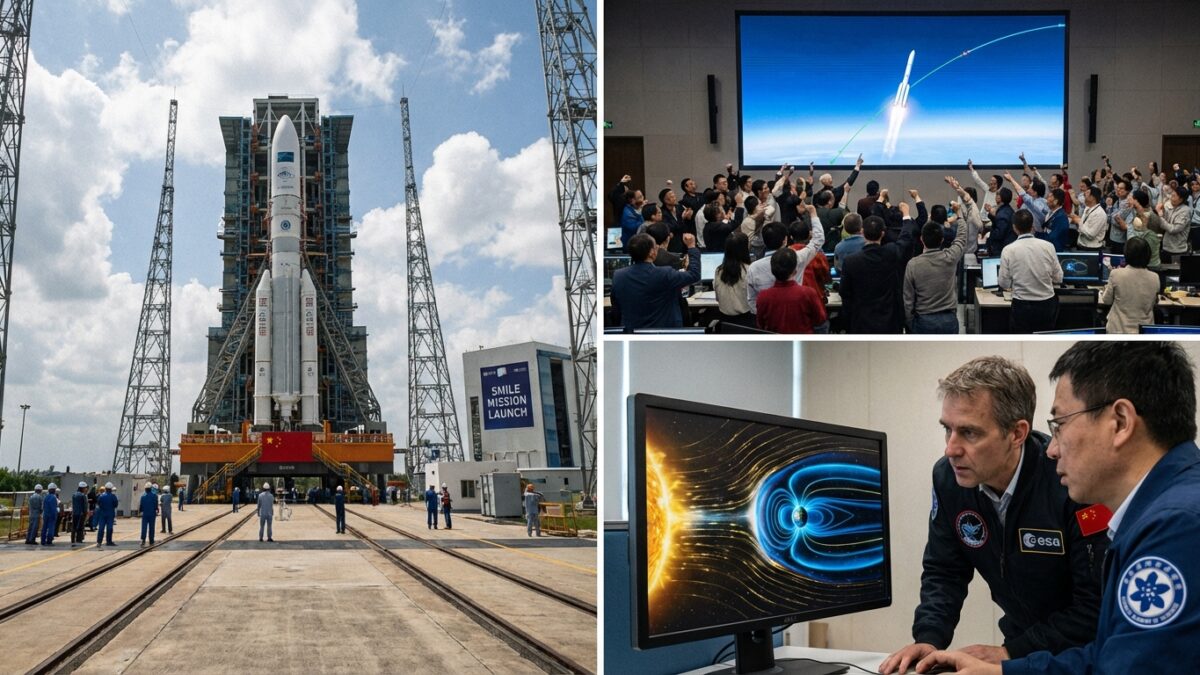
The Solar Wind Magnetosphere Ionosphere Link Explorer, known as SMILE, is scheduled to launch aboard a Vega-C rocket on April 8, 2026, in a joint mission between the European Space Agency and the Chinese Academy of Sciences that will provide humanity’s first global images of how Earth’s magnetic field responds to the solar wind. The mission addresses a critical gap in space weather prediction at a time when the vulnerability of satellites, power grids, and communication systems to solar storms has never been greater. (Source: NASASpaceFlight; SETI Institute)
Why Space Weather Matters
In 2025, powerful solar storms forced airlines to reroute and ground flights, disrupted radio communications, and pushed vivid auroras as far south as Florida. These events demonstrated the tangible impact of space weather on modern infrastructure. A severe solar storm, comparable to the Carrington Event of 1859, could cause trillions of dollars in damage by disabling satellites, disrupting GPS navigation, overwhelming power grids, and degrading communications networks. Understanding how Earth’s magnetic shield interacts with the solar wind is essential for predicting and mitigating these risks. (Source: Astronomy.com)
Bobby Braun, head of the space exploration sector at Johns Hopkins Applied Physics Laboratory, emphasized the importance of increasing focus on space weather prediction in 2026, noting that a storm that is not known in advance can negatively impact satellites and even the electrical grid, depending on which portion of the Earth is facing the direction of high-energy radiation. (Source: Johns Hopkins APL)
How SMILE Works
SMILE will orbit Earth in a highly elliptical path with an apogee of approximately 121,000 kilometers, giving it a wide-angle view of the magnetosphere. The spacecraft carries instruments that observe soft X-rays and ultraviolet light generated when the solar wind interacts with Earth’s magnetic boundary. Current space weather monitoring relies on point measurements from individual satellites, providing data from only one location at a time. SMILE will deliver the first images showing the entire interaction zone simultaneously, transforming space weather observation from a scattered sampling approach to comprehensive imaging. (Source: NASASpaceFlight)
The joint ESA-CAS nature of the mission makes it a notable example of international scientific cooperation at a time when geopolitical relations between Europe and China are strained. The scientific benefits of the collaboration, including shared data and complementary expertise in spacecraft design and space physics, demonstrate that productive partnerships remain possible even between nations with significant political disagreements.
The 2026 Telescope Revolution
SMILE joins an extraordinary lineup of space science missions in 2026. NASA’s Nancy Grace Roman Space Telescope is targeted for October, offering infrared surveys covering areas 200 times larger than Hubble. The Vera C. Rubin Observatory is ramping up its Legacy Survey of Space and Time. The ESA-JAXA BepiColombo mission enters Mercury orbit after seven years. China’s Tianwen-2 sample-return mission reaches asteroid Kamo’oalewa. Together, these missions represent the most significant expansion of observational capability in a generation. (Source: NASASpaceFlight; SETI Institute)
For SMILE specifically, the mission’s data will feed directly into the models used by space weather forecasting centers worldwide, improving the accuracy and lead time of warnings that protect everything from airline operations to military communications. In an era of increasing dependence on space-based infrastructure, the ability to see the entire magnetospheric boundary in real time is not merely a scientific advancement but an essential piece of critical infrastructure protection. (Source: Astronomy.com; Johns Hopkins APL)
The SMILE spacecraft carries specialized instruments that observe in soft X-ray and ultraviolet wavelengths, detecting emissions generated when charged particles from the solar wind collide with neutral atoms at the boundary of Earth’s magnetic field. Current monitoring relies on individual satellites providing point measurements from single locations. SMILE will deliver images showing the entire interaction zone simultaneously, a capability analogous to replacing individual weather stations with a weather satellite that can photograph an entire storm system at once. (Source: NASASpaceFlight; SETI Institute)
The joint ESA-CAS nature of the mission is notable in the current geopolitical context. European-Chinese scientific cooperation persists even as political and trade relations are strained by disagreements over technology transfer, human rights, and strategic competition. The scientific community has long argued that collaborative research transcends political boundaries, and SMILE provides a test case for whether productive partnerships can continue amid rising tensions. The data SMILE generates will be shared between both agencies and made available to the global scientific community, demonstrating the kind of open international collaboration that produces benefits no single nation could achieve alone. (Source: Astronomy.com; NASASpaceFlight)
The practical applications of improved space weather forecasting extend to everyday life in ways most people do not realize. GPS navigation, which underpins everything from driving directions to precision agriculture to financial transaction timestamps, depends on satellites that are vulnerable to solar storm disruption. Airline routes over the poles, which are shorter but expose aircraft to increased radiation during solar events, require accurate forecasting to maintain safe operations. Power grid operators need advance warning to implement protective measures against geomagnetically induced currents that can damage transformers and cause widespread blackouts. (Source: Astronomy.com; Johns Hopkins APL)