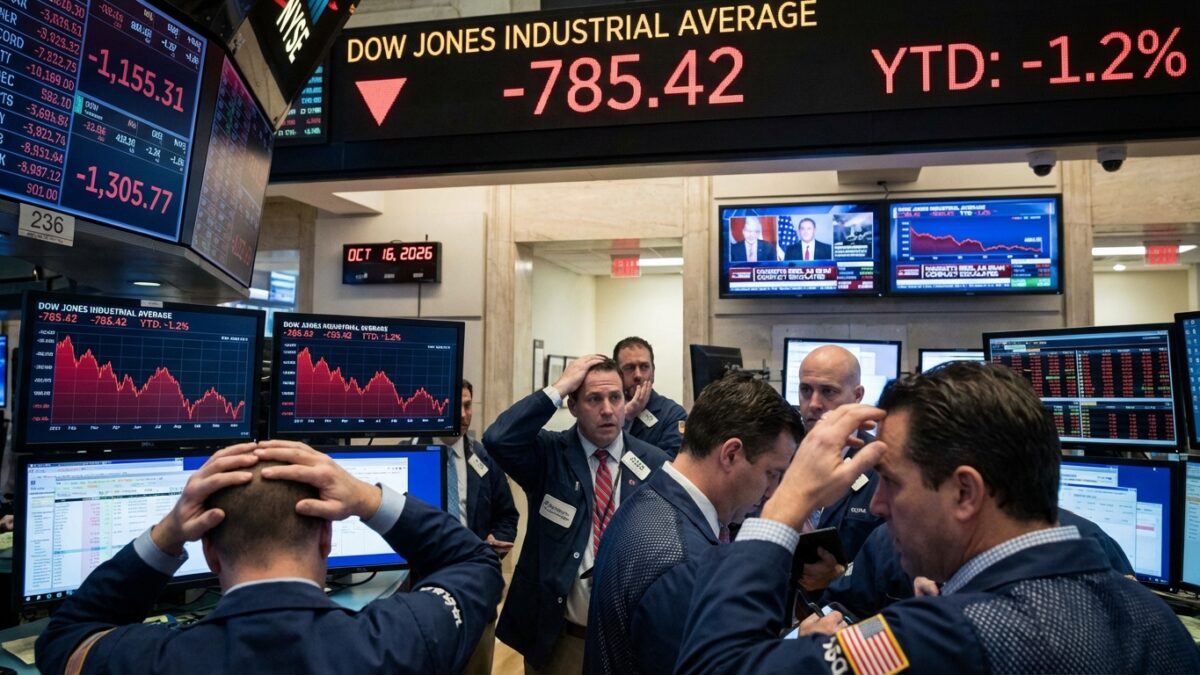
The Dow Jones Industrial Average turned negative for 2026 after a punishing week of losses driven by the Iran war, falling 785 points on March 5 alone to close at 47,955, its lowest level since late January. The blue-chip index has now erased all gains from the year’s first two months, joining the S&P 500 in negative territory as investors confront the possibility that the conflict could trigger an economic downturn through sustained energy price increases, disrupted trade routes, and the chilling effect of geopolitical uncertainty on business investment and consumer spending. (Source: CNBC; TheStreet)
A Week of Wild Swings
The week produced extraordinary volatility. On Tuesday March 3, the Dow plunged more than 1,200 points intraday before recovering to close down 404. Wednesday saw a modest rebound as Trump suggested the Navy would escort tankers through the Strait of Hormuz. Thursday’s 785-point decline, triggered by Iran’s missile strike on an oil tanker, was the most severe one-day drop since April 2025’s Liberation Day tariff shock. At its worst intraday point on Thursday, the Dow had fallen more than 1,100 points before a partial afternoon recovery. (Source: CNBC; TheStreet)
The sell-off was led by economically sensitive industrials and financials. Caterpillar fell 4.1 percent, Goldman Sachs dropped 3.9 percent, and GE Aerospace lost 3.4 percent as investors priced in supply chain disruption and margin compression. The Dow Jones Transportation Index fell 2.9 percent. Only energy stocks bucked the trend, with Exxon Mobil rising 2.2 percent as higher oil prices boosted revenue expectations. (Source: CNBC)
Investor Sentiment Plummets
The American Association of Individual Investors weekly survey showed bullish sentiment falling to 33.1 percent, its lowest since November 2025, while neutral sentiment surged to 31.4 percent, the highest since January 2025. The CBOE Volatility Index spiked 30 percent. Gold, which had been trading like a meme stock with volatile swings in recent weeks, benefited from safe-haven demand, holding above $5,000 per ounce despite a sharp one-day selloff earlier in the week. Bitcoin dropped below $71,000 as crypto failed to serve as the uncorrelated safe haven its advocates had promised. (Source: CNBC; TheStreet)
Berkshire Hathaway provided a notable counterpoint, disclosing that new CEO Greg Abel had purchased $15 million in company stock and that the conglomerate had resumed share buybacks for the first time since 2024. The move signaled that at least one major institutional investor viewed the sell-off as an opportunity rather than a harbinger of further decline. However, the broader market remained firmly in risk-off mode, with investors rotating into defensive sectors, Treasuries, and cash. (Source: CNBC)
What Wall Street Is Watching
Goldman Sachs estimated that current oil prices around $85 implied markets expected approximately four weeks of disruption. The firm warned that if disruption extends further, forced demand destruction through triple-digit oil prices could become necessary to rebalance supply. JPMorgan analysts identified four key variables: the extent of supply disruption, its duration, whether alternative supply can be mobilized, and what comes next strategically. With Iran’s foreign minister rejecting ceasefire calls and the new supreme leader signaling hardline continuity, the optimistic four-week timeline that markets had priced in appeared increasingly fragile. (Source: Fortune; CNBC)
The February jobs report, due March 6, provides the next major economic datapoint. Challenger’s February data showed 48,307 job cuts with AI cited as the driver for 10 percent, while year-to-date hiring plans were down 56 percent from the prior year. A weak report would heighten recession fears; a strong one would complicate the Fed’s ability to cut rates. Either way, the Iran war has introduced a level of economic uncertainty that makes traditional market analysis unreliable, with the Dow’s journey into negative territory for the year reflecting not just a temporary shock but potentially a fundamental repricing of risk in a world where two simultaneous wars and an escalating trade conflict have become the new normal.
The semiconductor sector faced additional pressure. Bloomberg reported the administration was considering new AI chip export permits, sending the VanEck Semiconductor ETF sliding more than 3 percent. The iShares MSCI South Korea ETF plunged 6.4 percent. The convergence of war volatility and potential tech regulatory restrictions created a particularly challenging environment for investors. (Source: Bloomberg; TheStreet)
Professional investors counseled patience, noting markets historically recover from geopolitical shocks. But the combination of oil above $80, sticky inflation, a war with no end date, and the expired nuclear arms treaty has created a risk environment unlike any since the early 2000s. For individual investors watching portfolios decline, the question is whether historical recovery patterns apply to a conflict simultaneously more intense, more expensive, and more expansive than any previous Middle Eastern war in the modern era.
Berkshire Hathaway provided a notable counterpoint to the market gloom, disclosing that new CEO Greg Abel purchased $15 million in company stock and the conglomerate resumed share buybacks for the first time since 2024. The move signaled that at least one major institutional investor viewed the sell-off as opportunity rather than harbinger of decline. The broader investment community is watching whether Abel’s early conviction proves prescient, a determination that depends entirely on the war’s duration and resolution. For the millions of Americans whose retirement savings are invested in index funds tracking the Dow and S&P 500, the market’s journey into negative territory represents not just an abstract financial metric but a direct reduction in future financial security.