
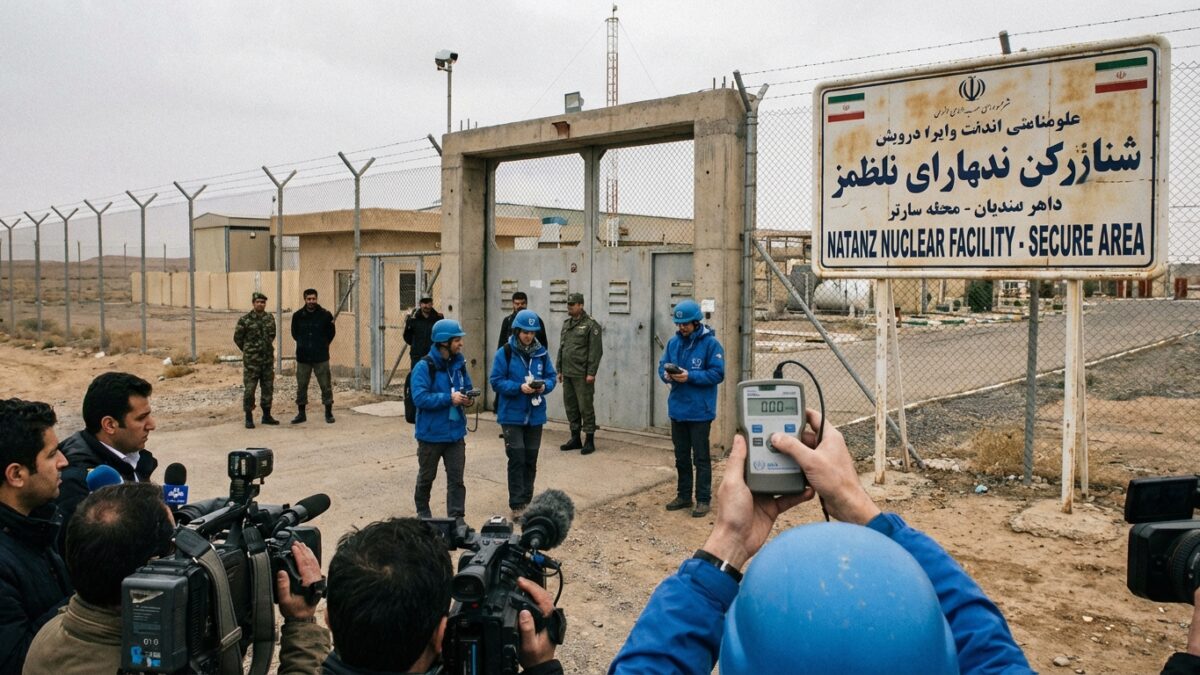
The International Atomic Energy Agency confirmed that the entrances to Iran’s underground Natanz Nuclear Facility were bombed during the U.S.-Israeli military campaign, but stated that there were no signs of increased radiation at the site. The confirmation, reported by Reuters on March 3, provides the first independent verification of strikes on Iran’s nuclear infrastructure and raises complex questions about both the effectiveness and the risks of targeting nuclear facilities during wartime. (Source: Reuters; Wikipedia)
What Was Struck
Natanz is Iran’s primary uranium enrichment facility, located approximately 200 kilometers south of Tehran. The site includes both above-ground structures and a massive underground hall housing centrifuge cascades buried under meters of concrete and earth. The IAEA’s statement that entrances were bombed suggests the strikes targeted access points rather than attempting to penetrate to the underground enrichment halls themselves, a distinction that has significant implications for both the facility’s operational status and the environmental risk. (Source: Reuters; Wikipedia)
The IAEA’s finding of no increased radiation is important because strikes on active enrichment facilities could release radioactive material, creating a public health emergency that would extend far beyond the immediate conflict zone. The fact that radiation levels remained normal suggests either that the underground enrichment operations were not directly damaged or that the facility was not actively enriching uranium at the time of the strikes. Iran had dramatically increased its oil exports in the weeks before the conflict, but its nuclear activities in the immediate pre-war period remain less transparent. (Source: Reuters)
Previous Nuclear Strikes
The Iran war is not the first time the country’s nuclear infrastructure has been targeted. During the Twelve-Day War in June 2025, the U.S. bombed the Fordow enrichment facility, the Natanz facility, and the Isfahan nuclear technology center. That earlier campaign was followed by a ceasefire and the resumption of negotiations. The current strikes are far more extensive and come after those negotiations collapsed, removing the diplomatic framework that previously provided an alternative to military action. (Source: Wikipedia)
The IAEA’s role as an independent monitor of Iran’s nuclear program has been complicated by the conflict. The agency’s inspectors were last able to verify Iran’s nuclear activities before the war began, and their ability to return to the country depends on a cessation of hostilities. Without ongoing IAEA monitoring, the international community has limited visibility into the status of Iran’s enrichment program, creating uncertainty about whether the strikes actually achieved their stated objective of degrading Iran’s nuclear capabilities. (Source: Reuters)
Nonproliferation Implications
Following the ceasefire that ended the June 2025 conflict, Iranian officials had already signaled that Iran might cease complying with the Nuclear Non-Proliferation Treaty. Foreign Minister Araghchi and other officials questioned Iran’s future commitment to nonproliferation agreements. The current, far more devastating military campaign is likely to intensify those sentiments, potentially accelerating rather than preventing the nuclear weapons development it was intended to stop. As the Council on Foreign Relations warned in its February 2026 assessment, the most likely outcomes for leadership change in Iran are also the least auspicious for U.S. interests, with successors likely to extend Tehran’s most destabilizing policies including its nuclear program. (Source: Wikipedia; Council on Foreign Relations)
The paradox of striking nuclear facilities to prevent nuclear weapons development while potentially motivating the regime to accelerate that development is one of the most consequential dilemmas of the conflict. The IAEA’s monitoring absence means the world may not know for months or years whether the strikes succeeded in degrading Iran’s nuclear capabilities or merely provided the motivation to rebuild them in more hardened, more dispersed, and more secretive configurations.
The Natanz strikes also raise questions about military action and nonproliferation. Iran was enriching uranium to near weapons-grade per a December 2024 IAEA report. Strikes damaged some infrastructure, but the knowledge base and institutional capacity to rebuild remain intact. History shows military strikes delay but do not permanently prevent nuclear development when political motivation persists, as demonstrated by Israel’s 1981 Iraq and 2007 Syria strikes. (Source: Reuters; Wikipedia)
The NPT Review Conference scheduled for spring 2026 takes place in the shadow of these strikes, creating an extraordinarily challenging diplomatic environment. Nuclear-weapon states must demonstrate disarmament progress, but New START’s expiration, the strikes on Iranian facilities, and China’s expansion paint a picture of proliferation risks increasing. The international framework for nuclear restraint faces its most severe stress test since the Cold War’s end. (Source: ICAN; Council on Foreign Relations)
Iran’s nuclear scientists and technical personnel, many of whom trained at institutions that remain intact, represent a knowledge base that cannot be destroyed through airstrikes. The experience of post-invasion Iraq, where nuclear scientists scattered but retained their expertise, demonstrates that destroying physical infrastructure without addressing the human knowledge base provides only temporary setback. The broader question for international security is whether the military campaign has created conditions more or less favorable to eventual nuclear proliferation, a question that may not be answerable for years but whose implications will shape Middle Eastern security for decades.