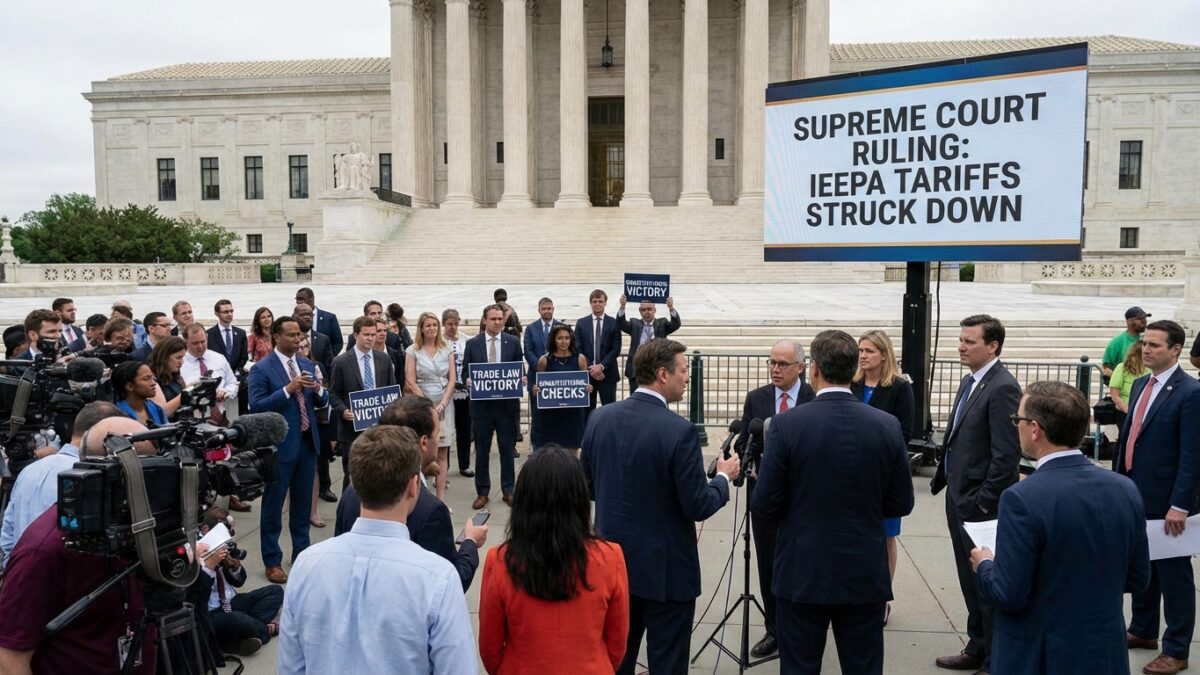
The U.S. Supreme Court ruled on February 20, 2026, in a decisive 6-3 decision, that the International Emergency Economic Powers Act does not authorize the president to impose tariffs, striking down the sweeping trade measures that had defined much of President Donald Trump’s economic agenda. The ruling in Learning Resources, Inc. v. Trump represents a historic rebuke of executive tariff authority and has immediate implications for U.S. trade policy, consumer prices, and the global economy. (Source: Supreme Court opinion, 607 U.S. ___ (2026))
The Ruling
Chief Justice John Roberts authored the majority opinion, joined fully by Justices Neil Gorsuch and Amy Coney Barrett, and in part by Justices Sonia Sotomayor, Elena Kagan, and Ketanji Brown Jackson. Justices Clarence Thomas, Samuel Alito, and Brett Kavanaugh dissented.
Roberts wrote that the president’s claim of sweeping tariff authority rested on just two words separated by 16 others in IEEPA — regulate and importation — and that those words cannot bear such weight. He further noted that IEEPA contains no reference to tariffs or duties and that no previous president had read IEEPA as conferring such power. (Source: SCOTUSblog)
In a significant section joined by Gorsuch and Barrett, Roberts also invoked the major questions doctrine, the principle that if Congress wants to delegate decisions of vast economic or political significance, it must do so clearly. The Court had previously relied on this doctrine to strike down the Biden administration’s student-loan forgiveness program in 2023.
The ruling invalidates all tariffs imposed under IEEPA, including the so-called Liberation Day tariffs and the border security and fentanyl tariffs targeting imports from China, Canada, and Mexico. However, tariffs imposed under separate authorities — including Section 232 tariffs on steel, aluminum, copper, automobiles, semiconductors, and other products — remain in effect.
Financial Impact
The Tax Foundation estimated that IEEPA tariffs had raised more than $160 billion for the federal government through February 20, 2026, and would have generated $1.4 trillion from 2026 through 2035 had they remained in place. The ruling erases nearly three-quarters of the new tax revenue the Trump administration had hoped to raise from tariffs. (Source: Tax Foundation)
The Yale Budget Lab estimated that the tariffs as of the ruling date would raise approximately $1.2 trillion over ten years — roughly half of what would have been raised if IEEPA tariffs had been upheld. The lab’s analysis found that tariffs are a regressive tax, with lower-income households bearing a disproportionate burden. Average annual costs to households in the lowest income decile were approximately $400, while those in the top decile faced costs of roughly $1,800 in 2025 dollars. (Source: Yale Budget Lab)
According to research from the Federal Reserve Bank of New York, nearly 90 percent of tariff costs had been borne by American firms and consumers. The U.S. average effective tariff rate had climbed to nearly 17 percent, the highest since the early 1930s, according to analysis cited by Brookings Institution experts.
The President’s Response
Within hours of the decision, President Trump signed an executive order directing agencies to cease collection of IEEPA tariffs, stating they shall no longer be in effect. However, the order did not address the critical question of refunds. Trump then invoked Section 122 of the Trade Act of 1974 to impose a 10 percent temporary import surcharge on products from all countries, effective February 24. The following day, he raised that rate to 15 percent — the maximum allowed under Section 122.
Section 122 tariffs are limited to 150 days unless Congress votes to extend them, creating a built-in deadline of July 24, 2026. Trump indicated he would use the 150-day period to launch investigations under Section 301 of the Trade Act that could serve as the basis for longer-term tariff actions. Legal experts widely expect the Section 122 tariffs to face their own court challenges.
The Peterson Institute for International Economics noted that Section 122 applies to balance-of-payments deficits, which are conceptually distinct from the trade deficits Trump has cited. The president’s own lawyers had argued in the IEEPA case that Section 122 was no substitute for IEEPA authority. (Source: PIIE)
Refund Uncertainty
The Court did not address how refunds of previously collected IEEPA tariffs should be processed. In his dissent, Justice Kavanaugh warned that the government may be required to refund billions of dollars to importers who paid the tariffs. Nearly 2,000 importers had filed cases at the Court of International Trade challenging the IEEPA tariffs ahead of the ruling.
Holland & Knight attorneys advised importers to act promptly to preserve their refund rights by contacting legal counsel, preserving records of entries subject to IEEPA tariffs, and monitoring administrative mechanisms. The administration has signaled it may resist issuing refunds, suggesting the matter could take years to resolve through litigation. (Source: Holland & Knight)
Broader Implications
The ruling has significant political consequences heading into the 2026 midterm elections. Both the House and Senate had previously passed bills disapproving of the IEEPA tariffs and would be unlikely to authorize their continuation through congressional action. The 150-day clock on Section 122 tariffs will force members of Congress to take recorded votes on trade policy just months before November elections.
For consumers and businesses, the immediate picture is mixed. While IEEPA tariffs have been eliminated, the replacement Section 122 tariffs keep overall tariff rates at levels comparable to those in place before the ruling. Prices at the store are likely to remain elevated as long as tariffs persist in any form, analysts noted. Businesses continue to face both higher input costs and sustained policy uncertainty.
The European Union has expressed relief at the ruling but remains cautious about Washington’s trade unpredictability. The decision reinforces the constitutional principle that the power to tax — including through tariffs — belongs to Congress, not the executive branch, a point that Chief Justice Roberts emphasized throughout the majority opinion.