
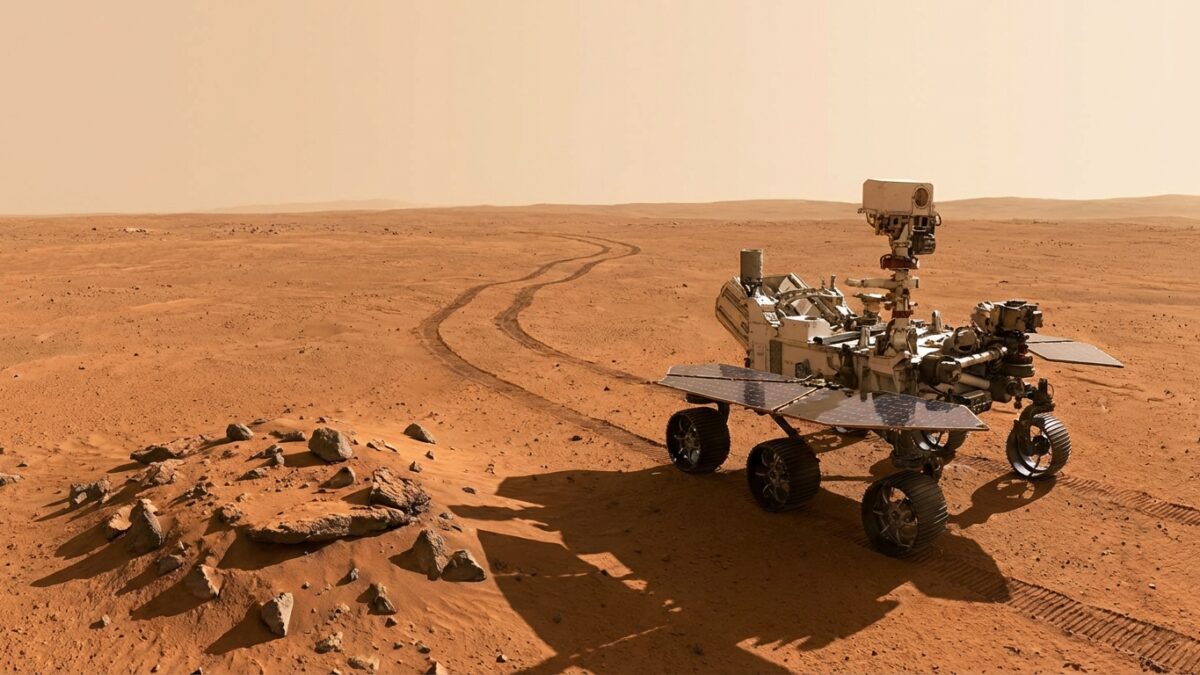
NASA’s Perseverance rover has made history by becoming the first spacecraft to drive across Mars using routes planned entirely by artificial intelligence rather than human operators. The milestone, announced in early February 2026, marks a significant advancement in autonomous space exploration and could reshape how future missions navigate extraterrestrial terrain. (Source: ScienceDaily, February 2, 2026)
How It Works
Traditionally, Mars rover navigation has been a painstaking process involving teams of human operators on Earth who analyze images and terrain data transmitted from the rover, plan safe driving routes, and upload instructions that the rover follows on subsequent sols, or Martian days. The round-trip communication delay between Earth and Mars — ranging from approximately 4 to 24 minutes depending on orbital positions — makes real-time driving impossible, and the cautious human planning process has historically limited rovers to relatively short daily drives.
The new AI system changes this paradigm fundamentally. A vision-capable AI analyzes the same images and terrain data normally used by human rover planners but does so autonomously and on the rover itself, identifying safe paths, evaluating hazards, and generating optimized driving routes without waiting for instructions from Earth. The system can process terrain information far more quickly than human planners and can adapt its route in near-real-time as new visual data becomes available during the drive. (Source: NASA)
Perseverance’s Record-Setting Journey
The AI-planned drive comes as Perseverance continues to set records on the Martian surface. By the end of 2025, the rover had traveled a total of 39.96 kilometers since landing in Jezero Crater in February 2021 — surpassing the distance logged by its predecessor Curiosity, which had accumulated 36.16 kilometers since its 2012 landing. If Perseverance continues at its current pace, it is expected to break the all-time extraterrestrial driving distance record of 45.16 kilometers set by the Opportunity rover sometime in 2026. (Source: NASASpaceFlight.com)
The AI driving capability could accelerate this timeline significantly. By reducing the dependency on Earth-based planning cycles, autonomous navigation allows the rover to cover more ground per sol, maximizing the scientific return from each day of the mission. This is particularly valuable as Perseverance continues its primary mission of collecting rock and soil samples from Jezero Crater that may contain evidence of ancient microbial life.
Scientific Significance
Perseverance’s exploration of Jezero Crater has already yielded remarkable scientific results. NASA scientists studying rock samples collected by Curiosity at nearby Gale Crater have uncovered the largest organic molecules ever detected on Mars — compounds known as decane and undecane. Importantly, researchers determined that meteorite delivery cannot fully explain the presence of these molecules, suggesting they may have a geological or potentially biological origin. (Source: ScienceDaily, February 12, 2026)
The discovery of complex organic molecules on Mars has been one of the most tantalizing findings of recent planetary exploration. While the presence of organic compounds does not prove that life existed on Mars, it establishes that the chemical building blocks necessary for biology were present on the planet’s surface. A separate NASA study published in February 2026 found that key building blocks of proteins could survive tens of millions of years in pure Martian ice, suggesting that if ancient life existed, its molecular signatures could potentially be preserved in the planet’s frozen polar caps.
Implications for Future Missions
The successful demonstration of AI-planned driving on Mars has immediate implications for upcoming missions. Japan’s Martian Moons eXploration mission, scheduled to launch in 2026, will travel to the Martian moon Phobos to collect samples for return to Earth. China’s Tianwen-2 sample-return mission will target asteroid 469219 Kamo’oalewa in 2026. Both missions could benefit from autonomous navigation technologies developed and proven by Perseverance.
Looking further ahead, the European Space Agency and its research partners have unveiled a bold mission concept for exploring lava tubes on the Moon and Mars using teams of three different robots working together autonomously. Hidden lava tunnels could one day shelter human explorers, offering natural protection from radiation and space debris, and robotic exploration of these environments will require precisely the kind of autonomous navigation Perseverance has now demonstrated. (Source: ScienceDaily, February 2, 2026)
The Broader AI-Space Convergence
Perseverance’s AI driving achievement reflects a broader trend of artificial intelligence transforming space exploration. Stanford researchers announced in January 2026 that they had developed an AI system capable of predicting future disease risk using data from a single night of sleep. University of Michigan researchers created an AI that can interpret brain MRI scans in seconds. These medical AI advances, while terrestrial in application, share the same underlying principles of pattern recognition and autonomous decision-making that enable a rover to navigate an alien landscape.
For NASA, the technology represents a step toward the more autonomous systems that will be essential for human missions to Mars, where communication delays make real-time Earth-based control of any surface operations impractical. As the agency prepares for the Artemis program’s eventual crewed Mars missions, the lessons learned from Perseverance’s AI driving system will inform the design of navigation, habitat management, and scientific exploration tools that future astronauts will rely upon.