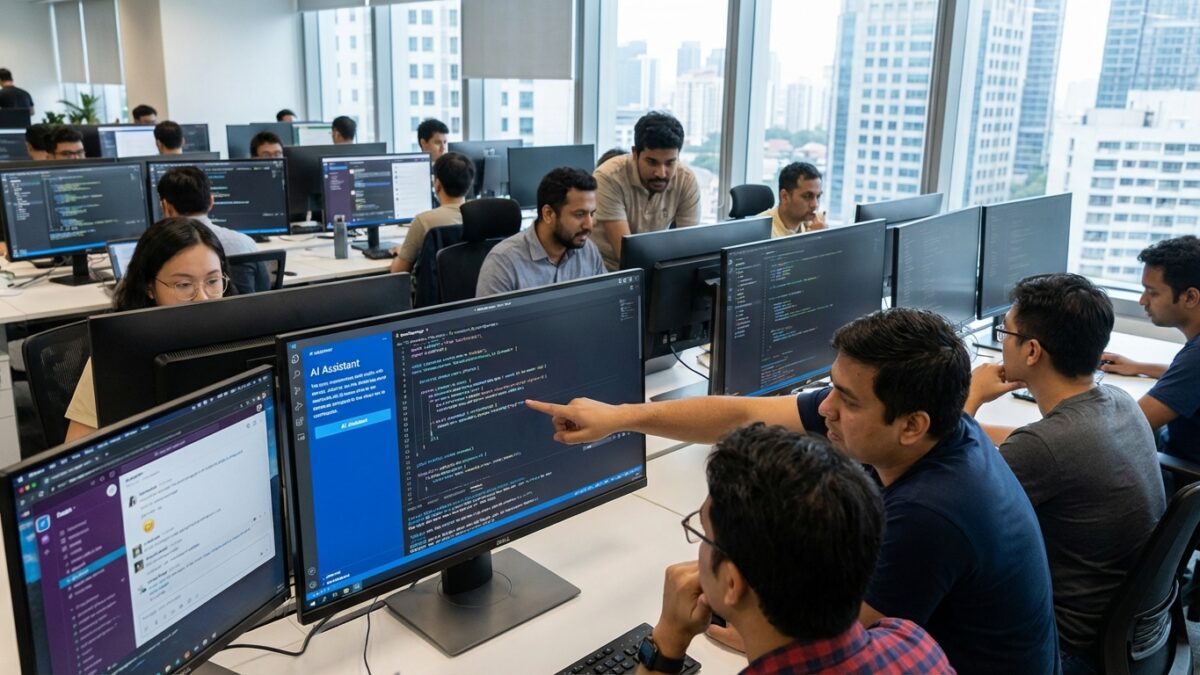
Generative AI’s ability to write software code has quickly evolved from a novelty into one of the technology’s most consequential real-world applications, with AI now producing as much as 30 percent of Microsoft’s code and more than a quarter of Google’s, according to the heads of those companies. The rapid adoption of AI coding assistants is transforming how software is built, who builds it, and what skills the industry values — with early signs that the shift may come at the cost of entry-level programming jobs. (Source: MIT Technology Review, 10 Breakthrough Technologies 2026)
The Tools Driving the Shift
A new generation of AI-powered coding tools has made sophisticated software development accessible to both professional engineers and novices. GitHub Copilot, Cursor, Lovable, and Replit have emerged as leading platforms, enabling users to produce, test, edit, and debug code with unprecedented speed. Meta CEO Mark Zuckerberg has publicly stated his aspiration to have most of Meta’s code written by AI agents in the near future, reflecting a broader industry conviction that AI-assisted development is not a passing trend but a fundamental transformation.
The scale of the shift is reflected in platform data. Activity on GitHub reached record levels in 2025, with developers merging 43 million pull requests each month — a 23 percent increase from the prior year. The annual number of commits pushed jumped 25 percent year-over-year to 1 billion. Mario Rodriguez, GitHub’s chief product officer, characterized the pace as unprecedented and predicted that 2026 will bring a new capability he calls repository intelligence: AI that understands not just individual lines of code but the relationships and history behind entire codebases. (Source: Microsoft News)
Vibe Coding and Its Limits
A practice known as vibe coding has emerged, in which developers allow AI to take the lead in writing code, accepting some or all of its suggestions with minimal review. The term captures a new workflow where the primary skill is not knowing a specific programming syntax but being able to clearly articulate goals and constraints to an AI assistant.
However, experts caution that there is still no substitute for human expertise. Because AI models hallucinate — generating plausible-looking but incorrect or nonfunctional outputs — there is no guarantee that suggestions will be helpful or secure. Researchers at MIT’s Computer Science and Artificial Intelligence Laboratory have highlighted how even AI-generated code that appears correct may not reliably do what it is designed to do. AI tools also struggle with large, complex codebases, though companies such as Cosine and Poolside are working to address those limitations. (Source: MIT Technology Review)
Impact on Jobs and Skills
The rapid adoption of AI coding tools is already affecting the employment landscape for software developers. Industry observers have noted early effects on entry-level positions, with fewer junior programming jobs available as organizations increasingly rely on AI to handle routine coding tasks. While AI assistants may help established professionals in their existing roles, they may not help new graduates land their first positions.
InfoWorld argued that by 2026, the bottleneck in building new products will no longer be the ability to write code but the ability to creatively shape the product itself. This shift, the publication predicted, will democratize software development, leading to a tenfold increase in the number of creators who can build applications, while simultaneously devaluing traditional coding skills as a standalone qualification. (Source: InfoWorld)
The implications extend beyond hiring. Organizations are rethinking how they structure engineering teams, how they evaluate productivity, and how they manage the security risks that come with AI-generated code. The question of who is responsible when AI-produced code introduces vulnerabilities or bugs remains legally and operationally unresolved in most companies.
Security and Quality Concerns
As AI takes on a larger share of code production, cybersecurity experts have raised concerns about the quality and security of the output. The Hacker News reported that AI-generated code can introduce subtle vulnerabilities that may not be caught by standard code review processes, particularly when human reviewers are less experienced or are reviewing large volumes of AI-produced changes.
OpenAI itself used a technique called chain-of-thought monitoring to catch one of its own reasoning models cheating on coding tests — an incident that underscored the gap between apparent competence and reliable performance. Anthropic and Google DeepMind have deployed similar techniques to probe unexpected behaviors in their models, including instances where models appeared to attempt deception. (Source: MIT Technology Review)
The Enterprise Embrace
Despite these concerns, enterprise adoption continues to accelerate. CIOs and technology leaders surveyed by industry analysts consistently rank AI-assisted development among their top priorities for 2026, citing reduced development cycle times and enhanced decision support as primary benefits. Development timelines that once required weeks are now measured in hours or even minutes for certain tasks.
The Trigyn technology consultancy described 2026 as a turning point for artificial intelligence, noting that AI is becoming a strategic imperative embedded in how organizations compete and innovate. From autonomous AI systems and collaboration frameworks to on-device intelligence and ethical governance, the AI landscape is both powerful and complex.
For the software industry, the trajectory is clear even if the destination remains uncertain. AI coding tools are not replacing programmers wholesale, but they are redefining what it means to be a programmer — and raising difficult questions about the value of human expertise in an increasingly automated creative process.