
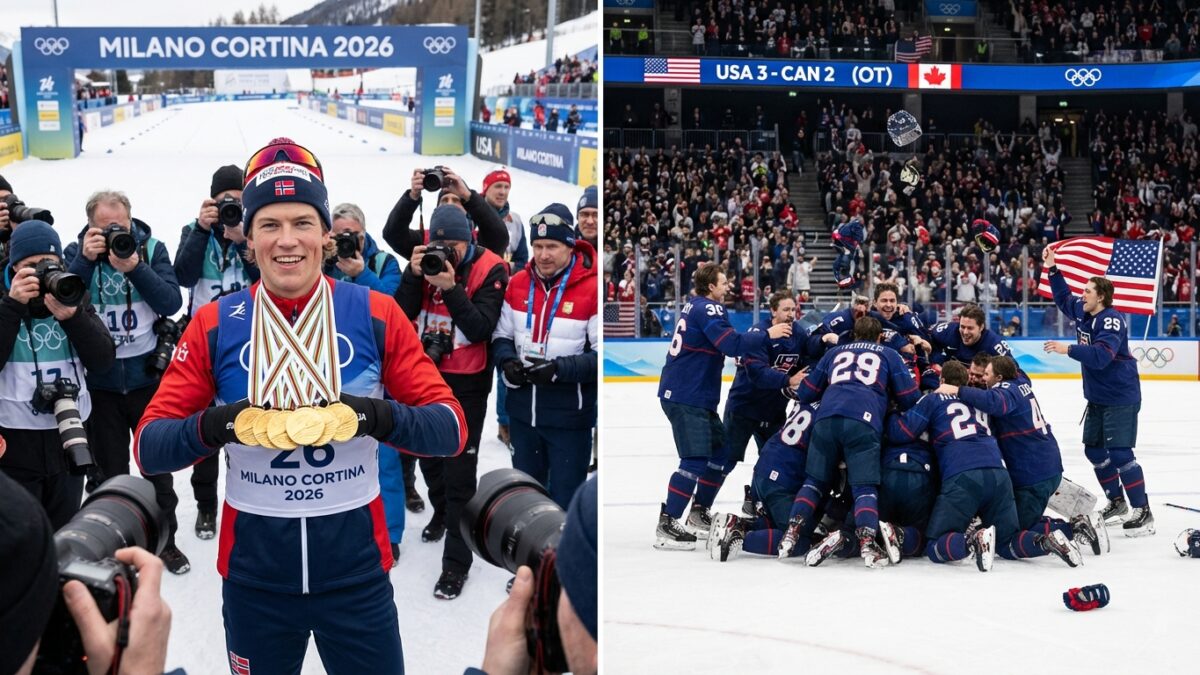
The XXV Olympic Winter Games in Milano Cortina concluded on February 22 with a closing ceremony at the Verona Arena, capping 16 days of competition that produced historic milestones, stunning upsets, and performances that will be remembered for generations. Nearly 2,900 athletes competed across 116 medal events in 16 disciplines, making these the largest Winter Olympics ever held. (Source: International Olympic Committee)
Klaebo’s Unprecedented Dominance
Norway’s Johannes Hoesflot Klaebo cemented his status as the greatest cross-country skier in Olympic history with a staggering six gold medals at a single Games, a feat never before achieved in any winter sport. His final triumph came in the grueling 50km mass start classic, where he won by 17.5 seconds over teammate Martin Lowstrom Nyenget, completing a Norwegian podium sweep. (Source: Olympics.com)
At 29, Klaebo now holds 11 career Olympic gold medals across three Games, extending his record as the all-time leader. His dominance was so thorough that commentators compared his impact to that of the greatest single-Games performers in Olympic history, including swimmer Michael Phelps. (Source: Olympics.com)
Team USA’s Hockey Miracle on Ice Sequel
In what will likely become the defining moment of these Games for American audiences, Team USA defeated Canada 2-1 in overtime to win men’s ice hockey gold for the first time since the legendary 1980 Miracle on Ice. Jack Hughes scored the overtime winner, sparking celebrations that echoed across the host city. The victory was particularly significant as it marked the first Winter Olympics since 2014 to feature NHL players, following an agreement between the International Ice Hockey Federation and the league. (Sources: Olympics.com, NBC Olympics)
The women’s hockey tournament produced its own overtime classic, with Team USA defeating Canada 2-1 to claim their third Olympic title. The rivalry between the two nations delivered two of the most compelling hockey games in Olympic history on consecutive days.
Stars Across Every Discipline
China’s Eileen Gu further burnished her legacy as the most decorated freeskier in Olympic history, winning halfpipe gold with an electrifying third-run score of 94.75 to complete a three-medal haul that included silver in slopestyle and big air. She now holds six career Olympic medals. (Source: Olympics.com)
American figure skater Alysa Liu became the first U.S. woman to win individual gold in 24 years, while 17-year-old Choi Gaon of South Korea stunned two-time defending champion Chloe Kim in the women’s snowboard halfpipe. The Netherlands dominated speed skating, with Xandra Velzeboer and Jens van’t Wout each claiming multiple medals. (Source: Olympics.com)
Ski mountaineering made its triumphant Olympic debut, with Spain’s Oriol Cardona Coll and Switzerland’s Marianne Fatton crowned as the sport’s first Olympic champions in the sprint events. American alpine skier Breezy Johnson added Olympic gold to her World Championship crown in the women’s downhill, winning by just 0.04 seconds over Germany’s Emma Aicher. (Source: Olympics.com)
A Landmark Games for the Sport
The 2026 Games were the first under new IOC President Kirsty Coventry, and the first to be officially co-hosted by two cities, with Milan handling ice events and Cortina d’Ampezzo hosting snow disciplines alongside venues in Livigno and Fiemme. The opening ceremony at Milan’s San Siro stadium, titled Armonia, featured performances by Mariah Carey, Laura Pausini, and Andrea Bocelli, and introduced a historic first: two Olympic cauldrons lit simultaneously in both host cities. (Source: Wikipedia)
Italy’s Federica Brignone delivered for the home crowd with a stirring victory in alpine skiing just weeks after returning from injury, while France’s biathlon team dominated with Julia Simon winning three gold medals before compatriot Oceane Michelon edged her in a thrilling mass start final. (Source: Olympics.com)
The closing ceremony, titled Beauty in Action, included the formal handover to the French Alps as hosts of the 2030 Winter Olympics. The Paralympic Winter Games will follow from March 6 to 15 at the same venues. (Source: IOC)
For a Games that faced years of scrutiny over infrastructure delays and budget concerns, Milano Cortina 2026 ultimately delivered the sporting spectacle that organizers promised, producing 116 sets of medals and countless memories that will endure far beyond the Italian Alps.
Medal Count and National Highlights
Norway dominated the overall medal table, fueled largely by Klaebo’s historic cross-country campaign and strong performances across biathlon and Nordic combined, where Jens Luraas Oftebro won three gold medals of his own. The United States enjoyed one of its strongest Winter Olympics performances in years, anchored by the men’s and women’s hockey double gold and strong results in freestyle skiing and figure skating.
The Netherlands cemented its status as a speed skating powerhouse, while France’s biathlon program proved the deepest in the world. Germany maintained its stranglehold on luge, winning gold in every event for the fourth consecutive Olympics. Host nation Italy celebrated victories in alpine skiing and short track speed skating that sent home crowds into raptures at venues across the country.
The Games also served as a reminder of the evolving geography of winter sports. South Korea produced several memorable moments, including Choi Gaon’s stunning upset of Chloe Kim and strong performances in short track. China’s Eileen Gu and Ning Zhongyan, who won speed skating gold in an Olympic record time, reflected the nation’s growing investment in winter sports development since hosting the 2022 Beijing Games.