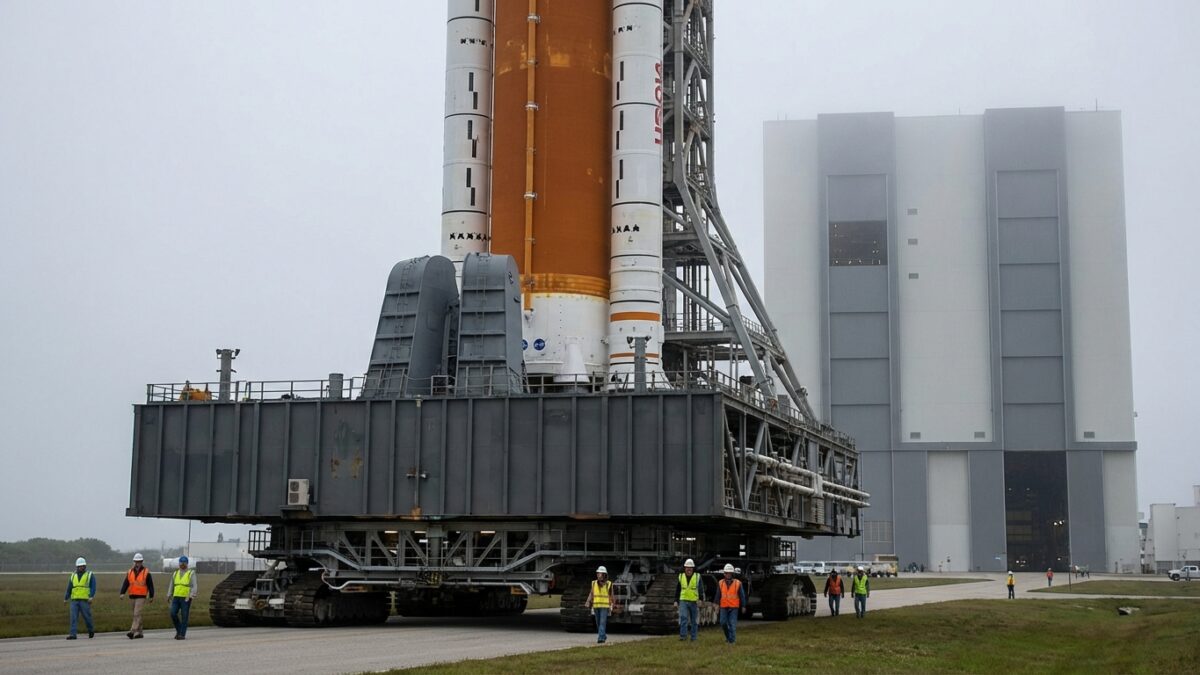
NASA’s long-awaited Artemis II mission — the first crewed flight around the Moon since Apollo 17 in 1972 — has been pushed to no earlier than April 2026 after engineers encountered a helium flow issue that required rolling the massive Space Launch System rocket and Orion spacecraft back to the Vehicle Assembly Building at Kennedy Space Center in Florida. The rollback, completed on February 25, marks the latest in a series of technical setbacks that have repeatedly delayed the historic mission. (Source: NASA)
A Troubled Path to the Pad
The Artemis II stack — comprising the SLS rocket, the Orion crew capsule, the European Service Module, and the launch abort system — had been standing on Launch Pad 39B since January 18, when it completed a dramatic 4-mile rollout from the VAB. Teams had been preparing for a wet dress rehearsal, a critical prelaunch test that involves fueling the rocket to identify and resolve issues before an actual launch attempt.
The first wet dress rehearsal began on January 31, with engineers starting the approximately 49-hour countdown. Cold weather at Kennedy Space Center caused delays in bringing some hardware interfaces to acceptable temperatures. During the fueling process on February 2, engineers spent several hours troubleshooting a liquid hydrogen leak in an interface used to route cryogenic propellant into the rocket’s core stage. While the team ultimately met many of its planned objectives, the hydrogen leak and other issues pushed the mission off the February launch window. (Source: NASA mission blog)
A second wet dress rehearsal on February 19 proved more successful, completing the tanking process without the hydrogen leak that had plagued the first attempt. However, on February 21, a new problem emerged: an issue with the flow of helium to the rocket’s upper stage, the Interim Cryogenic Propulsion Stage. Teams identified the problem as potentially involving the interface between ground and rocket lines, a valve in the upper stage, or a filter between the ground and the vehicle.
The Rollback Decision
NASA Administrator Jared Isaacman stated that an actual launch date would only be confirmed after successful testing, and managers determined that returning to the VAB was necessary to access and diagnose the helium issue. With high winds forecast for the Space Coast, teams moved quickly to prepare for rollback. The SLS rocket began rolling off the launch pad at 9:38 a.m. EST on February 25, arriving inside the Vehicle Assembly Building approximately 12 hours later after the 4-mile trek. (Source: NASA)
The rapid preparations were designed to preserve the April launch window, though that timeline depends on how quickly the helium issue can be resolved, repairs completed, and testing resumed. For lunar missions, there are monthly windows of a few days determined by the Moon’s orbital position, and daily windows of a few hours within those monthly periods. The revised Artemis II flight plan, which calls for Orion to conduct a shorter skip reentry rather than the originally planned profile, further constrains available launch dates.
The Crew
The Artemis II astronauts — Commander Reid Wiseman, Pilot Victor Glover, and Mission Specialist Christina Koch from NASA, along with Canadian Space Agency astronaut Jeremy Hansen — had entered quarantine in Houston on January 21 in preparation for a February launch. They were released from quarantine on the evening of February 21 following the decision to stand down from the February window. The crew will re-enter quarantine approximately two weeks before the next targeted launch opportunity.
The mission will make history in multiple ways. Glover will become the first person of color, Koch the first woman, and Hansen the first non-American to travel beyond low Earth orbit and around the Moon. The crew will travel farther from Earth than any previous human mission before reentering the atmosphere at approximately 25,000 miles per hour during the planned 10-day flight. (Source: NASA mission overview)
Accelerated Artemis Plans
Despite the Artemis II delays, NASA announced on February 28 an ambitious expansion of the Artemis program. The agency is increasing its cadence of missions, adding a new Artemis III mission in 2027 designed to test systems in low Earth orbit, including a potential rendezvous and docking with commercial landers from SpaceX and Blue Origin. Artemis IV, now the first planned lunar surface landing mission, is targeted for 2028, with plans for at least one surface landing every year thereafter.
Acting Associate Administrator Lori Glaze expressed confidence in the accelerated timeline, stating that she was grateful to Administrator Isaacman for taking bold steps to assure the needed support and resources. Boeing, the manufacturer of the SLS core stage, affirmed its workforce and supply chain were prepared to meet increased production demands. (Source: NASA press release)
Heat Shield Concerns
The delays to Artemis II are partly rooted in complications discovered after the uncrewed Artemis I mission in 2022. During Artemis I’s reentry, engineers observed unexpected damage to Orion’s heat shield, a phenomenon known as spalling where material flaked off in an unanticipated pattern. This prompted extensive investigations and a redesign of the reentry profile for Artemis II, eliminating the originally planned skip reentry in favor of a steeper entry to reduce stress on the heat shield.
The heat shield issue delayed the start of SLS rocket stacking operations by more than two months and pushed the overall mission timeline from the originally targeted September 2025 launch date to early 2026. With the latest helium issue adding further delays, the patience of the public and political stakeholders is being tested. However, NASA officials continue to emphasize that crew safety remains the highest priority.
Once the helium issue is resolved and the rocket is prepared for another rollout, teams will conduct additional testing before setting an official launch target. The eyes of the space community — and millions of people worldwide — remain fixed on Pad 39B, waiting for the moment when humans once again set course for the Moon.