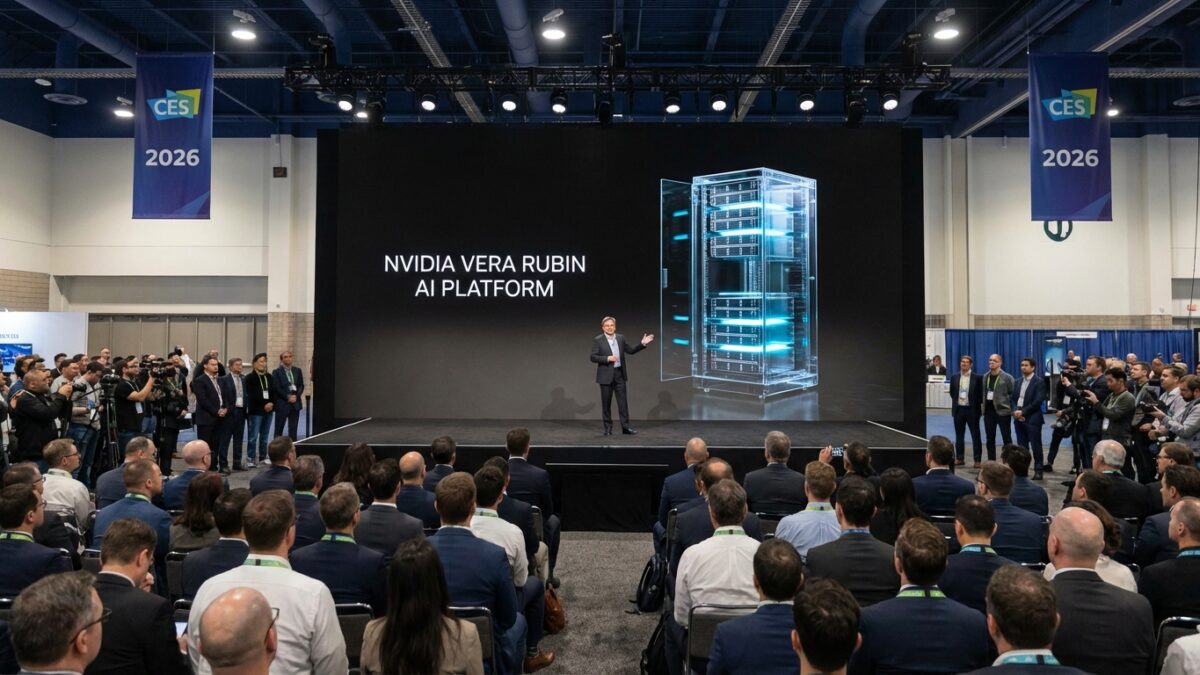
NVIDIA officially unveiled its next-generation AI platform, codenamed Vera Rubin, during its CES 2026 keynote in January, signaling a major leap forward in the infrastructure powering artificial intelligence systems worldwide. The Rubin platform, which succeeds the company’s Blackwell architecture, introduces substantial improvements in processing power and memory bandwidth engineered specifically for the massive scaling demands of frontier AI models and agentic systems. (Source: NVIDIA CES 2026 keynote)
Architecture and Capabilities
Named after the pioneering American astronomer Vera Rubin, whose observations provided some of the first evidence for dark matter, the new platform continues NVIDIA’s tradition of naming GPU architectures after scientific luminaries. The Vera Rubin architecture represents a generational shift in how AI workloads are processed, with improvements designed to address the most pressing bottleneck in modern AI development: the sheer scale of computation required to train and run increasingly sophisticated models.
While NVIDIA has not disclosed all technical specifications ahead of production availability, the company indicated that the Rubin platform will deliver radical improvements over Blackwell in both raw throughput and energy efficiency — a critical consideration as data center power consumption has become a growing concern for the industry and environmental advocates alike. The platform is expected to support the next wave of large language models, multimodal AI systems, and autonomous agent architectures that require sustained high-bandwidth memory access across billions of parameters.
Meta has already announced plans to purchase millions of NVIDIA Blackwell and forthcoming Rubin GPUs, along with CPUs and Ethernet switches, for its AI data center expansion, underscoring the insatiable demand from hyperscale customers. (Source: SemiEngineering)
Market Context and Competition
NVIDIA’s announcement comes at a pivotal moment for the AI chip market. The company maintains an overwhelming dominance in the GPU market for AI training and inference, but faces intensifying competition from multiple directions. Chinese manufacturers are investing heavily in domestic AI chip production, though their technology nodes lag years behind and yields remain poor, according to analysis from the Carnegie Endowment’s technology program. Meanwhile, companies such as Google, Amazon, and Microsoft continue developing custom AI accelerators for their own cloud platforms.
MIT Technology Review’s annual breakthrough technologies list for 2026 noted that while China is going all in on developing advanced AI chips, NVIDIA’s dominance still looks unassailable for now. The gap between Chinese releases and the Western frontier has been shrinking — from months to weeks — but NVIDIA’s ecosystem advantages in software, developer tools, and the CUDA programming platform remain formidable barriers for competitors. (Source: MIT Technology Review)
The Shift Beyond Scaling
The Vera Rubin launch also reflects an evolving understanding of where AI progress will come from in the coming years. Multiple industry observers have noted that the era of simply adding more compute and data to build ever-larger foundation models is reaching its limits. Yann LeCun, formerly Meta’s chief AI scientist who left to start his own world model research lab, has argued against overreliance on scaling and stressed the need for better architectures.
Ilya Sutskever, co-founder of OpenAI, said in a recent interview that current models are plateauing and pretraining results have flattened, indicating a need for new ideas. This perspective was echoed by TechCrunch, which described 2026 as the year AI moves from hype to pragmatism, with the industry transitioning from brute-force scaling to researching new architectures and from flashy demos to targeted deployments. (Source: TechCrunch)
NVIDIA’s platform strategy appears designed to support both paradigms — providing the raw power for organizations still pursuing scale while also enabling the more sophisticated workloads associated with agentic AI, world models, and hybrid quantum-classical computing approaches that are gaining traction among researchers.
Agentic AI and Infrastructure Demand
The Vera Rubin platform arrives as the AI industry increasingly focuses on agentic AI — systems capable of making decisions, carrying out multi-step tasks independently, and operating with persistent memory. InfoWorld identified agent interoperability, self-verification, and memory as the most significant AI advances expected in 2026, arguing that these capabilities will transform AI from isolated tools into integrated systems handling complex workflows.
Peter Lee, president of Microsoft Research, predicted that in 2026, AI will move beyond summarizing papers and answering questions to actively joining the process of scientific discovery. AI will generate hypotheses, use tools and apps that control scientific experiments, and collaborate with both human and AI research colleagues, Lee said in a Microsoft corporate blog post. (Source: Microsoft News)
This vision of AI as an active collaborator — rather than a passive tool — places enormous demands on the underlying compute infrastructure, demands that NVIDIA is positioning Vera Rubin to meet. As organizations across healthcare, financial services, manufacturing, and scientific research deploy increasingly autonomous AI systems, the appetite for next-generation GPUs shows no signs of slowing.
Looking Ahead
NVIDIA’s stock performance has closely tracked the AI investment boom, and the Vera Rubin announcement is expected to sustain investor confidence in the company’s forward trajectory. However, questions remain about the sustainability of current data center spending levels. Some University of California, Berkeley AI experts have described the current investment climate as a potential bubble, noting that revenues remain underwhelming relative to spending and that there are clear theoretical limits on the ability of large language models to learn certain concepts efficiently.
Whether the Vera Rubin platform helps justify the massive capital expenditures flowing into AI infrastructure — or merely extends a cycle of escalating investment without proportional returns — may be one of the defining business questions of 2026.