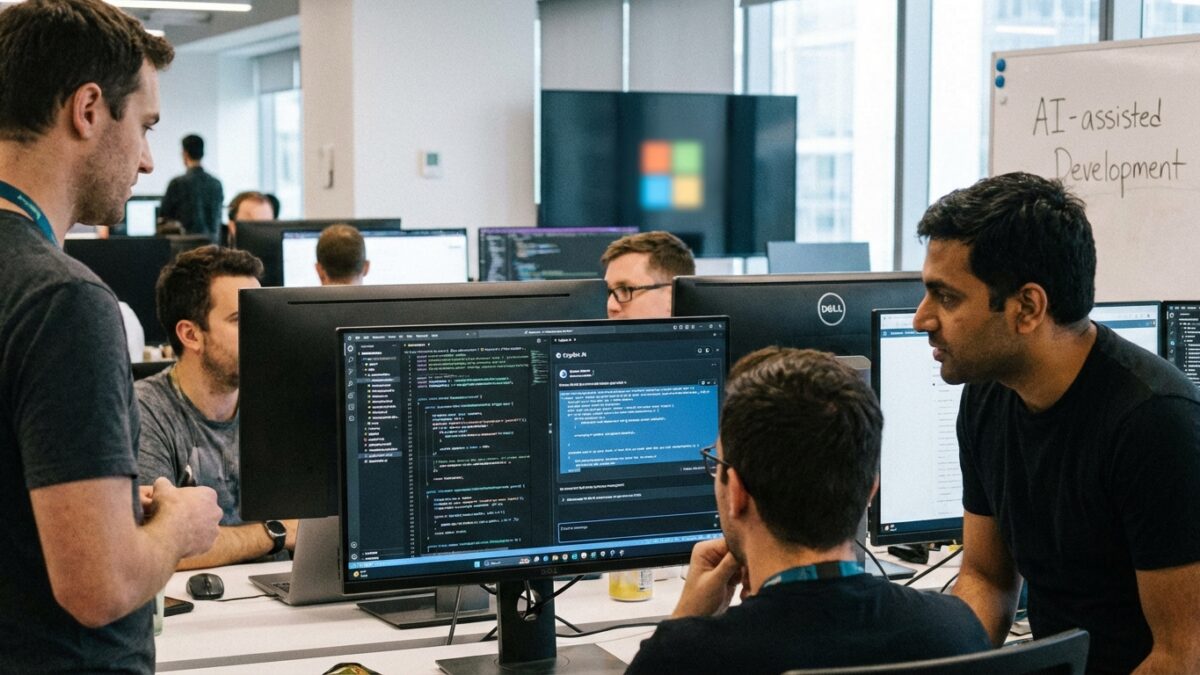
Artificial intelligence tools are now responsible for writing between 25 and 30 percent of new code at the world’s largest technology companies, a milestone that has arrived faster than most industry observers predicted and is fundamentally transforming how software is conceived, written, tested, and maintained.
Microsoft has disclosed that AI coding assistants now generate approximately 30 percent of the code in its repositories, while Google has confirmed that more than 25 percent of its new code is AI-generated. These figures represent a dramatic acceleration from just two years ago, when AI-assisted coding was largely confined to autocomplete suggestions and boilerplate generation. (Sources: Microsoft, Google, Alphabet earnings calls)
The GitHub Metric
The scale of the shift is perhaps best captured by GitHub’s platform statistics. Monthly pull request activity reached 43 million, a 23 percent year-over-year increase, while the platform recorded over 1 billion commits annually, up 25 percent. GitHub has attributed much of this growth to the proliferation of AI coding tools, led by its own Copilot product but increasingly including competitors like Cursor, Sourcegraph’s Cody, and Anthropic’s Claude Code. (Source: GitHub)
The nature of AI-generated code has also evolved considerably. While early AI coding tools primarily excelled at generating small functions and boilerplate patterns, current systems can produce entire modules, write comprehensive test suites, perform complex refactoring operations, and engage in multi-step reasoning about codebases spanning millions of lines. The shift from code completion to code generation to code reasoning represents a qualitative leap in capability. (Source: GitHub)
Impact on Developer Productivity
Internal studies at companies that have broadly deployed AI coding tools report productivity gains ranging from 30 to 55 percent for specific tasks, though the aggregate impact on overall software delivery timelines is more nuanced. Developers consistently report that AI tools are most effective at eliminating repetitive work, accelerating onboarding to unfamiliar codebases, and generating initial implementations that can then be refined.
Thomas Dohmke, GitHub’s CEO, has described the current moment as one where the developer’s role is evolving from writing code to reviewing, directing, and architecting systems where AI handles much of the implementation work. The analogy he frequently employs is the transition from hand-drafted architectural blueprints to computer-aided design: the architect’s expertise becomes more important, not less, even as the tools handle much of the execution.
Quality and Security Concerns
The rapid adoption has not been without controversy. Studies have found that AI-generated code can introduce subtle bugs and security vulnerabilities that are difficult to detect precisely because the code appears syntactically correct and passes basic tests. Researchers at Stanford and Carnegie Mellon have published analyses showing that developers using AI coding assistants sometimes exhibit reduced scrutiny of generated code, a phenomenon described as automation complacency.
Several high-profile incidents in which AI-generated code introduced security vulnerabilities into production systems have prompted organizations to implement dedicated review processes for AI-assisted development. Some companies now require that AI-generated code be flagged and subjected to additional security scanning before deployment. (Source: Stanford University)
The Open Source Question
AI coding tools have also raised complex questions about open source licensing and intellectual property. Since these models are trained on vast repositories of publicly available code, there is ongoing legal and ethical debate about whether AI-generated code that closely resembles existing open source projects creates licensing obligations. Several lawsuits are working their way through the courts, and the outcomes could significantly affect how AI coding tools operate in the future.
Looking Ahead
Industry analysts project that AI-generated code could account for 50 to 70 percent of new code at major technology companies by 2028. This trajectory raises fundamental questions about the future of software engineering as a profession, the economics of software development, and the trust frameworks needed to ensure that increasingly AI-generated codebases remain reliable, secure, and maintainable.
For now, the consensus among technology leaders is that AI coding tools augment rather than replace human developers, shifting the profession toward higher-level design, architecture, and oversight responsibilities. But the pace of improvement in these systems suggests that the nature of software development will continue to evolve in ways that are difficult to predict, even for those building the tools themselves.
Education and Workforce Implications
The rapid adoption of AI coding tools has sparked intense debate within the computer science education community. Some universities have embraced AI-assisted development as a core part of their curriculum, reasoning that graduates need to be proficient with the tools they will use in the workforce. Others have expressed concern that reliance on AI code generation during the learning process may produce developers who lack the deep understanding of algorithms, data structures, and system design that has traditionally been the foundation of the profession.
Bootcamps and alternative education programs have been among the fastest to adapt, integrating AI coding tools into their curricula as productivity multipliers that allow students to build more ambitious projects in shorter timeframes. The long-term implications for the software engineering workforce remain uncertain, though most industry leaders believe the profession will continue to grow in total employment even as the nature of the work evolves significantly toward higher-level architectural and oversight roles.