
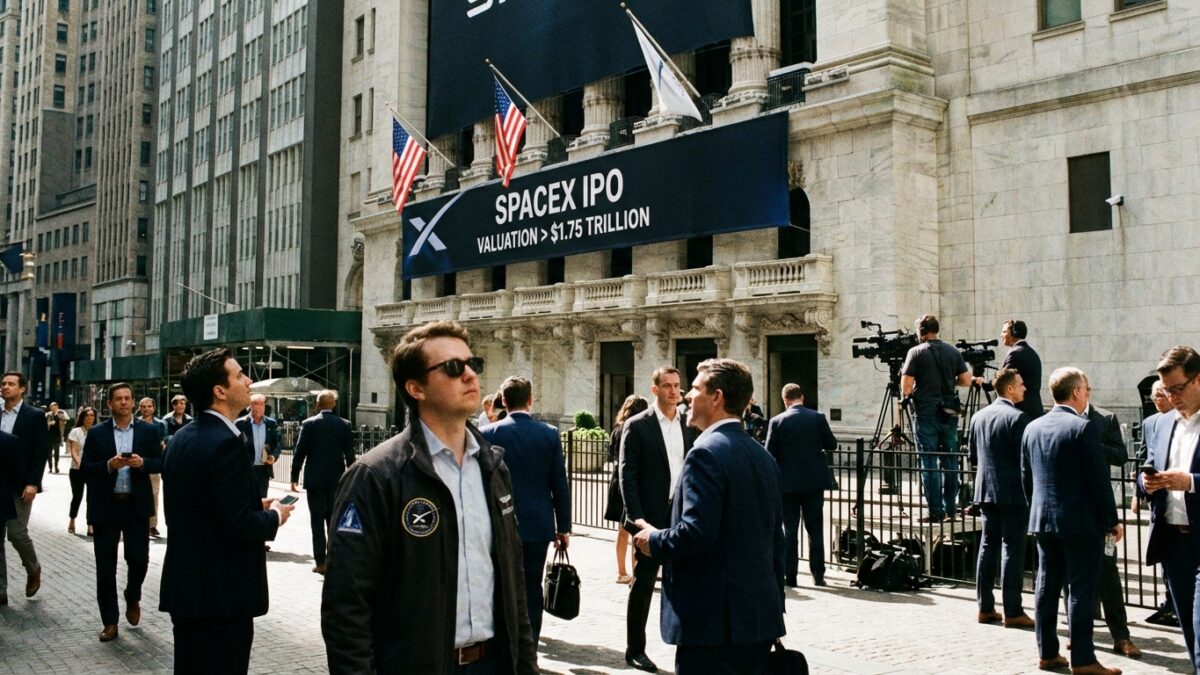
SpaceX is preparing to file with the Securities and Exchange Commission as early as March 2026 for an initial public offering that could become the largest in history, potentially raising as much as $50 billion and seeking a valuation exceeding $1.75 trillion. The filing would put the Elon Musk-founded rocket company on track for a June offering, ahead of potential mega-IPOs from AI leaders OpenAI and Anthropic later in the year. (Source: Yahoo Finance; Bloomberg)
Scale of the Offering
If SpaceX achieves its target valuation, the IPO would immediately place the company among the largest in the world, rivaling members of the Magnificent Seven group of tech giants. The $50 billion raise would dwarf Saudi Aramco’s $29 billion IPO in 2019, which currently holds the record for the largest public offering. (Source: Bloomberg via Yahoo Finance)
SpaceX’s current private valuation sits at approximately $1.25 trillion following its absorption of Musk’s xAI artificial intelligence company in February. The combined entity brings together the world’s most active launch provider, the Starlink satellite internet constellation serving millions of subscribers globally, and an AI company that has rapidly grown its Grok model series to compete with ChatGPT and Claude.
What SpaceX Has Built
The company’s valuation reflects a remarkable portfolio of operational businesses and development programs. SpaceX launched a record-setting number of missions in 2025, dominating the commercial launch market with its partially reusable Falcon 9 rocket. The company landed a Falcon 9 in The Bahamas for the second time ever in February 2026, continuing to push the boundaries of rocket reusability. (Source: Space.com)
Starship, the company’s next-generation fully reusable rocket and the largest and most powerful ever built, continued its flight test program throughout early 2026. A German Aerospace Centre study analyzed Starship’s flight data and concluded that while Europe could develop a competitive response, it would require a fundamentally different approach. (Source: Universe Today)
According to Bloomberg reporting from December, SpaceX told employees the IPO would fund an insane flight rate for Starship, a lunar base, and data centers in space, suggesting the company’s ambitions extend well beyond traditional launch services.
The AI Angle
The February absorption of xAI adds a significant artificial intelligence dimension to SpaceX’s public offering story. Grok 4.20, xAI’s flagship model released February 17, implements a novel four-agent parallel processing architecture that has attracted attention in the competitive AI model landscape. The integration of an AI company into a space and satellite infrastructure business creates a unique investment narrative that spans two of the hottest sectors in technology. (Source: Mean CEO/AI News)
Competition and Context
SpaceX’s IPO arrives amid growing competition in the launch industry. Blue Origin successfully debuted its New Glenn rocket in 2025, while Chinese commercial company LandSpace’s Zhuque-3 is also operational. These partially reusable rockets are encroaching on SpaceX’s decade-long effective monopoly on rapid, reusable orbital launch services, though the company maintains a commanding lead in flight rate and reliability. (Source: Scientific American)
The offering would also land in a year that could see multiple technology mega-IPOs. OpenAI has reportedly set a target IPO valuation of $1 trillion for the second half of 2026, while Anthropic is also expected to go public. BitGo, the cryptocurrency custody firm, has already completed a successful IPO. (Source: SiliconANGLE; Yahoo Finance)
Risks and Questions
Potential investors will weigh significant factors beyond the company’s technological achievements. Musk’s dual role as CEO of SpaceX and Tesla, combined with his ownership of X (formerly Twitter) and various government advisory positions, creates governance complexity. Regulatory scrutiny of the combined SpaceX-xAI entity is likely, particularly given the defense and intelligence implications of both satellite communications and AI technology.
The ongoing Iran conflict and associated market volatility also introduce timing risk. However, if SpaceX proceeds as planned, the June offering could arrive as markets stabilize, potentially capturing investor enthusiasm for a company that has fundamentally transformed access to space.
The Travel Disruption
Beyond financial markets, the conflict has created massive real-world disruptions. Tens of thousands of travelers and significant volumes of air cargo remain stranded in Dubai, Abu Dhabi, and other Gulf destinations after airports suspended operations. Airlines have rerouted flights away from the entire Gulf region, adding hours to routes between Europe and Asia.
Dubai’s Jebel Ali port, one of the world’s busiest and a critical transshipment hub for goods between Asia, Europe, and Africa, has been directly targeted by Iranian strikes. Any extended closure would force rerouting of container traffic through longer, more expensive routes, adding inflationary pressure to global trade.
For the Federal Reserve and other central banks, the Iran crisis creates a painful dilemma. Higher energy prices are inflationary, arguing for maintaining interest rates. But economic uncertainty and potential growth slowdown argue for easing. The bond market’s whipsaw reaction reflects this tension, with yields initially falling on safe-haven buying before surging as inflation fears took hold.
How central banks navigate this dual challenge could determine whether the economic impact remains contained or spirals into a broader slowdown. The next few weeks will be critical, as markets search for signals about the conflict’s duration and scope while corporate earnings season adds another layer of uncertainty to an already volatile environment.