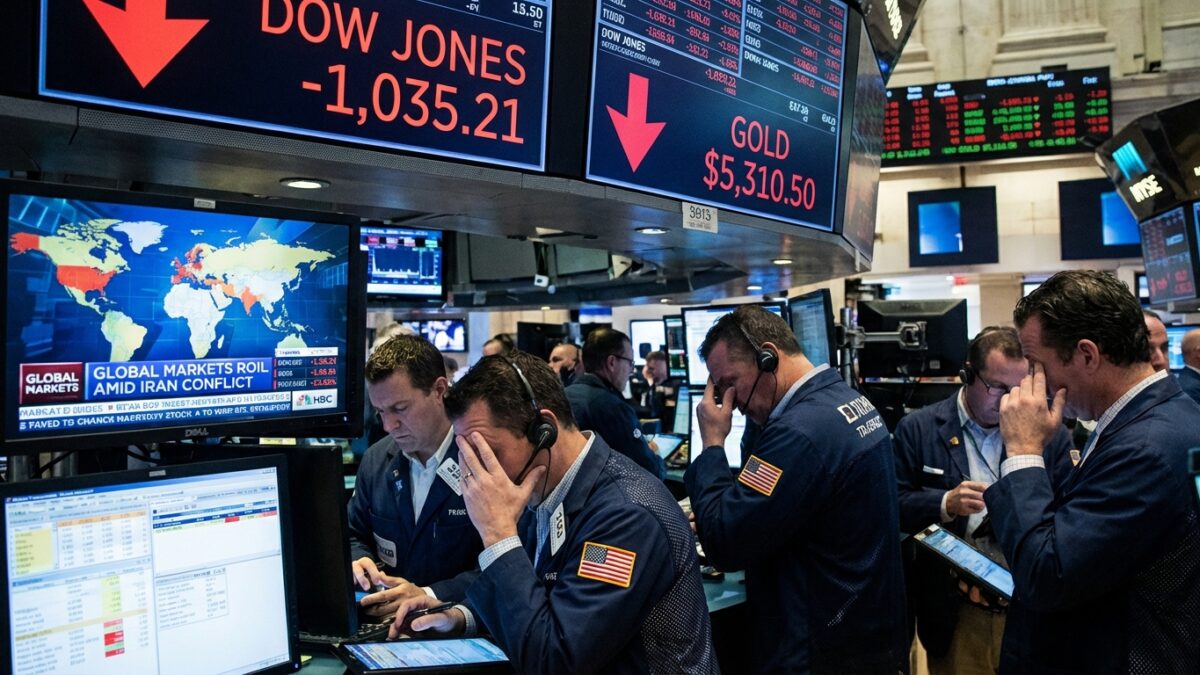
Global financial markets experienced their most turbulent week in months as the military conflict in Iran sent shockwaves through equities, commodities, and currencies. The Dow Jones Industrial Average plunged more than 1,000 points on Tuesday, March 3, in one of its largest single-day declines since the tariff-driven selloff of April 2025, while gold surged to a new high above $5,300 per ounce and the U.S. dollar strengthened as investors fled to safe-haven assets. (Source: Deseret News; Bloomberg)
The Equity Selloff
Stocks fell sharply on both Monday and Tuesday as investors grappled with the implications of a potentially protracted Middle Eastern conflict. On Monday, the Dow initially dropped nearly 600 points before recovering to close down just 73 points, while the S&P 500 and Nasdaq finished marginally positive. But Tuesday brought a much harsher reaction. At its intraday lows, the S&P 500 declined as much as 2.5 percent, the Dow plunged 1,277 points, and the Nasdaq dropped 2.7 percent. (Source: NBC News)
Markets partially recovered by the close, with the S&P 500 and Nasdaq both finishing down approximately 1 percent and the Dow closing lower by more than 400 points. Defense stocks including Northrop Grumman and Lockheed Martin bucked the trend, rising sharply alongside oil companies Exxon and Chevron. Airlines were among the biggest losers as the conflict disrupted air routes across the Middle East. (Source: CNN Business)
Gold Hits New Records
Gold, traditionally considered a safe-haven asset, surged past $5,300 per ounce, gaining more than $100 in a single session. The precious metal had already been exhibiting unusual volatility in recent weeks, with Bloomberg describing it as acting like a meme stock with volatile swings. The Iran conflict provided a more conventional catalyst for the rally, as uncertainty about oil prices and geopolitical stability drove demand. (Source: Bloomberg)
Bond Market Whiplash
The bond market delivered mixed signals. Treasury prices initially rose Sunday night as investors sought safety, but reversed course on Monday as the inflationary implications of higher oil prices took hold. Ten-year yields experienced their biggest advance since October, as traders reduced their expectations for Federal Reserve interest rate cuts. If oil prices remain elevated, the resulting inflationary pressure could force the Fed to hold rates steady for longer, complicating the economic outlook. (Source: Bloomberg)
Currency Movements
The U.S. Dollar Index rose nearly 1 percent on Monday, erasing its losses for the year and trading at its highest level in five weeks. The dollar’s strength reflected its traditional role as a safe-haven currency during geopolitical turmoil, as well as expectations that higher oil-driven inflation could delay monetary easing. In the Middle East, the UAE and Kuwait temporarily closed their stock markets, citing exceptional circumstances. European indices fell sharply, with the STOXX 600 dropping 1.61 percent and Japan’s Nikkei 225 declining 1.35 percent. (Source: Al Jazeera; CNN Business)
Crypto Takes a Hit
Cryptocurrency markets joined the broader selloff, with Bitcoin and other digital assets declining sharply. The correlation between crypto and risk assets during periods of geopolitical stress has increased in recent years, undermining the narrative of digital currencies as uncorrelated safe havens. (Source: Deseret News)
What Wall Street Is Watching
The consensus on Wall Street appears to be that the conflict will be relatively short-lived, with Goldman Sachs noting that current oil prices imply a market expectation of roughly four weeks of disruption. Stocks historically tend to shrug off geopolitical events and rebound once tensions settle. However, this optimistic baseline rests on uncertain assumptions about Iran’s remaining military leadership, the scope of U.S. strategic objectives, and the durability of the effective Strait of Hormuz closure. (Source: Fortune)
Angie Gildea, the U.S. energy strategy leader at KPMG, noted that while there are buffers including strategic reserves, rerouted cargoes, and elevated floating inventories, these are stopgaps. The critical variable, she emphasized, is the duration of the conflict. If it stretches beyond market expectations, the financial fallout could escalate from contained volatility to a genuine economic shock. (Source: NPR)
Asian Economies at Risk
The energy disruption poses particular risks for Asian economies. China and India, heavily dependent on oil imported through the Strait of Hormuz, face potential economic slowdowns. Japan, which imports virtually all its oil, saw the Nikkei fall 1.3 percent. (Source: Al Jazeera)
Insurance markets have responded aggressively. Marine insurance providers have either dramatically increased premiums for Gulf transits or withdrawn coverage entirely, creating a de facto blockade even beyond any physical military interdiction. This insurance-driven shutdown means commercial traffic would not resume immediately even if military activity ceased. (Source: Kpler)
LNG markets are also disrupted. QatarEnergy halted production Monday and suspended output of other energy products Tuesday. European natural gas markets surged over 20 percent, though U.S. spot prices remain within their recent range due to domestic supply. The U.S. is now the world’s largest LNG exporter, and higher prices boost companies shipping gas overseas but contribute to rising domestic electricity costs. (Source: NPR)
Strategic petroleum reserves provide some buffer. The U.S. holds approximately 400 million barrels, enough to replace Gulf imports for several months but not indefinitely. If the conflict extends beyond what markets are pricing in, governments may face difficult decisions about whether and when to tap these reserves, adding another layer of uncertainty to an already volatile situation.