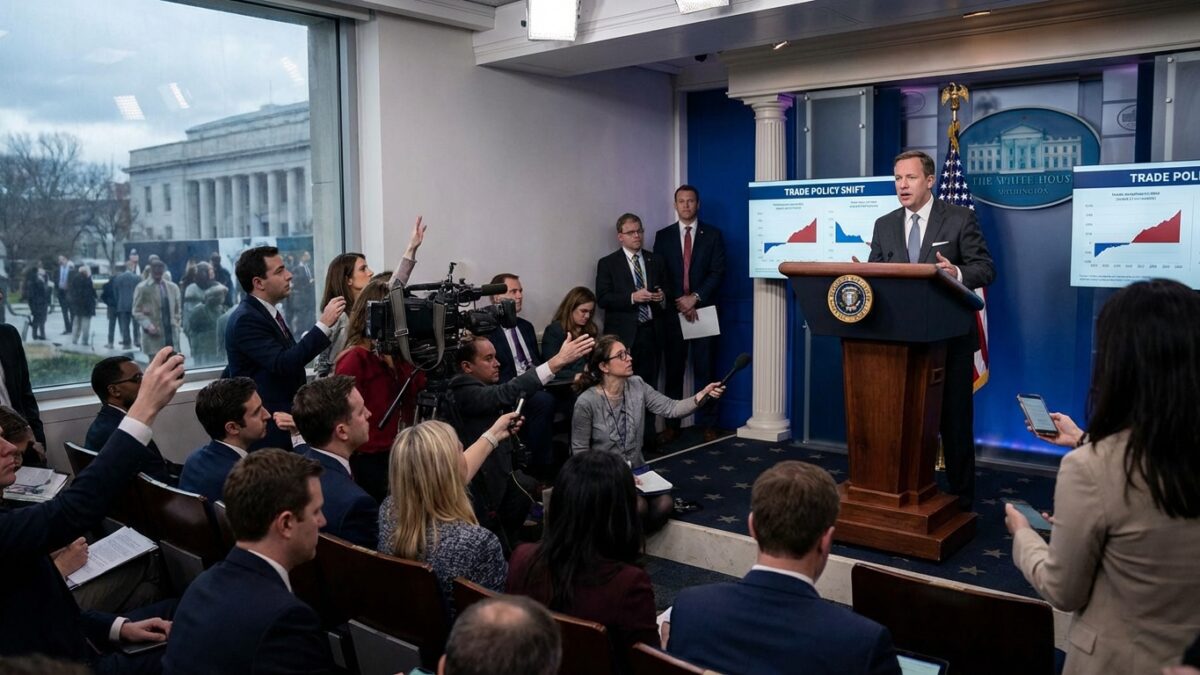
The U.S. Supreme Court’s February 20 decision striking down President Trump’s authority to impose tariffs under the International Emergency Economic Powers Act has triggered the most significant realignment of American trade policy in decades, forcing the administration to adopt a new legal framework while businesses scramble to adjust to rapidly shifting import costs.
In a 6-3 ruling in Learning Resources v. Trump, the court held that IEEPA does not grant the president authority to unilaterally impose tariffs on foreign nations, invalidating the legal basis for most of the sweeping import duties the administration had imposed since 2025. The decision immediately called into question roughly $160 billion in tariff revenue already collected and eliminated an estimated $1.4 trillion in projected future revenue. (Sources: Supreme Court of the United States, Reuters, The Washington Post)
The Legal Reasoning
Writing for the majority, the court found that IEEPA’s emergency powers, while broad, were never intended to serve as a substitute for the tariff-setting authority that the Constitution explicitly vests in Congress. The statute, enacted in 1977, authorizes the president to regulate international economic transactions during declared national emergencies, but the majority held that interpreting this power to include the imposition of new import duties would effectively render congressional trade authority meaningless.
The three dissenting justices argued that the broad language of IEEPA and historical precedent supported the president’s actions, warning that the ruling could hamper executive flexibility during genuine economic emergencies. (Source: SCOTUSblog)
The Section 122 Pivot
Within days of the ruling, the administration announced it would invoke Section 122 of the Trade Act of 1974, a rarely used provision that allows the president to impose temporary tariffs of up to 15 percent for a maximum of 150 days to address balance-of-payments deficits. The initial rate was set at 10 percent, with plans to escalate to the full 15 percent. (Sources: Reuters, Bloomberg)
Trade analysts immediately noted the limitations of this approach. Unlike IEEPA, which the administration had used to justify tariffs exceeding 100 percent on some categories of Chinese goods, Section 122 imposes strict caps on both rates and duration. The provision has been invoked only once before, by President Nixon in 1971, and legal scholars have questioned whether it can withstand the same judicial scrutiny that ultimately felled the IEEPA tariffs.
Scott Lincicome, vice president of general economics at the Cato Institute, noted that the ruling represented a major reassertion of congressional prerogatives over trade policy. Industry groups, meanwhile, have been split between those celebrating the removal of unpredictable tariff escalation and those warning of uncertainty as businesses try to plan around shifting trade rules. (Source: Cato Institute)
Economic Fallout
The ruling’s immediate economic effects have been complex. S&P Global’s Flash Composite PMI dropped to a 10-month low of 52.3 in February, while the Core PCE inflation reading remained elevated at 3.0 percent, reflecting what economists describe as a stagflationary environment partly shaped by months of tariff uncertainty. (Source: S&P Global)
The decision has also complicated the administration’s fiscal planning. The tariff revenue that had been projected under the IEEPA framework was a key component of proposed spending offsets, and its elimination has reignited debates about the federal deficit. Congressional leaders from both parties have signaled interest in comprehensive trade legislation, though the path to bipartisan agreement remains unclear.
For businesses, the ruling has created a paradox: relief from the most extreme tariffs coexists with uncertainty about what will replace them. Importers who had built supply chains around the previous tariff structure now face the prospect of yet another recalibration, while exporters worry about retaliatory measures from trading partners navigating their own policy responses.
As S&P Global noted in its March economic preview, the combination of the Supreme Court ruling and the unfolding Middle East crisis has created a uniquely challenging environment for economic forecasting, with uncertainty likely to dampen business investment in the months ahead. (Source: S&P Global Market Intelligence)
Congressional Response and Legislative Prospects
The ruling has catalyzed a renewed push in Congress for comprehensive trade legislation, though the path forward remains politically fraught. Senate Finance Committee Chair Ron Wyden introduced the Trade Authority Restoration Act, which would establish a new framework for presidential trade actions that includes congressional notification requirements and sunset provisions. However, Republican leaders have expressed reservations about constraining executive flexibility, particularly given the administration’s argument that trade tools are essential for national security and economic competitiveness.
The legal community has been closely analyzing the ruling’s broader implications. Several prominent constitutional law scholars have noted that the decision represents one of the most significant constraints on executive economic authority in decades, drawing parallels to landmark separation-of-powers cases. Some analysts have suggested that the ruling could have ripple effects on other areas where presidents have used emergency powers to bypass congressional authority, including sanctions programs and financial regulations.
For American consumers, the near-term impact is uncertain. While the removal of the highest IEEPA tariffs should theoretically reduce prices on some imported goods, the transition to Section 122 duties, combined with supply chain disruptions from the Middle East crisis, may mute any relief. Retailers and manufacturers have expressed frustration at the continued uncertainty, with the National Retail Federation calling for a stable, predictable trade framework that allows businesses to plan with confidence.