
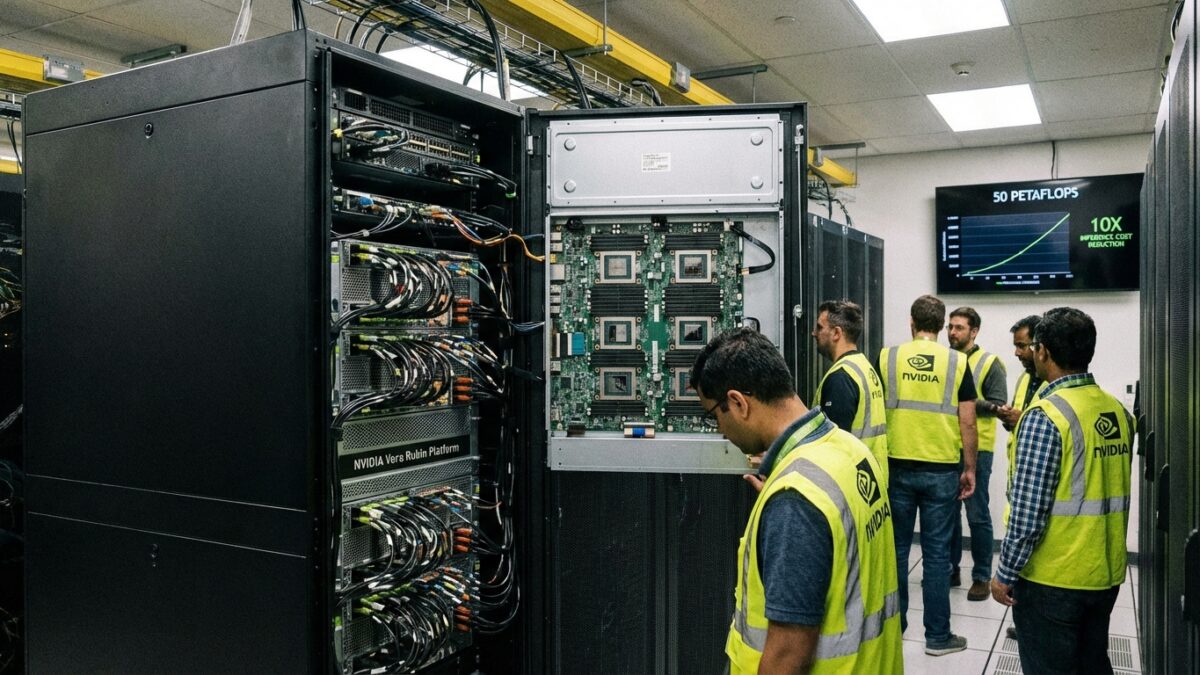
NVIDIA’s Vera Rubin computing platform, unveiled at CES 2026 in January and now entering full production, represents the most ambitious hardware architecture the company has ever attempted, combining six purpose-built chips into a unified system designed to slash AI inference costs by a factor of ten and fundamentally reshape how the world’s largest technology companies build their AI infrastructure.
The Rubin architecture, named after the pioneering astrophysicist Vera Florence Cooper Rubin, replaces NVIDIA’s Blackwell platform in the company’s now-annual cadence of transformative hardware releases. Jensen Huang, NVIDIA’s CEO, declared at the CES keynote that the platform addresses the fundamental challenge of skyrocketing AI computation demands, telling the audience that Vera Rubin was already in full production. (Sources: TechCrunch, NVIDIA)
Six Chips, One Supercomputer
At the heart of the architecture is the Rubin GPU, manufactured by TSMC on a 3-nanometer process with HBM4 high-bandwidth memory, capable of 50 petaflops of inference performance in 4-bit floating point, a fivefold improvement over Blackwell. But the real innovation lies in the platform’s integrated approach: six distinct chips, including the Vera CPU with 88 custom Arm-based Olympus cores, NVLink 6 switches, ConnectX-9 networking interfaces, and BlueField-4 data processing units, all designed from the outset to work as a single, tightly coupled system. (Sources: IEEE Spectrum, The Register)
Gilad Shainer, NVIDIA’s senior vice president of networking, explained the design philosophy to IEEE Spectrum, noting that the same processing unit connected in a different way will deliver completely different performance levels. NVIDIA calls this extreme co-design, treating the data center rather than the individual GPU server as the fundamental unit of compute. (Source: IEEE Spectrum)
Performance at Scale
The numbers NVIDIA is citing are striking. Compared to Blackwell, the Rubin platform delivers 3.5 times faster training performance, five times faster inference, and eight times more inference compute per watt. The flagship Vera Rubin NVL72 configuration combines 72 Rubin GPUs, 36 Vera CPUs, and 20.7 terabytes of HBM4 memory into a single rack-scale system connected by NVLink 6 fabric running at 3.6 terabytes per second per GPU. (Sources: TechCrunch, Tom’s Hardware)
Perhaps more practically significant, NVIDIA claims the platform achieves a fourfold reduction in the number of GPUs needed to train mixture-of-experts models and a tenfold reduction in inference token costs, metrics that directly affect the economics of operating large-scale AI services. (Source: NVIDIA)
Industry Adoption
Major cloud providers and AI companies have quickly committed to the platform. Microsoft announced plans to deploy Vera Rubin NVL72 systems in its next-generation AI data centers, including future Fairwater AI superfactory sites. CoreWeave will integrate Rubin-based systems into its AI cloud platform beginning in the second half of 2026. Google’s Sundar Pichai, Oracle’s Clay Magouyrk, and other cloud leaders have all made public commitments to Rubin deployment. (Source: NVIDIA Newsroom)
NVIDIA has also announced the Rubin CPX, a purpose-built variant optimized for massive-context inference processing, capable of handling million-token coding and generative video workloads. The CPX configuration packs 8 exaflops of AI performance and 100 terabytes of fast memory into a single rack. (Source: NVIDIA Newsroom)
Competitive Dynamics
The Rubin launch comes amid intense competition in AI infrastructure. AMD’s aggressive rack-scale roadmap may have contributed to NVIDIA’s decision to reveal Rubin at CES rather than waiting for its traditional GTC conference. Huang estimated in a recent earnings call that between $3 trillion and $4 trillion will be spent on AI infrastructure over the next five years, a staggering figure that underscores the scale of the opportunity and the intensity of the competition. (Source: TechCrunch)
The Rubin architecture will be followed by Rubin Ultra in 2027, which will effectively double performance by connecting two Rubin cores, and then by the Feynman architecture. NVIDIA is using current-generation Blackwell GPUs to accelerate the design of its future architectures, creating a self-reinforcing cycle of AI-powered chip design. (Source: Wikipedia)
With a market capitalization that has made it the world’s most valuable corporation, NVIDIA’s hardware roadmap has become a bellwether for the entire AI industry. The Vera Rubin platform is not just a product launch; it is a statement about the trajectory of AI computing and the infrastructure that will power the next generation of artificial intelligence applications.
The Broader AI Infrastructure Ecosystem
The Rubin platform arrives at a moment when AI infrastructure spending is reaching staggering levels. Major technology companies collectively committed hundreds of billions of dollars to AI-related capital expenditure in 2025, a pace that shows no signs of slowing. The build-out of AI data centers has become one of the largest industrial construction projects in human history, with implications for power grids, water resources, and real estate markets in communities hosting these facilities.
The energy requirements of next-generation AI training clusters have prompted a parallel boom in power generation, with several major technology companies announcing investments in nuclear, solar, and natural gas capacity specifically to serve AI workloads. NVIDIA’s emphasis on power efficiency in the Rubin architecture, including eight times more inference compute per watt compared to Blackwell, is a direct response to the growing concern that AI’s energy appetite could become a constraint on its development.