
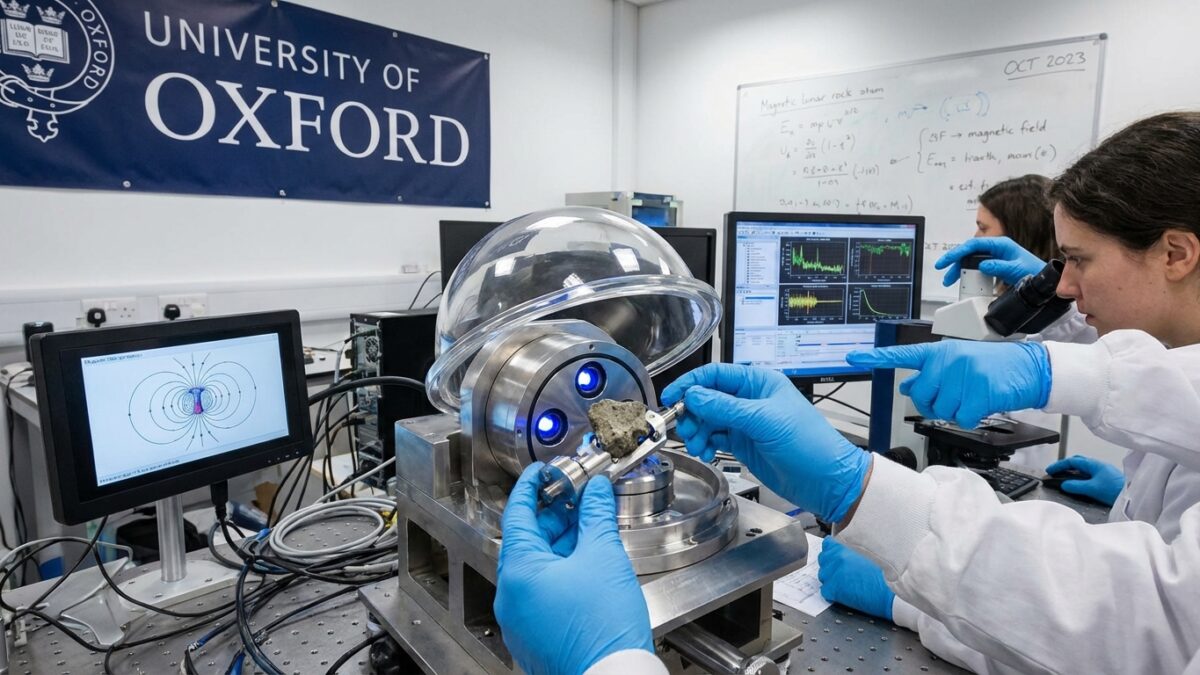
A team of researchers at the University of Oxford has resolved one of the most persistent mysteries in planetary science: whether the Moon once possessed a global magnetic field similar to Earth’s. Using sophisticated new analytical techniques applied to rock samples collected during NASA’s Apollo missions more than half a century ago, the scientists have confirmed that the Moon did indeed generate a genuine magnetic field through an internal dynamo, but one that was significantly shorter-lived than previously estimated. (Source: University of Oxford, published February 26, 2026)
The Magnetic Moon Controversy
For decades, scientists have been divided over the interpretation of magnetic signals found in lunar rocks. Some Apollo samples showed strong magnetization, suggesting that the Moon once had a powerful magnetic field generated by a churning molten iron core, much like the dynamo that produces Earth’s protective magnetosphere today. But other measurements told a different story, and critics argued that the magnetization could have been produced by impact events or other mechanisms that did not require a lunar dynamo. (Source: Nature Geoscience)
The debate has significant implications beyond the Moon itself. Understanding when and why the lunar dynamo operated, and why it stopped, provides insights into the thermal evolution of rocky bodies throughout the solar system and the conditions that determine whether a planet or moon can sustain a protective magnetic field.
The Breakthrough Analysis
The Oxford team, led by researchers in the university’s Department of Earth Sciences, applied advanced paleomagnetic techniques to Apollo samples that had been stored at NASA’s Johnson Space Center since the 1970s. The key innovation was the use of quantum diamond magnetometry, a cutting-edge measurement technique that can detect extremely weak magnetic signatures at microscopic scales. (Source: University of Oxford)
By analyzing the magnetic orientation of individual mineral grains within the samples, the researchers were able to distinguish between magnetization acquired in a sustained global field and magnetization produced by transient events like meteorite impacts. Their results confirmed that the signature of a genuine dynamo-generated field was present in samples from early lunar history but faded much earlier than some previous estimates had suggested.
A Shorter-Lived Dynamo
The findings indicate that the Moon’s dynamo was active during the first several hundred million years after the Moon’s formation, roughly 4.5 billion years ago, but declined significantly earlier than the 1-to-2-billion-year persistence that some researchers had proposed. The shorter timeline is more consistent with models of the Moon’s thermal evolution, which predict that the relatively small lunar core would have cooled and solidified faster than Earth’s much larger core. (Source: Nature Geoscience)
The results reconcile what had been conflicting lines of evidence. Samples from the Moon’s oldest geological units show clear dynamo signatures, while younger samples that had been interpreted by some researchers as evidence of a long-lived field appear to have been magnetized by impact processes rather than a global field. The Oxford team’s ability to differentiate between these mechanisms at the grain scale resolved the apparent contradictions.
Implications for Planetary Science
The resolution of the lunar magnetic field debate has immediate relevance to the study of other bodies in the solar system. Mars, for example, shows evidence of having once possessed a global magnetic field that shut down early in its history, leaving the planet exposed to solar wind erosion of its atmosphere. Understanding the lunar dynamo’s timeline helps refine models of how internal heat engines in rocky bodies operate and fail.
The findings also have implications for future lunar exploration under the Artemis program. The Moon’s current lack of a global magnetic field means that future astronauts will be exposed to solar and cosmic radiation without the magnetic shielding that protects life on Earth. Understanding when and how the field disappeared informs planning for radiation protection in long-duration lunar surface operations. (Source: NASA)
Apollo’s Enduring Legacy
Perhaps the most remarkable aspect of the discovery is that it was enabled by samples collected by Apollo astronauts between 1969 and 1972. The 382 kilograms of lunar material brought back to Earth continue to yield new discoveries as analytical technologies advance, validating NASA’s careful curation of the samples over more than five decades.
The Johnson Space Center’s Astromaterials Research and Exploration Science division maintains the Apollo sample collection under strict contamination controls, releasing material to researchers in small, carefully documented allocations. Some samples have been deliberately withheld from study, preserved for a time when analytical methods could extract information that was inaccessible to earlier generations of scientists. (Source: NASA Johnson Space Center)
The Oxford team’s work demonstrates the wisdom of that approach. Technologies that did not exist when astronauts walked on the Moon have now resolved a scientific question that those missions posed but could not answer, a fitting testament to both the enduring value of the Apollo program and the relentless advancement of scientific capability.
Methodological Innovation
The quantum diamond magnetometry technique used in the study represents a significant advance in measurement capability that has applications well beyond lunar science. The method uses nitrogen-vacancy centers in diamond crystals as exquisitely sensitive magnetic field detectors, capable of measuring fields millions of times weaker than Earth’s at spatial resolutions of just a few micrometers. This allows researchers to map the magnetic history of individual mineral grains, separating signals that would be hopelessly blended in bulk measurements.
The Oxford researchers plan to apply the technique to samples from other planetary bodies, including meteorites believed to originate from Mars and the asteroid Vesta. NASA’s OSIRIS-REx mission, which returned samples from asteroid Bennu in 2023, and JAXA’s Hayabusa2, which returned samples from asteroid Ryugu, offer additional opportunities to study the magnetic histories of small bodies in the solar system. These analyses could reveal whether magnetic dynamos were common features of early solar system bodies or exceptions limited to the largest objects. (Source: Nature Geoscience)