As the United States confronts an evolving landscape of infectious disease threats, public health officials are sounding alarms on two fronts: the continued spread of H5N1 avian influenza through American dairy cattle and poultry flocks, and a troubling decline in childhood vaccination rates that threatens to strip the country of its measles-free status. Together, these challenges represent a stress test for a public health infrastructure already weakened by years of institutional disruption and declining public trust. (Source: Scientific American)
Bird Flu Spreads Through Livestock
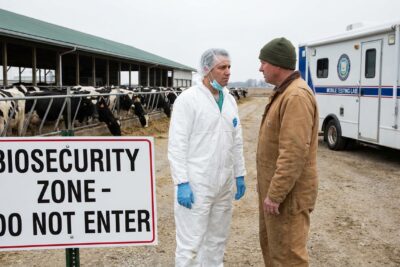
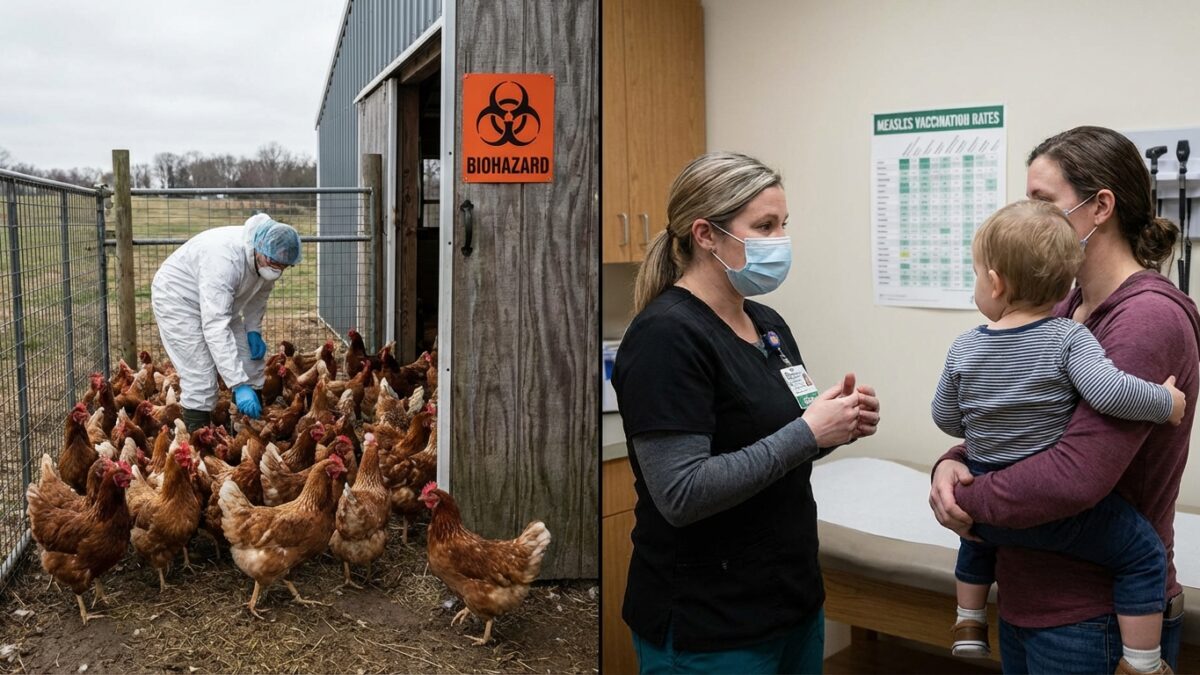
The H5N1 strain of avian influenza has been circulating among wild birds and other animals globally for several years, but its persistent infection of U.S. dairy cattle represents a concerning evolution. The virus has continued to spread through cattle herds and poultry flocks throughout 2025 and into 2026, with outbreaks in commercial chicken operations so severe that they contributed to significant spikes in egg prices across the country.
While H5N1 has not yet adapted to spread efficiently between humans, sporadic human infections have occurred among farmworkers with direct contact with infected animals. Public health experts have long warned that avian influenza strains circulating widely in mammalian populations have an elevated risk of mutating into forms capable of human-to-human transmission — a scenario that could trigger a pandemic far more deadly than COVID-19. The World Health Organization has maintained H5N1 on its list of pandemic-potential pathogens requiring enhanced surveillance.
The U.S. departure from the World Health Organization, which took effect in January 2026, has complicated international coordination on avian influenza monitoring. While domestic surveillance continues through the Centers for Disease Control and Prevention and the U.S. Department of Agriculture, the loss of WHO membership has reduced American access to global epidemiological data and international response coordination mechanisms. (Source: Live Science)
Measles-Free Status at Risk
The United States could lose its measles elimination status — a designation it has held since 2000 — if current infection trends continue. Measles, an extremely contagious yet vaccine-preventable illness, has seen a resurgence driven by declining vaccination rates in some communities. The disease was declared eliminated in the U.S. more than two decades ago, meaning sustained domestic transmission had been interrupted, but elimination requires maintaining high vaccination coverage to prevent imported cases from sparking outbreaks.
Scientific American reported that the measles-free status could be lost as soon as early 2026, depending on whether ongoing outbreaks can be contained and whether vaccination rates recover in affected communities. The publication noted that falling vaccination rates mean the country could return to an era when significantly more people die in childhood from preventable infections than has been the case in recent decades. (Source: Scientific American)
Institutional Challenges
The public health threats emerge against a backdrop of significant institutional disruption. Changes at the Department of Health and Human Services and the CDC have drawn criticism from scientific and medical communities concerned about the erosion of surveillance capabilities and evidence-based policymaking. Live Science noted that career scientists at the CDC have been sidelined and that the nation’s public health safety net faces further erosion in 2026.
Mass General Brigham researchers predicted that 2026 would bring a healthy reckoning for medical AI, as many tools fall short of expectations, exposing issues like bias and workflow fit. However, they also warned that the challenges facing the biomedical research enterprise extend beyond technology to fundamental questions about institutional capacity and public trust. Fabrisia Ambrosio, an investigator at Mass General Brigham, predicted that the challenges and uncertainties of 2025 will spark bold solutions and transformative breakthroughs, but acknowledged that 2026 offers a unique opportunity to demonstrate resilience. (Source: Mass General Brigham)
Vaccine Confidence
The decline in childhood vaccination rates reflects broader trends in vaccine confidence that accelerated during the COVID-19 pandemic. Misinformation about vaccine safety, amplified through social media platforms, has contributed to hesitancy among some parents. Public health experts emphasize that the measles, mumps, and rubella vaccine is one of the most thoroughly studied and effective vaccines in the history of medicine, with a safety profile established over decades of use in billions of people worldwide.
Efforts to restore vaccine confidence face headwinds from both political polarization and the erosion of trust in medical institutions. The American Academy of Pediatrics and other medical organizations have called for renewed investment in community-based education campaigns, particularly in underserved areas where vaccination rates have fallen most sharply.
Climate and Disease
The intersection of climate change and infectious disease adds another dimension to the public health outlook. Warmer temperatures are expanding the geographic range of mosquito-borne diseases, while extreme weather events disrupt healthcare delivery and create conditions favorable for disease outbreaks. The CAS science organization identified climate-smart agriculture and environmental health as among its top emerging trends for 2026, reflecting growing awareness that human health and planetary health are inextricable. (Source: CAS)
Paths Forward
Despite the challenges, there are grounds for cautious optimism. Advances in genomic surveillance allow public health officials to track disease outbreaks with greater speed and precision than ever before. The Illumina Billion Cell Atlas and similar multiomics platforms are providing researchers with unprecedented insight into disease mechanisms. And the global scientific community continues to collaborate on pandemic preparedness, even as specific institutional arrangements shift.
The test for 2026 will be whether these scientific capabilities can be translated into effective public health action in a political and social environment that has grown increasingly skeptical of institutional expertise. The stakes are high: avian influenza, measles, and other preventable diseases are not abstract threats but immediate risks to the health of millions of Americans.