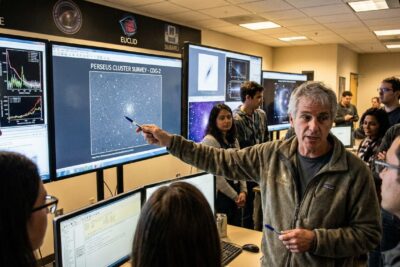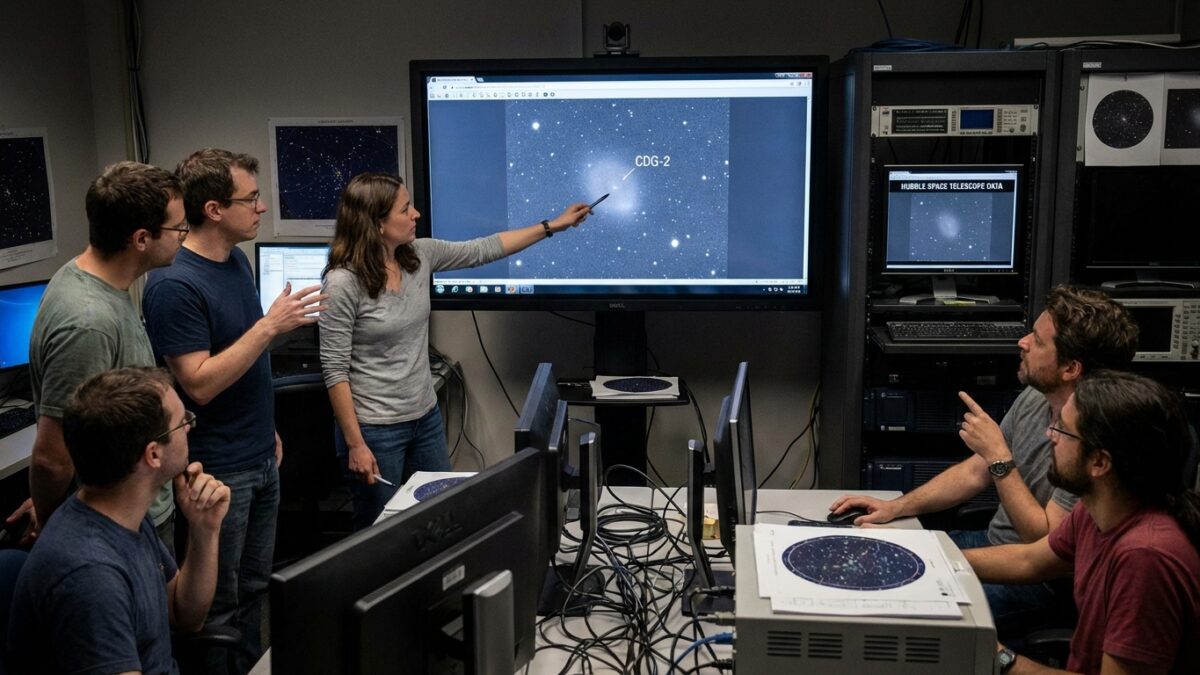
Astronomers using NASA’s Hubble Space Telescope have uncovered one of the most mysterious galaxies ever observed — a dim, ghostly object designated CDG-2 that appears to be composed almost entirely of dark matter. Located approximately 300 million light-years from Earth, the galaxy contains almost no visible stars, with dark matter accounting for an estimated 99 percent of its total mass. The discovery, announced on February 21, 2026, challenges existing models of galaxy formation and provides a rare laboratory for studying the invisible substance that constitutes the majority of matter in the universe. (Source: ScienceDaily, February 21, 2026)
A Galaxy Without Stars
CDG-2 was identified during a deep survey of the Coma Cluster, a massive grouping of galaxies that has long served as a hunting ground for astronomers studying the large-scale structure of the universe. The galaxy is classified as an ultra-diffuse galaxy, a type of object that has the physical extent of a large galaxy but an extraordinarily low surface brightness, making it extremely difficult to detect even with the most powerful telescopes.
What sets CDG-2 apart from other ultra-diffuse galaxies is the extreme ratio of dark matter to visible matter. While most galaxies contain a mixture of dark matter, stars, gas, and dust, CDG-2 appears to consist of almost nothing but dark matter, with only a tiny scattering of faint stars providing any visible light. The galaxy is so dim that it required the full sensitivity of Hubble’s Advanced Camera for Surveys to detect, appearing as little more than a faint smudge against the cosmic background.
Why Dark Matter Galaxies Matter
Dark matter is one of the most fundamental mysteries in modern physics. It does not emit, absorb, or reflect light, making it invisible to telescopes that detect electromagnetic radiation. Its existence is inferred from its gravitational effects on visible matter, the bending of light from distant galaxies, and the large-scale structure of the cosmic web. Approximately 27 percent of the universe is thought to consist of dark matter, compared to just 5 percent ordinary matter. (Source: NASA)
The discovery of a galaxy dominated almost entirely by dark matter provides scientists with a unique opportunity to study the substance in relative isolation. In most galaxies, the gravitational effects of dark matter are entangled with those of visible matter, making it difficult to separate the two contributions. CDG-2’s nearly pure dark matter composition could allow astronomers to measure dark matter’s properties — including its density distribution and response to gravitational interactions — with unprecedented clarity.
Challenges to Galaxy Formation Theory
Standard models of galaxy formation predict that dark matter halos — vast, roughly spherical concentrations of dark matter — serve as the gravitational scaffolding around which galaxies form. Gas falls into these halos, cools, and condenses into stars. A galaxy made almost entirely of dark matter with virtually no star formation raises difficult questions about why the standard process apparently failed in this case.
Several hypotheses have been proposed. The galaxy may have formed in an environment where the gas needed for star formation was stripped away by interactions with neighboring galaxies in the dense Coma Cluster environment. Alternatively, CDG-2 may represent a primordial dark matter halo that never accumulated sufficient gas to trigger significant star formation in the first place. Understanding which explanation is correct could reveal important details about the conditions required for galaxy formation and the role of environment in shaping cosmic evolution.
A Growing Census of the Invisible
CDG-2 is not the first dark-matter-dominated galaxy to be discovered, but it is among the most extreme examples. The finding adds to a growing body of evidence that the universe contains a substantial population of galaxies that are nearly invisible to conventional observations. As telescope technology improves, astronomers expect to find many more such objects.
The discovery comes during a particularly rich period for observational astronomy. NASA’s James Webb Space Telescope continues to make groundbreaking observations across the electromagnetic spectrum. In February 2026 alone, JWST detected sulfur in the atmospheres of four super-sized gas giant planets orbiting a distant star and revealed extraordinary organic molecules in an ultra-luminous infrared galaxy cloaked in thick clouds of gas and dust. (Source: ScienceDaily)
Meanwhile, ground-based facilities are poised for major advances. The Vera C. Rubin Observatory, which began operations in 2025, is ramping up its panoramic observations of the sky in 2026, using the largest digital camera ever built to create a time-lapse survey of the southern night sky. The observatory’s Legacy Survey of Space and Time is expected to discover an enormous number of new asteroids, comets, supernovae, and transient phenomena, and could identify additional dark-matter-dominated galaxies that have thus far escaped detection. (Source: Universe Today)
New Telescopes on the Horizon
Looking further ahead, the next generation of space telescopes promises to deepen our understanding of dark matter. NASA’s Nancy Grace Roman Space Telescope, now fully assembled, is on track for launch as early as fall 2026. Roman will study large-scale cosmic structures to clarify the nature of dark matter and dark energy, using a wide-field instrument that can survey vast areas of the sky far more efficiently than Hubble.
China’s Xuntian space telescope is also expected to launch in late 2026. Designed to survey enormous regions of the sky with image quality comparable to Hubble’s but with a field of view more than 300 times larger, Xuntian will hunt for dark matter and dark energy, survey billions of galaxies, and trace how cosmic structure has evolved over time. Uniquely, it will co-orbit with China’s Tiangong space station, allowing astronauts to service and upgrade the telescope. (Source: Astronomy.com)
For now, CDG-2 stands as a haunting reminder that the universe’s most abundant form of matter remains its most elusive. In the ghostly glow of a galaxy made almost entirely of dark matter, astronomers have found not just a curiosity but a potential key to understanding the hidden architecture of the cosmos.