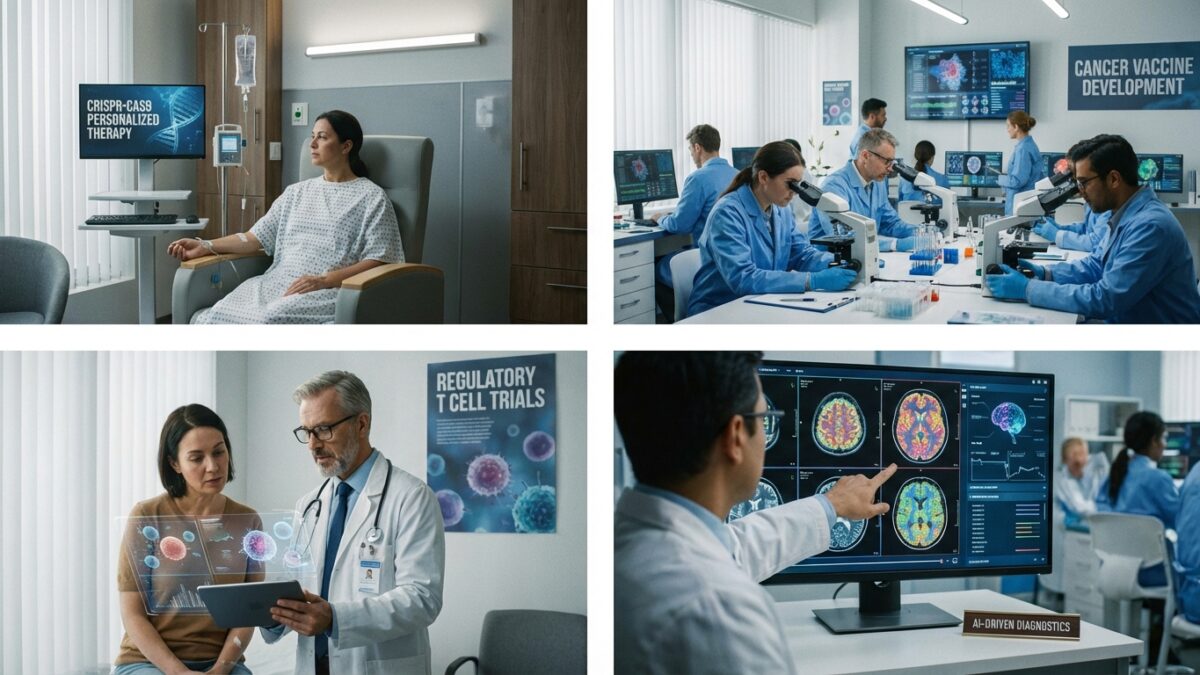
The field of gene therapy is entering a new era following the landmark treatment of KJ Muldoon, a baby born with a rare genetic disease who became the first person in the world to receive a customized CRISPR gene-editing treatment. The case, which came to light in May 2025, has opened the door to an entirely new approach to medicine — one in which treatments are designed from scratch for individual patients based on their specific genetic mutations. As 2026 begins, researchers are pursuing additional personalized gene-editing therapies while grappling with the enormous scientific, logistical, and ethical challenges of scaling this approach. (Source: Live Science)
From One-Size-Fits-All to Bespoke Medicine
The two CRISPR-based therapies approved to date — Casgevy for sickle cell disease and beta thalassemia — represent the first generation of gene-editing treatments. While groundbreaking, they use a standardized approach: cells are removed from a patient, edited in a laboratory to correct a common disease-causing mutation, and then reinfused. This one-size-fits-all model works well for conditions caused by the same mutation in every patient but cannot address the thousands of rare genetic diseases caused by unique individual mutations.
KJ Muldoon’s treatment was fundamentally different. Because his disease was caused by a specific mutation unique to him, researchers had to design a CRISPR treatment tailored to his individual genetic code. The process involved identifying the precise mutation, designing guide RNA sequences that could direct the CRISPR-Cas9 editing machinery to the correct location in his genome, and manufacturing a custom therapeutic product — all within the timeline demanded by a life-threatening condition in an infant.
The Scale of the Challenge
Personalized gene editing represents both an extraordinary scientific achievement and a daunting scalability problem. There are an estimated 7,000 rare genetic diseases, collectively affecting approximately 300 million people worldwide. Many of these diseases are caused by unique mutations, meaning that each patient would require a custom-designed therapy. Current CRISPR treatment development timelines can span months to years, and manufacturing costs for personalized therapies far exceed those of standardized products.
Scientific American identified personalized gene-editing treatments as one of the top health stories to watch in 2026, noting that while such therapies can take years to develop, the Muldoon case has established proof of concept and catalyzed research into streamlining the process. The publication cautioned that individual customized therapies are unlikely to bring rapid cures to other genetic diseases but represent a critical first step toward a more personalized approach to genetic medicine. (Source: Scientific American)
Regulatory T Cell Therapies
While CRISPR dominates headlines, another frontier in immune cell therapy is approaching a milestone. Regulatory T cell therapies — treatments that harness immune cells responsible for preventing the body from attacking itself — may receive their first FDA approval as early as spring 2026. The leading candidate is a therapy designed to prevent graft-versus-host disease in bone marrow transplant recipients, a serious complication in which donor bone marrow attacks the recipient’s body.
The discovery of these so-called peacekeeper cells earned a Nobel Prize, and clinical applications have been in development for years. Similar therapies are being tested for autoimmune diseases, potentially offering new treatment options for conditions such as lupus, rheumatoid arthritis, and type 1 diabetes. (Source: Scientific American)
Cancer Vaccines and Targeted Therapies
The broader landscape of precision medicine in 2026 extends well beyond gene editing. Dana-Farber Cancer Institute identified 10 cancer-related breakthroughs for the year, including personalized cancer vaccines designed to train individual patients’ immune systems to recognize and attack their specific tumors. Dana-Farber investigators including Catherine Wu and Patrick Ott are testing these vaccines in clinical trials for melanoma and kidney cancer.
Meanwhile, novel RAS inhibitors are showing promising early results in phase III trials for pancreatic cancer. Andrew Aguirre, co-director of Dana-Farber’s Center for RAS Therapeutics, described the revolution in targeting RAS as one of the biggest therapeutic advances in the history of clinical care for pancreatic cancer patients. Menin inhibitors, another class of targeted therapy developed with contributions from Dana-Farber researcher Scott Armstrong, are being tested in combination therapies for leukemia. (Source: Dana-Farber Cancer Institute)
AI Meets Precision Medicine
Artificial intelligence is increasingly integrated into precision medicine workflows. Illumina, a leader in genomics technology, unveiled its Billion Cell Atlas in January 2026 at the J.P. Morgan Healthcare Conference. The atlas uses AI to map biological pathways behind devastating diseases at unprecedented scale, with pharmaceutical partners AstraZeneca, Eli Lilly, and Merck among the first to use it for validating genetic targets and training AI models.
AstraZeneca and Tempus AI demonstrated how contrastive learning techniques can uncover biomarkers that forecast treatment response, yielding a 15 percent survival benefit in retrospective immuno-oncology clinical trials using an ensemble model that incorporates large language models and traditional machine learning. The CAS scientific information organization described this shift as a broader redefinition of diagnosis from identifying disease to accurately guiding therapeutic decisions. (Source: CAS)
Challenges to the Research Enterprise
Even as scientific advances accelerate, the foundations of the biomedical research enterprise face headwinds. Live Science’s health editor noted that the promise of decades of medical research is being realized even as the foundations of the field are coming under attack, pointing to disruptions at federal health agencies, declining public trust in scientific institutions, and policy changes that may reduce access to certain types of care.
The tension between scientific potential and systemic challenges defines the healthcare landscape in 2026. Personalized CRISPR therapies, cancer vaccines, GLP-1 medications, and AI-driven diagnostics all represent genuine advances. Whether those advances reach the patients who need them most will depend on the policy, funding, and institutional decisions that determine who benefits from the next generation of medicine.